
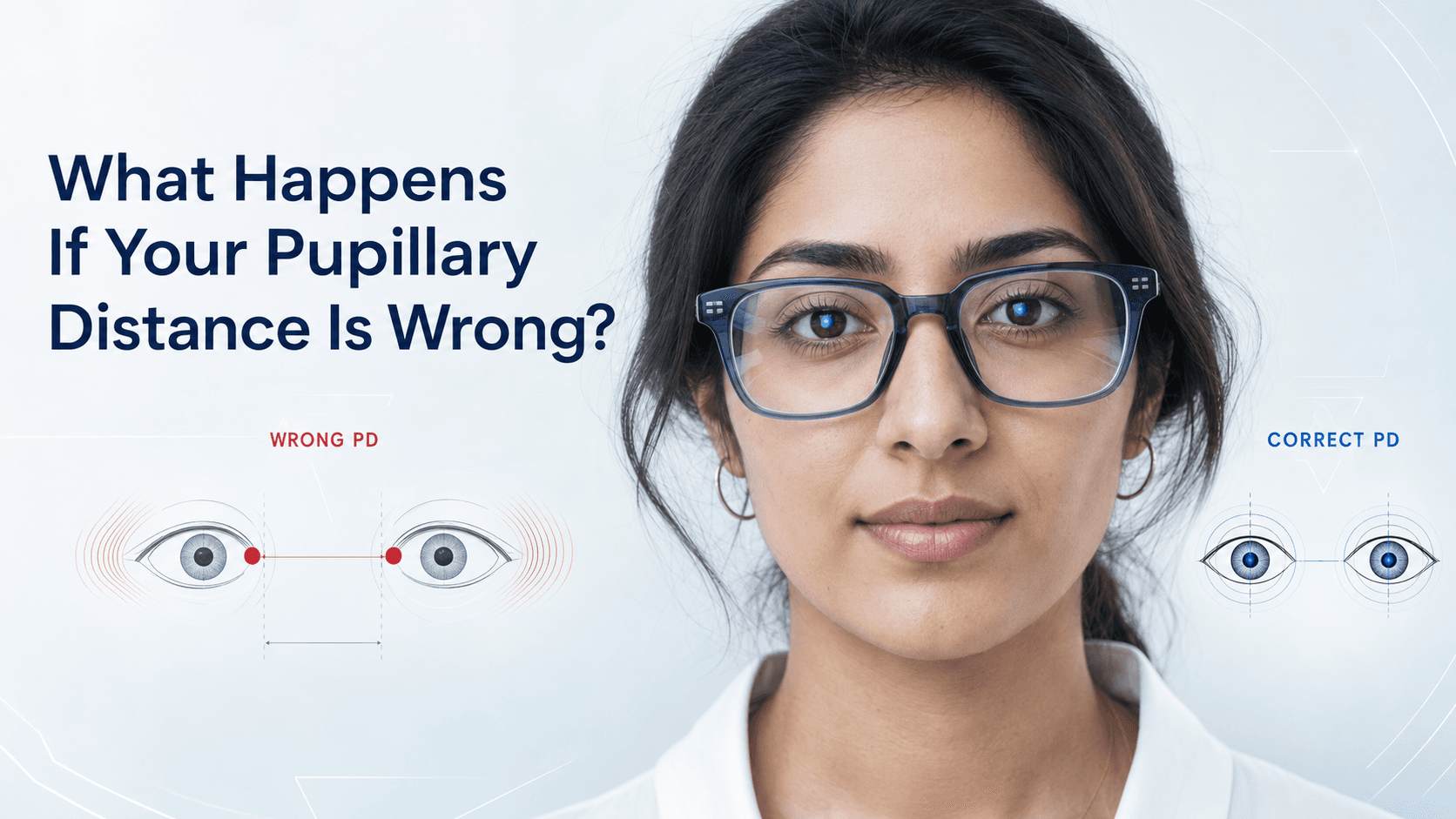
An incorrect pupillary distance (PD) causes the optical centres of your lenses to sit in front of the wrong part of your eyes. Even a small error of 2–3 mm can force your eyes to work harder to find focus, leading to blurry or doubled vision, persistent headaches, and a feeling that something is just "off" about your new glasses — regardless of how accurate your prescription is.
What Is Pupillary Distance and Why Does It Matter?
Pupillary distance is the measurement, in millimetres, between the centres of your two pupils. Lens manufacturers use this number to align each lens's optical centre directly in front of your pupil. When that alignment is correct, light bends exactly as your prescription intends. When it is off, every glance through the lens introduces unwanted prism — a lateral shift in the image that your eye muscles must constantly correct.
What Symptoms Does a Wrong PD Cause?
The symptoms range from mildly annoying to genuinely debilitating, depending on the size of the error and your lens power:
Eye strain and fatigue — your eye muscles work overtime to converge on the shifted image, especially during prolonged screen use or reading.
Headaches — typically felt behind the eyes or at the temples, often appearing within an hour of putting on the glasses.
Blurry or slightly doubled vision — most noticeable when looking straight ahead rather than through the near-vision zone of progressive lenses.
Dizziness or nausea — a wrong PD in high-minus or high-plus prescriptions can create enough induced prism to upset your sense of balance.
Difficulty adapting to new glasses — if you have never felt comfortable with a pair, a PD error is one of the first things worth checking.
Who Is Most at Risk?
People with stronger prescriptions (above ±3.00 dioptres) and those wearing progressive or bifocal lenses feel PD errors most acutely. A 2 mm error in a –1.00 lens may go unnoticed; the same error in a –6.00 lens can produce significant induced prism. Children are also vulnerable because their visual system is still developing, and compensating for a misaligned lens can reinforce binocular vision problems.
Single PD vs. Dual PD: Which Should You Use?
A single PD is the total distance between both pupils measured as one number (e.g., 64 mm). A dual PD (or monocular PD) gives a separate measurement for each eye from the nose bridge (e.g., 32 mm / 32 mm). Dual PD is more precise, particularly if your face is asymmetrical — which is true for most people. For progressive lenses or high prescriptions, always request and use your dual PD.
How to Check and Correct Your PD
If you suspect your PD is wrong, try these steps. First, revisit your optometrist or ophthalmologist and ask them to re-measure your PD with a pupillometer — the most accurate method. Second, compare the PD on your prescription against the PD value used by the lab that made your lenses. Third, if you order eyeglasses online, measure your own PD carefully using a mirror and ruler, or use a dedicated PD measurement app as a cross-check. At Rimloo, our order process prompts you to enter your dual PD values before any lens is cut, reducing the chance of a costly mistake.
When Should You Ask for a Remake?
If your symptoms started with a new pair of glasses and persist beyond two weeks — the usual adaptation window — contact your retailer immediately. A verifiable PD error is grounds for a lens remake. Keep your original prescription handy, as the lab will need to confirm whether the lenses were made to specification.
