
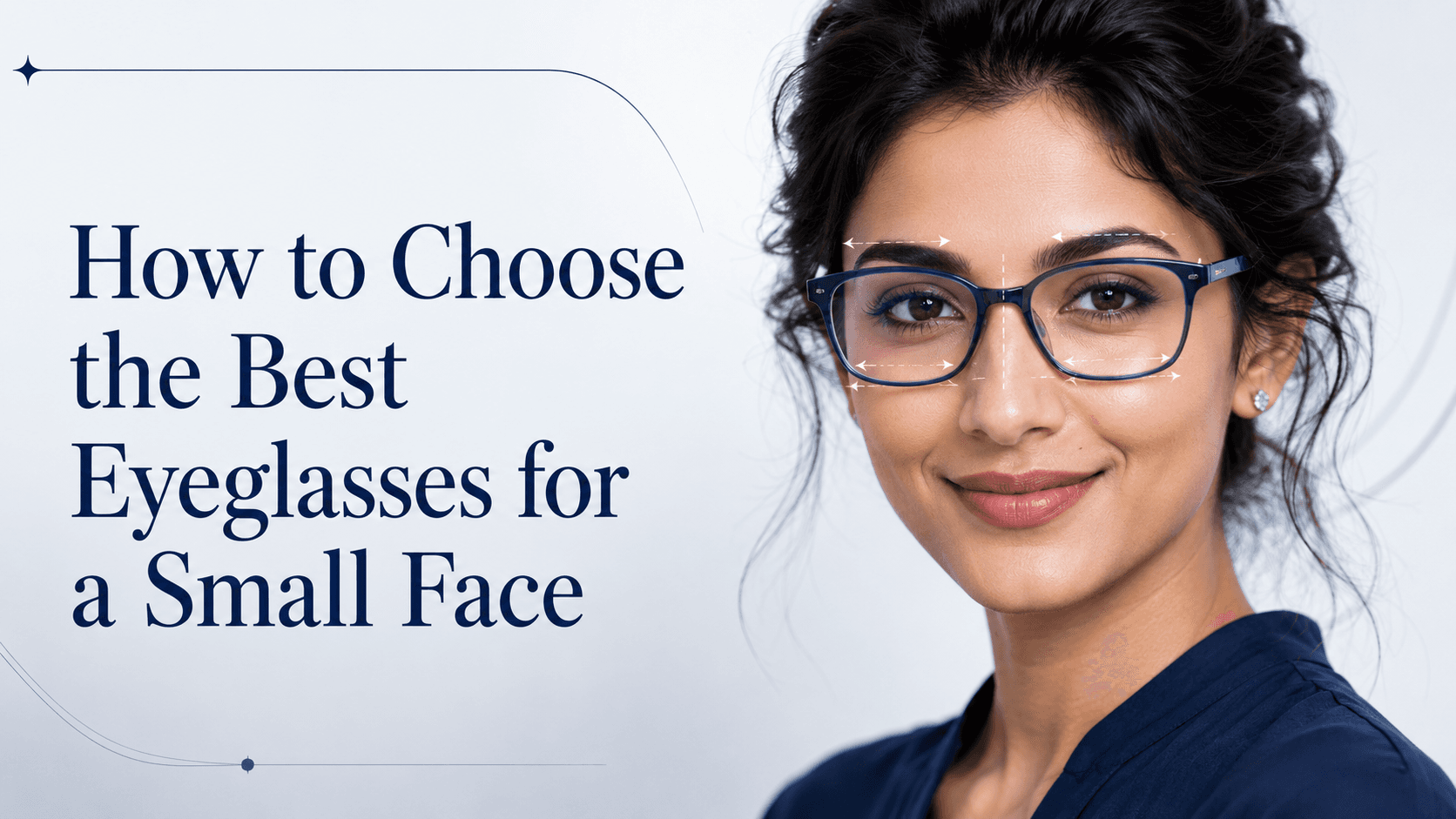
Finding stylish eyeglasses should feel exciting—not like a constant battle with frames that slide down, cover your eyebrows or make your face look smaller. If most standard frames appear oversized on you, the problem is probably not your face shape. You may simply need eyeglasses designed with more petite proportions.
The best eyeglasses for a small face should sit securely, complement your natural features and provide clear vision without overwhelming your appearance. Here is how to find the perfect pair.
Why Frame Width Is the Most Important Measurement
For a small face, frame width is the single most critical number. A frame that is wider than your face creates an unbalanced look and tends to slip down the nose. Look at the numbers printed on the inside of any frame — for example, 48□18-135 — where the first number is the lens width, the second is the bridge, and the third is the temple length. For small faces, aim for a lens width of 44–49 mm and a total frame width under 130 mm.
Which Frame Shapes Work Best for Small Faces?
Certain silhouettes are naturally more flattering on petite features:
Round frames add softness and look proportionate on narrow faces without overwhelming them.
Cat-eye frames draw attention upward and create the illusion of wider cheekbones — a great choice for small oval or heart-shaped faces.
Oval and soft rectangle frames strike a balance between structure and subtlety, working well across most small face shapes.
Rimless and semi-rimless frames minimise visual weight entirely, making them ideal if you want your frames to disappear into your look.
Frames to Avoid on a Small Face
Oversized square frames, heavy wraparound styles, and wide geometric shapes tend to overpower small features. Thick, high-profile acetate frames can also look disproportionate unless the lens size is kept small. Avoid frames with wide, decorative temples — they add bulk exactly where you do not want it.
Material and Weight: Why They Matter More on Smaller Frames
Because small frames have less surface area to distribute weight, a heavy frame will sit unevenly and cause nose-bridge discomfort faster. Titanium and beta-titanium are the lightest metals available and flex slightly for a secure fit. TR-90 (a memory plastic) is another excellent option — featherlight and flexible. Thin acetate works well too, provided the frame profile is kept low.
Colour and Pattern Tips for Small Faces
Lighter or translucent frames keep the face looking open. If you prefer bold colour, choose a frame with a gradient or two-tone finish — darker on top, lighter below — so the frame adds character without closing in your features. Avoid all-over dark, opaque frames in large shapes; they tend to dominate a small face rather than complement it.
Getting the Fit Right: Beyond the Numbers
Even a correctly sized frame can fit poorly if the nose pads are not adjusted. Ensure the pads grip gently without pinching, the frame sits level, and the temples curve comfortably behind the ears without pressing. If you are buying online, use a virtual try-on tool and always check the return or exchange policy so you can swap if the fit is off.
Find Your Perfect Petite Frame
Choosing the best eyeglasses for a small face comes down to accurate measurements, a secure bridge and balanced proportions. Do not limit yourself to one particular shape. Focus on how the frame fits, feels and reflects your personal style.
Explore Rimloo’s fashionable eyeglasses and use the AI Face Shape Finder to discover frame styles that complement your unique features.
