
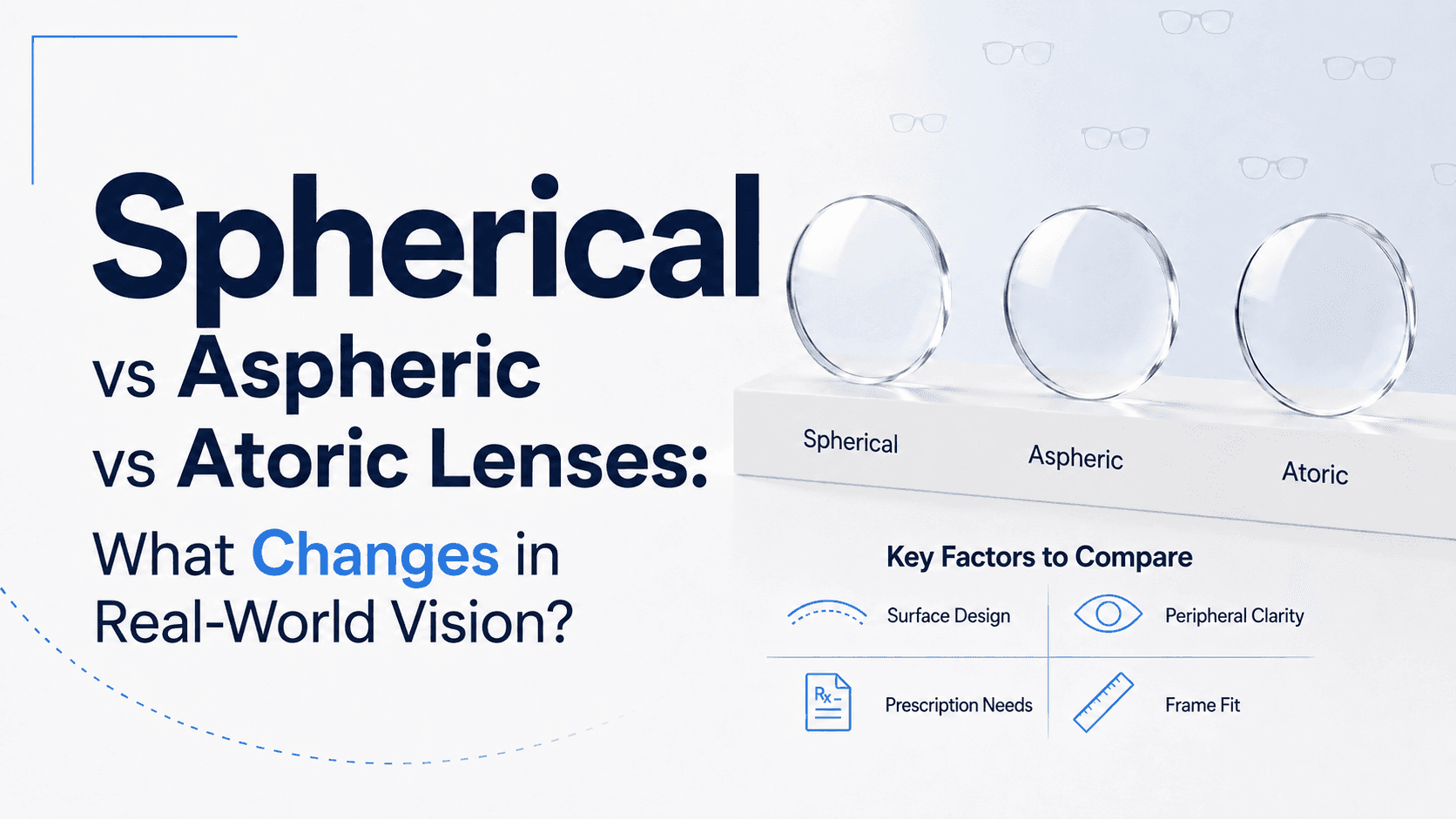
Spherical lenses have a uniform curve across their entire surface, aspheric lenses flatten gradually toward the edges to reduce distortion, and atoric lenses apply that same principle independently on two meridians to correct astigmatism more precisely. The design you wear determines edge sharpness, lens thickness, and how natural objects look when you glance off-centre.
What Is a Spherical Lens?
A spherical lens has the same curvature in every direction — imagine a slice taken from a perfect ball. This uniform shape is the oldest and most affordable manufacturing approach. It works well for low to moderate prescriptions, but at higher powers the edges bend light unevenly, causing peripheral distortion and a fishbowl effect where straight lines appear to curve slightly.
How Does an Aspheric Lens Differ?
An aspheric lens is not a single consistent curve. It starts with a steeper curve at the centre and gradually flattens toward the rim. This progressive change in curvature keeps incoming light focused more accurately across a wider field of view. The practical benefits for the wearer are significant:
Thinner and lighter profile — especially noticeable in prescriptions above ±3.00 D
Reduced magnification or minification of the eyes, so you look more natural to others
Less peripheral swim when moving your gaze from side to side
Flatter front surface, which suits modern slim frames better
Most quality single-vision lenses sold today are aspheric by default, making them a smart upgrade over basic spherical designs for nearly every prescription.
What Makes an Atoric Lens Different From an Aspheric One?
Atoric lenses take the aspheric concept one step further. While a standard aspheric lens applies its flattening correction symmetrically, an atoric lens optimises the curvature independently along the two main meridians of the lens. This is critical for people with astigmatism, where the eye has different focal powers in different axes.
With a conventional toric or even a basic aspheric design, off-axis distortion in astigmatic prescriptions can still be significant. An atoric surface calculates the ideal curvature for each meridian separately, delivering sharper, more accurate vision at the edges without the visual compromise that older toric designs sometimes produced.
Spherical vs Aspheric vs Atoric: Which Should You Choose?
The right lens depends on your prescription and visual demands:
Spherical — suits mild prescriptions (roughly ±1.50 D or less) and budget-conscious buyers
Aspheric — best for moderate to high sphere-only prescriptions; thinner, lighter, and cosmetically more flattering
Atoric — the strongest choice when significant cylinder power (astigmatism correction) is present, typically cylinder ≥1.00 D
Does Lens Design Affect Everyday Comfort?
Yes, meaningfully. Wearers upgrading from spherical to aspheric often notice that peripheral objects look less wobbly, reading at an angle feels steadier, and the lenses feel lighter on the nose over a long day. Those moving to atoric designs for astigmatism frequently report that text appears crisper and that the mild headaches caused by off-axis blur diminish within the first week of wear.
A Quick Word on Lens Care
Regardless of design, advanced lens surfaces — especially high-index aspheric and atoric lenses — benefit from careful handling. Use a microfibre cloth and a proper lens-cleaning solution rather than clothing or paper tissues, which can micro-scratch the anti-reflective coating that these premium lenses almost always carry. A scratched aspheric lens loses much of its optical advantage.
