
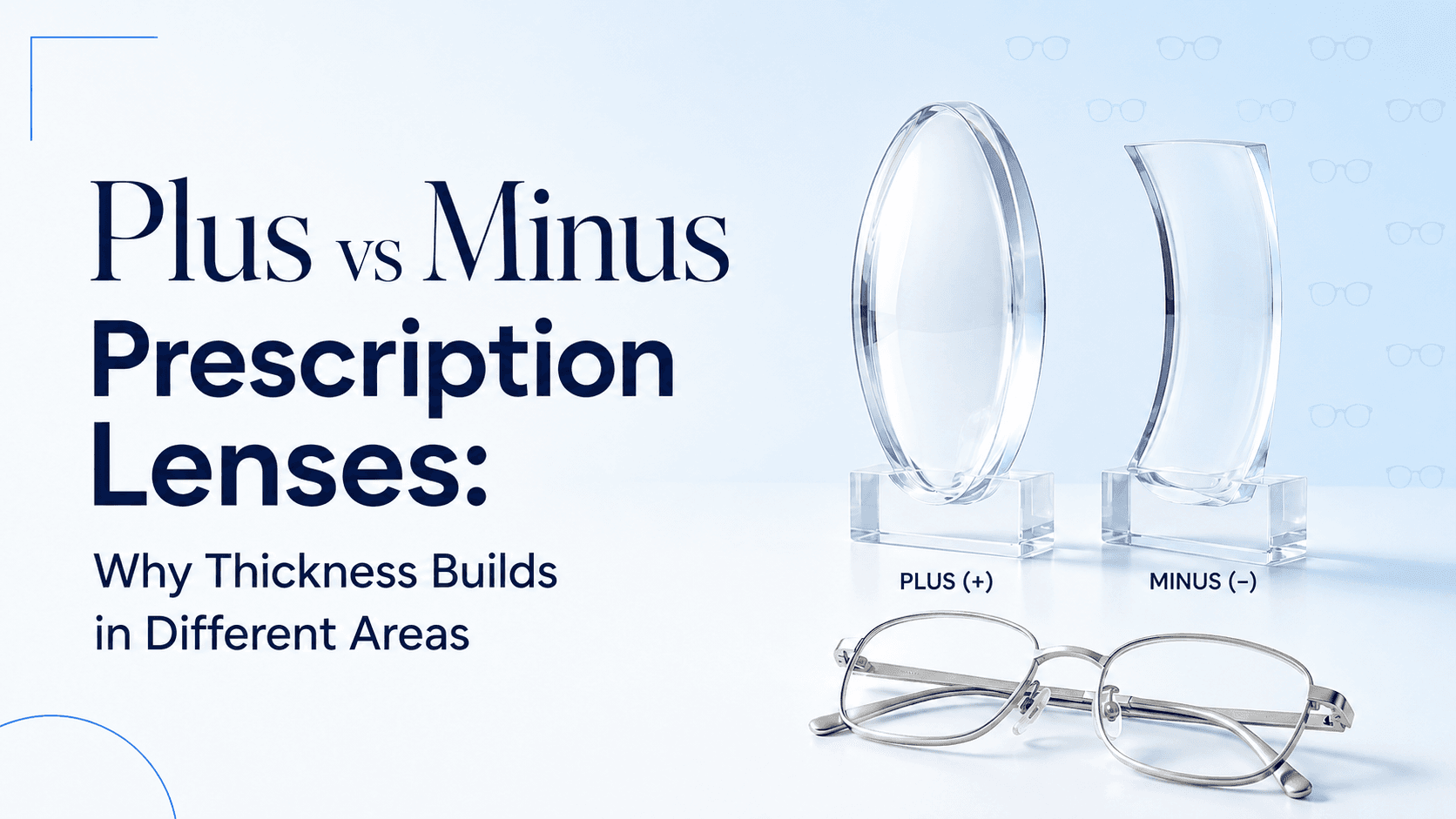
Plus lenses (for farsightedness) are thickest at the centre and taper toward the edges, while minus lenses (for nearsightedness) are thinnest at the centre and thickest at the edges. This fundamental difference in shape is determined by the optical prescription your eye doctor writes for you and directly influences which lens material and frame style will give you the slimmest, most comfortable result.
What Do Plus and Minus Numbers in Your Prescription Mean?
The numbers on your prescription, written as +1.50 or -2.75, describe how much the lens must bend light to bring it into sharp focus on your retina. A plus (+) prescription corrects hyperopia (farsightedness) by converging light rays. A minus (-) prescription corrects myopia (nearsightedness) by diverging light rays. The higher the absolute number, the more powerful the lens must be, and the more noticeable the thickness becomes.
Why Does Thickness Appear in Different Places?
Plus Lenses: Thicker at the Centre
A plus lens works like a convex magnifying glass. To converge light, it must curve outward on both surfaces, pushing material toward the middle. Someone with a +4.00 prescription will notice a distinctly domed centre, sometimes called the bullseye effect. The edges, by contrast, are ground down thin. This is why plus wearers often see their eyes appear magnified in photos.
Minus Lenses: Thicker at the Edges
A minus lens works like a concave lens. To diverge light, its surfaces curve inward, thinning the centre and pushing material outward toward the rim. A -5.00 prescription can produce visible rings of glass around the frame edge, sometimes called coke-bottle edges. The stronger the minus power, the wider and more pronounced those rings become.
How Lens Material Reduces Unwanted Thickness
The key measurement is refractive index — a number that describes how efficiently a material bends light. A higher index means the lens achieves the same power with less material, so it sits thinner on your face.
Standard CR-39 (index 1.50): Affordable but noticeably thicker beyond ±2.00 prescriptions.
Mid-index 1.56 or 1.60: A good balance for prescriptions up to about ±4.00.
High-index 1.67: Recommended for ±4.00 to ±6.00; meaningfully slimmer and lighter.
Ultra-high-index 1.74: Best choice for strong prescriptions beyond ±6.00; the thinnest option available.
Plus vs Minus: Which Lens Is Harder to Thin Down?
High plus prescriptions are generally harder to slim than equivalent minus prescriptions because the centre thickness cannot be reduced below a minimum safety point — the lens would crack during edging. Minus lenses only require managing edge thickness, which can be controlled more aggressively with higher-index materials and smaller frame sizes.
Frame Choice Tips to Minimise Visible Thickness
Frame selection is the easiest free upgrade you can make. Smaller lens diameters reduce both centre and edge thickness because the lens is cut from closer to its optical midpoint. For plus wearers, avoid large round frames that exaggerate the magnified-eye look. For minus wearers, darker or thicker rims disguise edge rings effectively. Rimless and semi-rimless styles, however, expose edges and are best reserved for prescriptions below ±3.00.
