
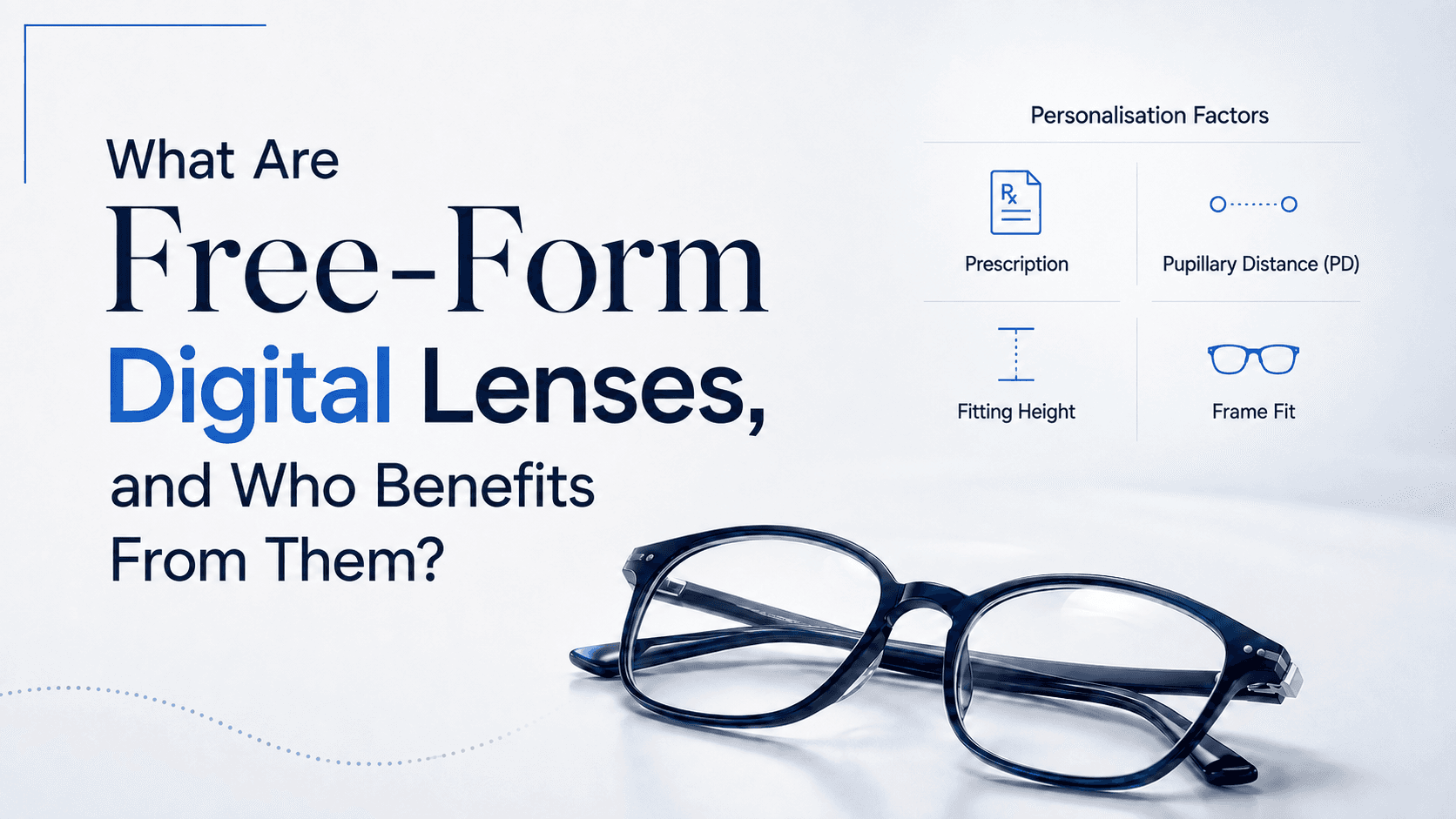
Free-form digital lenses are made using computer-controlled, point-by-point surfacing technology that places prescription corrections across thousands of reference points on the lens surface — compared to the few dozen used in traditional manufacturing. The result is noticeably sharper optics, reduced peripheral blur, and a wider usable field of view, especially for complex prescriptions.
How Do Free-Form Lenses Differ From Conventional Lenses?
Traditional lenses are ground using fixed tools that match a limited range of base curves. Free-form lenses, by contrast, are surfaced digitally to your exact prescription — including sphere, cylinder, axis, and even your pupillary distance — to within 0.01 dioptre increments. This level of precision simply isn't achievable with older, analogue grinding methods.
The practical difference? Less distortion at the edges of your lenses, fewer adaptation complaints when you first wear them, and crisper clarity whether you're reading fine print or scanning a room.
Who Benefits Most From Free-Form Digital Lenses?
High-Prescription Wearers
If your prescription sits beyond ±4.00 dioptres in sphere or has significant cylinder (astigmatism correction), free-form technology compensates for the optical aberrations that conventional lenses struggle with. The improvement in peripheral sharpness is immediately noticeable.
Progressive Lens Wearers
Free-form manufacturing is especially transformative for progressive addition lenses (PALs). Conventional progressives have fixed corridor widths and distortion zones. A digitally surfaced progressive is customised to your frame's tilt, wrap angle, and how far the lens sits from your eye — giving you a wider reading zone and smoother power transition.
People With High Astigmatism
Astigmatism corrections depend heavily on precise axis alignment. Free-form surfacing calculates the optimal placement across the entire lens, not just the optical centre, reducing swim and distortion that astigmatic wearers often experience with standard lenses.
Screen-Heavy Professionals
If you spend long hours in front of a laptop or phone, a free-form lens — particularly one with a blue-light filtering coating — reduces the visual fatigue caused by constant focusing effort. The sharper optics mean your eyes work less hard to pull a clear image.
First-Time Progressive or Varifocal Wearers
Adapting to progressives is notoriously tricky. A free-form customised progressive dramatically shortens the adaptation window because the distortion zones are smaller and positioned away from your natural line of sight.
Free-Form vs Standard Lenses: A Quick Comparison
Standard lenses are cost-effective and suitable for straightforward, low-to-mid prescriptions in single-vision format. Free-form digital lenses are the better choice when your prescription is complex, when you need progressives, or when maximum visual clarity matters — such as for driving, detailed work, or extended screen time.
What to Look for When Ordering
When choosing free-form lenses, ensure your optician provides a full prescription including near vision addition (for progressives) and accurate pupillary distance measurements — both monocular PD and fitting height. These measurements are the inputs that make digital surfacing worthwhile. Pairing free-form lenses with an anti-reflective coating and UV protection gives you the most complete optical package.
At Rimloo, you can upload your prescription and explore a curated range of frames suited to free-form lens fitting, ensuring the frame geometry complements the lens design for the sharpest possible result.
