
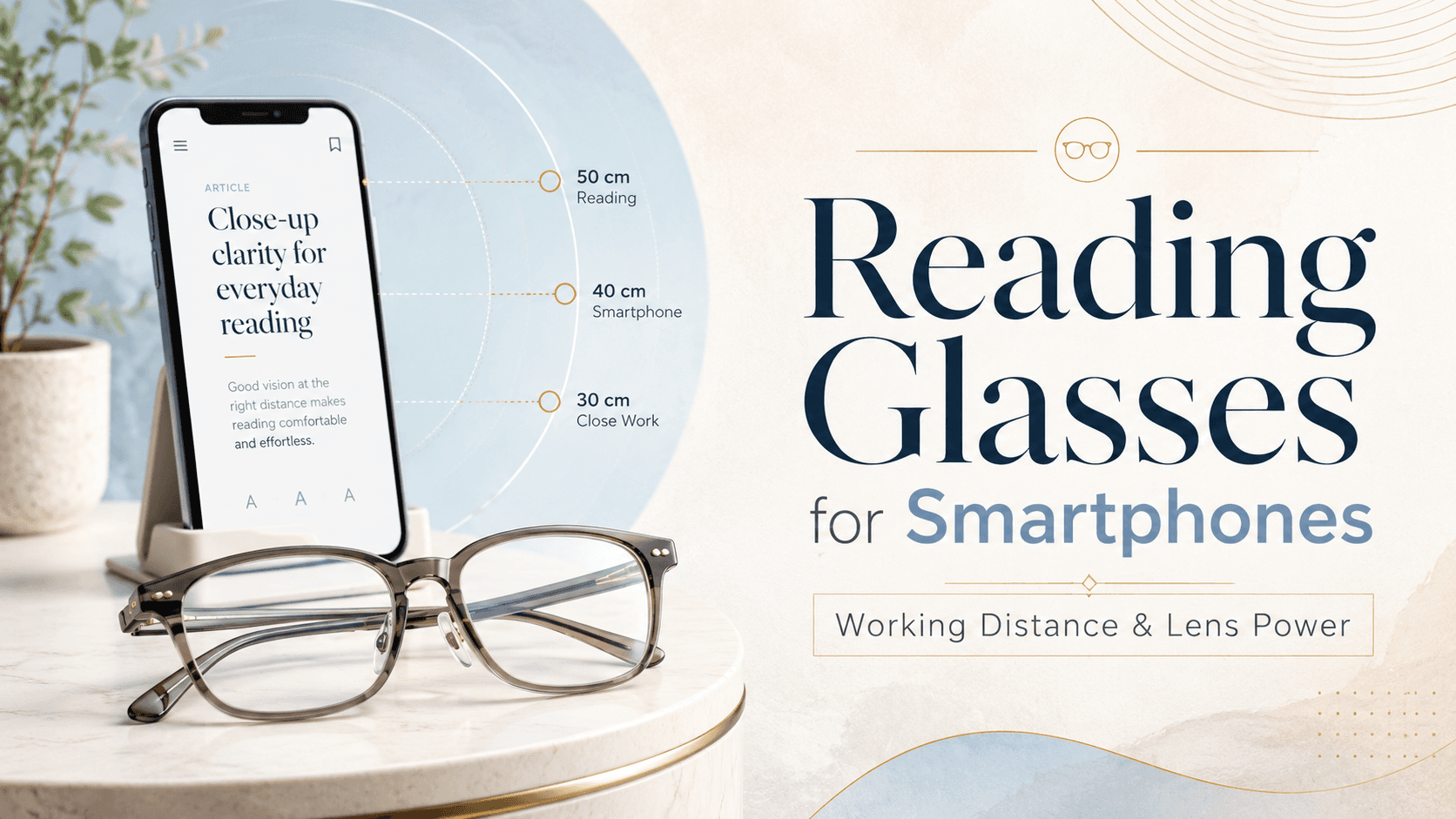
For smartphone use, most people need a lower reading power than for books — typically 0.25D to 0.75D less — because phones are held closer to the eyes (usually 25–35 cm) than printed text (40–45 cm). Using the wrong power strains your eyes and causes fatigue faster than you realise.
Why Does Working Distance Matter for Reading Glasses?
Lens power is not a single universal number. It is calculated relative to how far away the object sits from your eyes — a measurement called working distance. The closer the object, the more focusing effort your eyes need, and the higher the lens addition required. Move the object closer and the maths shifts.
A traditional reading prescription is typically set for a working distance of 40 cm — roughly the distance from your elbow to your hand. Most people hold a paperback or newspaper at roughly that distance. A smartphone, however, tends to sit at 30 cm or even less, especially when you are typing a message or reading small text on a crowded screen.
What Happens When You Use Book Reading Glasses for Your Phone?
When you use glasses optimised for 40 cm at a 30 cm distance, the lens is effectively under-powered for that shorter distance. Your ciliary muscles compensate by contracting harder, leading to:
Eye fatigue and headaches after extended screen time
Blurred text that forces you to squint
Neck and shoulder tension from unconsciously pushing the phone further away
Dry eyes from reduced blinking during the extra focusing effort
How to Calculate the Right Power for Smartphone Reading
A simple rule of thumb used by optometrists: add approximately +0.50D for every 10 cm reduction in working distance compared to the standard 40 cm reference. So if you hold your phone at 30 cm, you may need roughly +0.50D more than your book reading glasses. At 25 cm, the adjustment rises to around +0.75D–+1.00D.
In practice, this means someone with a +2.00D reading prescription for books might find a +1.50D or +1.75D lens more comfortable for prolonged smartphone use — counter-intuitive but optically correct.
Book Reading vs. Smartphone Reading: Which Power Should You Choose?
Use your standard reading power for physical books, newspapers, and printed documents held at arm's length. Opt for a slightly lower power — or purpose-made computer and screen reading glasses — when your primary use case is a phone, tablet, or laptop screen. Many users benefit from keeping two pairs: one for print, one for screens.
Does Blue-Light Coating Help Too?
Correcting the lens power for your working distance is the most important fix. However, pairing the right power with a blue-light filter coating can further reduce glare and eye strain from smartphone screens, especially during evening use when blue light affects melatonin levels. It is an add-on worth considering but not a substitute for getting the power right first.
When to See an Optometrist
If you are unsure of your working distance or find yourself adjusting the phone position constantly to find a clear focus, book a professional eye examination. An optometrist can measure your exact near vision needs and recommend an appropriate addition power for different tasks — including a specific smartphone distance if needed.
