
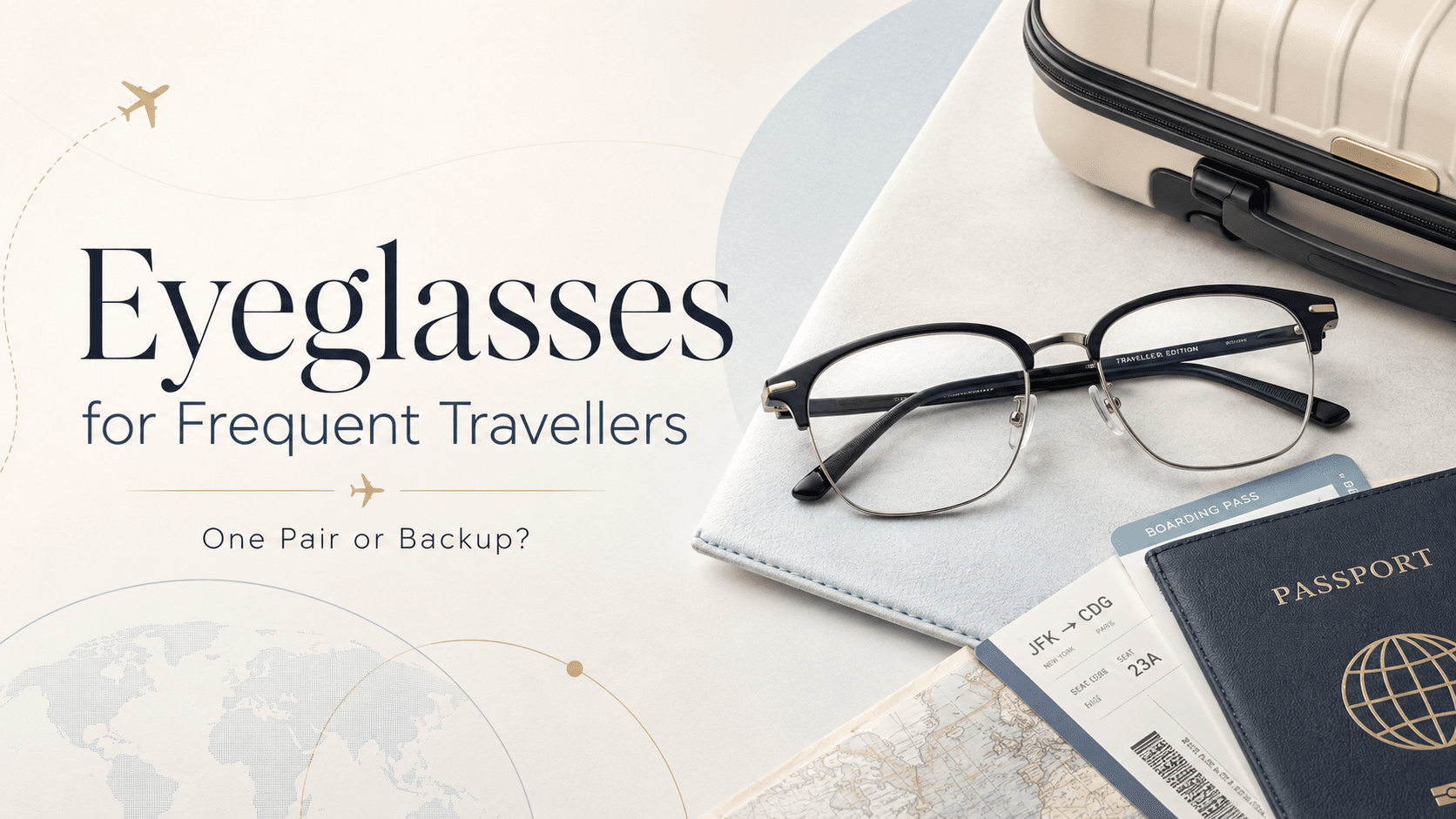
For frequent travellers, eyeglasses are not just an accessory — they are a travel essential. The smartest approach depends on your trip length, prescription strength, and how much risk you're willing to accept: a single versatile pair keeps your bag light, but a backup pair can save a trip if your primary frames break, scratch, or get lost.
Why Your Glasses Choice Matters More When You Travel
At home, a broken pair is an inconvenience. On a two-week international trip, it can be a genuine crisis. Opticians may not stock your exact prescription abroad, and sourcing replacement frames in an unfamiliar city costs time and money. The stakes are simply higher when you are far from your regular optician.
The Case for One Versatile Pair
Travelling light is a real advantage, and a single well-chosen pair can handle most situations if you pick wisely. Look for frames that balance everyday prescription use with some UV protection — photochromic (transition) lenses, for example, adapt from clear indoors to tinted outdoors, reducing the need to carry separate sunglasses. Lightweight titanium or flexible TR-90 frames resist bending during transit and fit comfortably for long-haul flights.
One-pair packing works best when your prescription is mild to moderate, your trip is short (under a week), and you are travelling to a major city where replacement options exist.
The Case for a Backup Pair
If your prescription is high, you have a complex or progressive lens prescription, or you are heading somewhere remote, a backup pair is not optional — it is essential. Losing your only pair of glasses on day one of a mountain trek or a beach holiday is a scenario no traveller wants to experience.
A backup does not need to be expensive. An older pair with a close prescription works fine as an emergency option. Alternatively, many Indian eyewear retailers offer affordable prescription glasses at a fraction of the cost of premium frames, making it easy to keep a functional spare without overspending.
One Pair vs Backup: Which Is Right for You?
Consider these factors before you decide:
Trip duration: Longer trips justify carrying a backup pair.
Prescription complexity: High-power or progressive lenses are harder to replace quickly abroad.
Destination: Remote or rural destinations offer fewer replacement options.
Activity level: Adventure travel — hiking, water sports, cycling — increases the risk of frame damage.
Lens type: Photochromic lenses can reduce the need for a separate sunglass pair on shorter urban trips.
Practical Tips for Travelling with Glasses
Whether you choose one pair or two, how you carry and protect your frames matters as much as which frames you pick.
Always store glasses in a hard-shell case, especially in checked or overhead luggage.
Keep your prescription details (sphere, cylinder, axis, PD) saved digitally — on your phone or email — so you can order replacements anywhere.
Pack a microfibre cleaning cloth and a small lens cleaning spray to manage smudges during long journeys.
If carrying two pairs, keep them in separate bags so a single lost bag does not take both pairs with it.
Anti-reflective coatings reduce eye fatigue during night drives and flights — worth the upgrade for frequent travellers.
The Rimloo Approach: Smart, Affordable Backup Pairs
At Rimloo, prescription eyeglasses are priced accessibly enough that owning a quality backup pair is realistic for most budgets. A lightweight everyday frame for daily use paired with a sturdy, affordable second frame for travel is a combination that gives you both convenience and peace of mind.
