
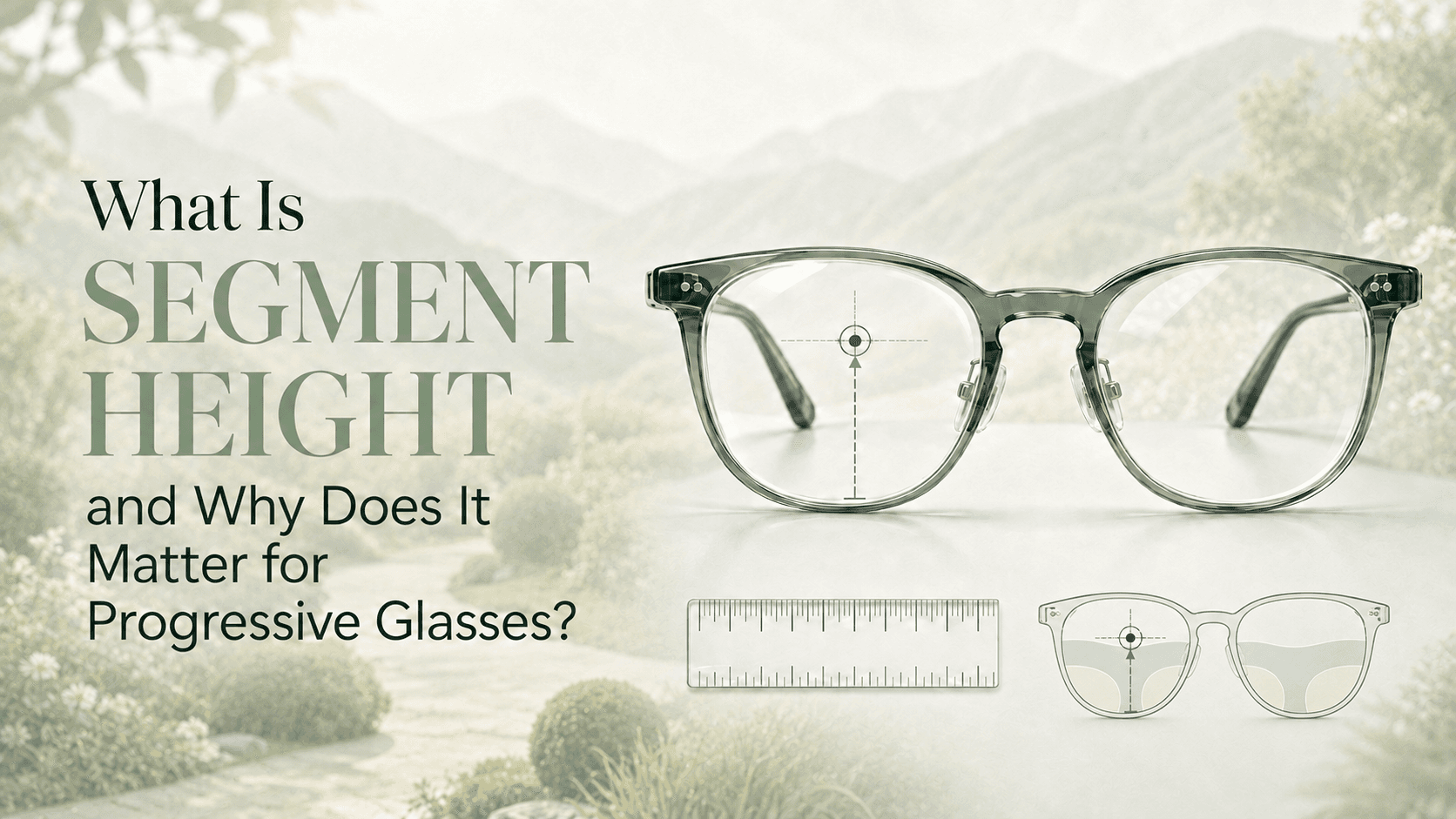
Segment height is a vertical measurement used to position multifocal lens zones correctly within an eyeglass frame. For progressive glasses, it helps place the distance, intermediate and near-vision areas where your eyes can access them naturally.
In progressive-lens fitting, the more precise term is often fitting height. However, many eyewear providers use “segment height” and “fitting height” interchangeably.
How Is Segment Height Measured?
For progressive glasses, segment height is generally measured from the lowest point of the lens opening to the centre of the pupil. The wearer should have the selected frame properly adjusted, sit or stand naturally and look straight ahead.
The right and left eyes should be measured separately because pupil positions and facial features are not always perfectly symmetrical.
Segment height is not usually determined by the written prescription alone. The measurement depends on:
The selected frame’s size and shape
How the bridge sits on the nose
The position of each pupil within the frame
Frame tilt and wearing position
The progressive lens design and corridor length
This is why an old segment-height measurement should not automatically be reused with a new frame.
Why Does Segment Height Matter?
Progressive lenses contain several powers blended without visible lines:
The upper section supports distance vision.
The middle corridor provides intermediate vision.
The lower section supports reading and close work.
Accurate segment height positions these zones relative to your natural eye movements. If the measurement is too high, you may look through part of the intermediate corridor when trying to see far away. If it is too low, you may struggle to reach the reading zone without lowering your eyes or tilting your head excessively.
Incorrect fitting may contribute to:
Blurred distance, intermediate or near vision
Difficulty finding the clearest viewing area
Headaches or eye strain
A swimming or off-balance sensation
Excessive head or chin movement
Slow or unsuccessful adaptation
Some adjustment is normal with a first pair of progressives, but persistent problems should be checked by an optical professional.
Is There a Minimum Segment Height?
Yes, but there is no universal minimum for every progressive lens. Each design has its own corridor length and fitting requirements.
For example, current ZEISS progressive lens designs include options for fitting heights from approximately 13 mm, while several HOYA progressive designs specify minimum fitting heights around 14 or 15 mm.
A shallow frame may require a short-corridor progressive lens. If the frame is too small for the selected design, part of the intermediate or reading zone could be cut away during lens production.
Segment Height vs Pupillary Distance
Pupillary distance and segment height perform different jobs:
Pupillary distance (PD) positions each lens horizontally.
Segment or fitting height positions the progressive zones vertically.
Both measurements are important. Accurate PD cannot compensate for incorrect segment height, and vice versa.
Can Segment Height Change?
Your segment height can change when you choose a different frame or when the existing frame fit changes. If glasses slide down the nose, the progressive zones also move lower relative to your pupils. A professional frame adjustment may sometimes resolve a visual problem without replacing the lenses.
