
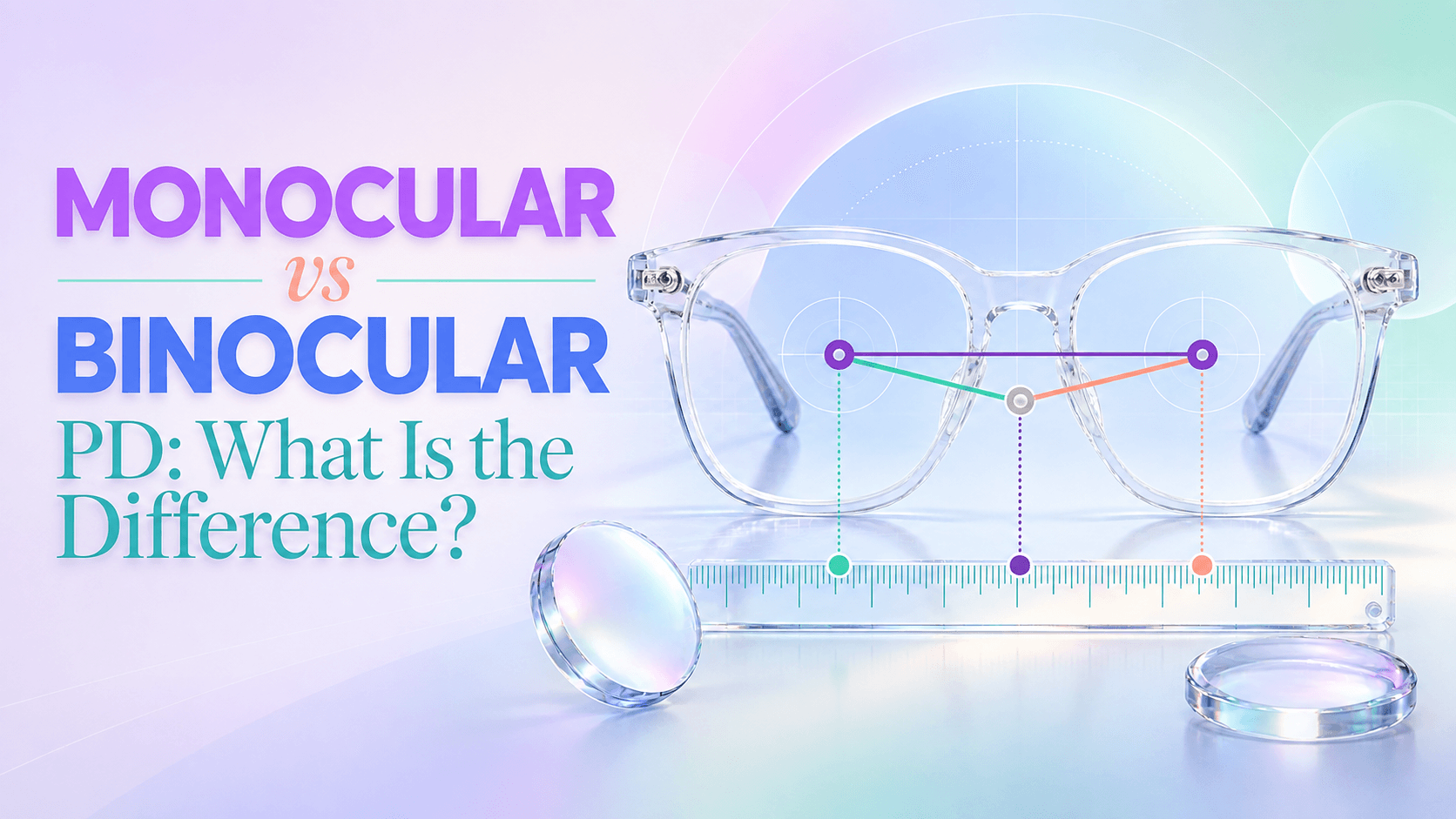
Monocular vs Binocular PD: What Is the Difference?
Pupillary distance, or PD, is the distance between your pupils measured in millimetres. It helps an optical laboratory align each lens with your eyes so you look through the intended optical area.
The main difference is simple: binocular PD provides one total measurement, while monocular PD provides separate measurements for your right and left eyes.
Monocular vs Binocular PD Compared
FeatureBinocular PDMonocular PDAlso calledSingle or total PDDual or individual PDMeasurementPupil centre to pupil centreNose bridge to each pupilFormatOne number: 63 mmTwo numbers: 31/32 mmAccounts for asymmetryNot individuallyYesCommonly used forStandard single-vision lensesProgressives and complex prescriptions
What Is Binocular PD?
Binocular PD measures the total horizontal distance from the centre of one pupil to the centre of the other. It is written as a single number, such as 63 mm.
This measurement is often suitable for standard single-vision glasses when the eyes are positioned relatively evenly around the centre of the nose. However, dividing a binocular PD equally does not always produce accurate monocular measurements because faces are rarely perfectly symmetrical.
What Is Monocular PD?
Monocular PD measures each eye separately from the centre of the nose bridge to the centre of its pupil. For example, a monocular PD of 31/32 mm means one eye sits 31 mm from the facial centre and the other sits 32 mm away.
The two monocular measurements should add up to the binocular PD. The Cleveland Clinic describes monocular PD as a two-number measurement, usually recorded with the right-eye value first.
Which PD Is Better for Prescription Glasses?
Neither format is automatically “better” for every pair of glasses. The correct choice depends on the prescription and lens design.
Binocular PD may work for uncomplicated, lower-powered single-vision lenses. Monocular PD provides more precise centring and is commonly recommended for:
Progressive or varifocal lenses
Bifocal and trifocal lenses
Strong prescriptions
Noticeable facial asymmetry
Eye-alignment conditions
Digitally customised lenses
Research published in Community Eye Health explains that monocular PD can improve optical-centre placement because the pupils are not always equally positioned from the nose.
Progressive lenses also require an accurate fitting height, so PD alone is not enough to manufacture them correctly.
Distance PD vs Near PD
Distance and near PD describe where you are looking, not how the measurement is recorded.
Distance PD is measured while looking at a faraway target.
Near PD is measured while focusing on reading distance.
Near PD is usually smaller because the eyes turn inward when viewing close objects. Use the measurement specified for your intended lenses rather than converting it yourself.
Why Does Accurate PD Matter?
Incorrect lens positioning can create unwanted prismatic effects. Depending on the prescription and size of the error, this may contribute to blurred vision, headaches, eye strain or difficulty adapting to new glasses. Stronger and multifocal prescriptions are generally less tolerant of measurement errors.
For the most reliable result, have your PD measured by an optometrist, optician or trained dispenser—especially when ordering progressive or high-prescription lenses.
