
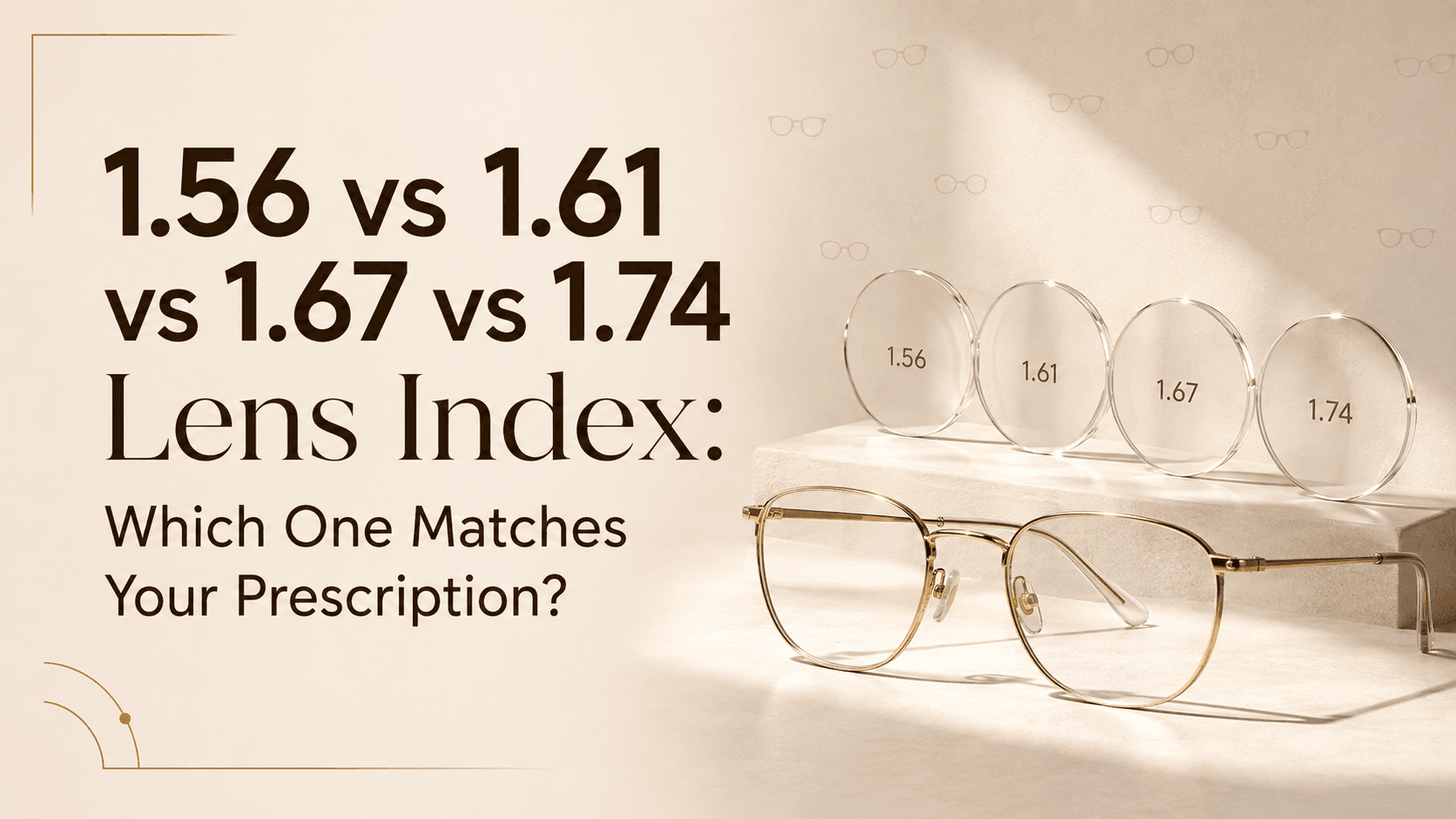
The right lens index depends on your prescription power (sphere, cylinder, or both). As a rule: 1.56 suits mild prescriptions up to ±2.00D, 1.61 works for ±2.00D to ±4.00D, 1.67 covers ±4.00D to ±6.00D, and 1.74 is ideal for high powers beyond ±6.00D. Choosing the correct index keeps your lenses thin, light, and comfortable — without paying more than you need to.
What Does Lens Index Actually Mean?
Lens index is a number that describes how efficiently a material bends light. A higher index means the lens can achieve the same optical correction at a thinner cross-section. For wearers with strong prescriptions, this matters enormously — thick lenses are heavy, distort your appearance, and can cause headaches from edge distortion.
1.56 Lens Index — Best for Low Prescriptions
The 1.56 index is the standard entry-level lens. It is made from a lightweight plastic (CR-39 derivative) and is perfectly adequate for prescriptions within ±2.00 diopters. It is the most affordable option and widely available. If your prescription is mild, there is no benefit to going thinner — you would just be spending extra money.
1.61 Lens Index — The Everyday Sweet Spot
The 1.61 index is the most popular choice for Indian eyeglass wearers. It handles prescriptions from ±2.00D to ±4.00D while keeping the lens noticeably thinner and lighter than 1.56. It is compatible with most rimless and semi-rimless frames and strikes the best balance between cost and performance for the average prescription.
1.67 Lens Index — For Moderate to High Powers
If your prescription falls between ±4.00D and ±6.00D, the 1.67 index is the right call. The lenses are significantly thinner at the edges, which reduces the magnified or minified eye effect that thick lenses cause. They are also lighter on the nose, making all-day wear far more comfortable. Most full-rim frames pair well with this index.
1.74 Lens Index — For High Prescriptions
The 1.74 index is the thinnest material widely available for prescription eyeglasses. It is designed for powers beyond ±6.00D or for anyone with high cylinder values. The lenses look virtually normal in thickness even at very strong corrections. The trade-off is price — 1.74 lenses cost considerably more, so they are recommended only when lower indices would produce uncomfortably thick lenses.
Quick Comparison: Which Index Should You Choose?
Up to ±2.00D — 1.56 index (standard, budget-friendly)
±2.00D to ±4.00D — 1.61 index (best all-round value)
±4.00D to ±6.00D — 1.67 index (thinner, lighter, more comfortable)
Beyond ±6.00D — 1.74 index (maximum thinness for strong prescriptions)
Does Frame Choice Affect Which Index You Need?
Yes. Rimless and semi-rimless frames expose the lens edge, so even moderate prescriptions benefit from a higher index for cosmetic reasons. Full-rim frames hide the edge, giving you slightly more flexibility to use a lower index without it looking thick. Always factor in your frame choice when deciding.
A Note on Coatings
Regardless of which index you choose, pairing your lenses with an anti-reflective (AR) coating is strongly recommended. Higher-index materials have a naturally higher refractive index, which increases surface reflections — an AR coating counteracts this and improves visual clarity significantly.
