
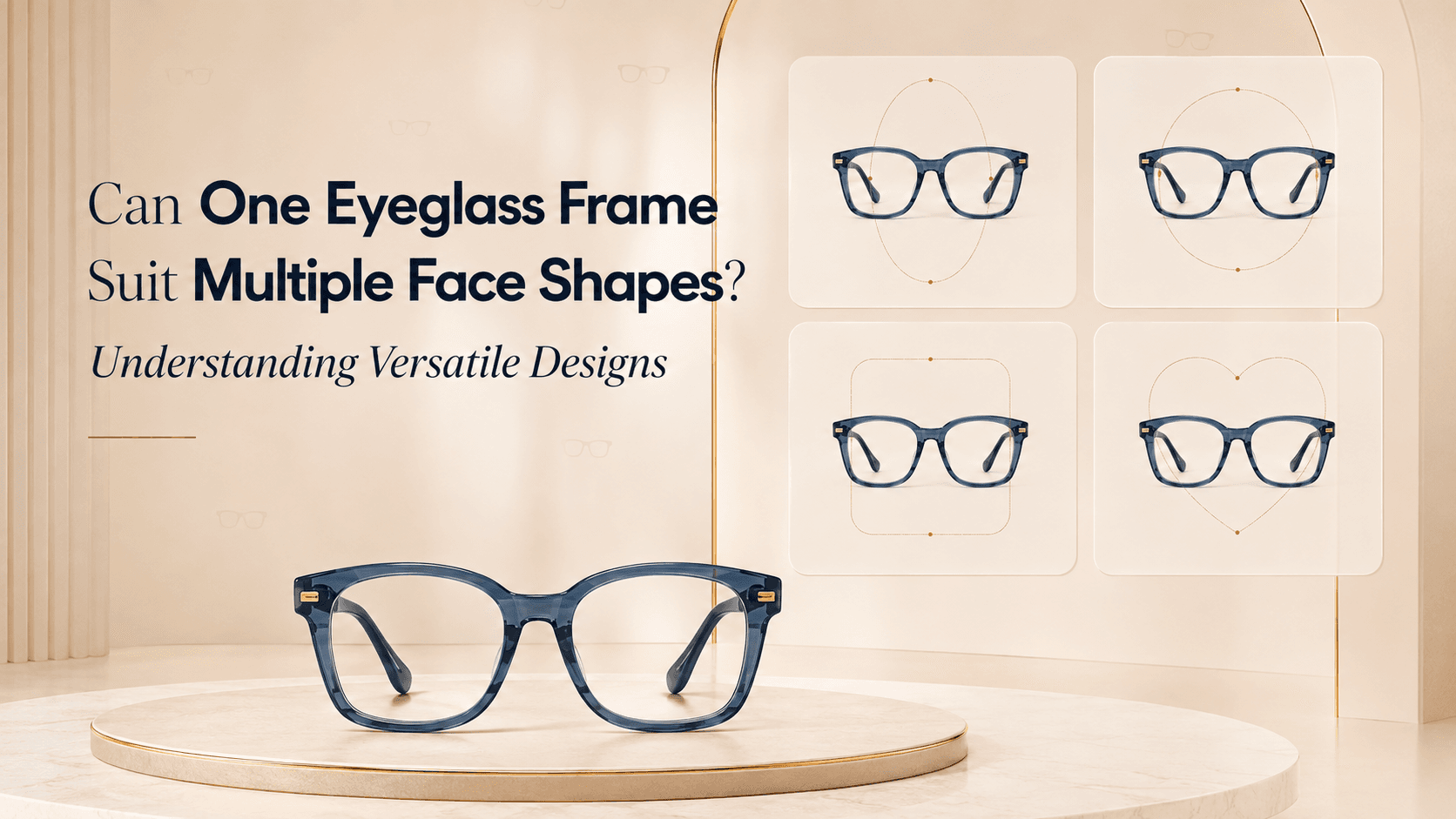
Yes — certain eyeglass frame silhouettes are designed with proportions that complement more than one face shape. Styles like classic rectangular frames, soft geometric shapes, and thin round frames share structural qualities — balanced width, neutral angles, and medium depth — that make them flattering across oval, round, square, and heart-shaped faces. Knowing which design features create this versatility helps you shop smarter and invest in frames you will actually wear every day.
Why Do Some Frames Work for Multiple Face Shapes?
Frame versatility comes down to geometry. A face shape guide tells you which frames contrast your natural contours — softening angles on a square face, or adding structure to a round one. Versatile frames sit in the middle of that spectrum: they are neither too angular nor too curved, neither too wide nor too narrow. They introduce gentle contrast without overcorrecting, which is why they read as flattering on many different people.
Three design qualities predict versatility the most reliably:
Medium frame width — roughly aligning with the widest part of the face without extending far beyond it.
Balanced lens depth — not too tall, not too shallow, keeping the frame proportional to most face lengths.
Subtle shape transitions — rounded rectangles and soft polygons avoid the extremes of a perfect circle or a sharp cat-eye, making them universally wearable.
Which Frame Shapes Are the Most Universally Flattering?
Rounded Rectangular Frames
The rounded rectangle is arguably the most versatile silhouette in eyewear. Slightly curved corners soften a strong jaw on a square face, while the horizontal line adds definition to a rounder face. On oval and heart-shaped faces, the balanced proportions simply disappear into the background — in the best way possible.
Soft Geometric Frames (Hexagonal and Octagonal)
Soft geometric shapes with flattened edges offer subtle angularity without aggression. They add visual interest and a modern edge while remaining neutral enough to work on most face contours. These have become a dominant fashion trend in Indian eyewear over the past two years.
Classic Oval Frames
Oval frames are the traditional go-to for universal fit. Their gentle curves introduce no strong competing angle, so they rarely clash with any face shape. The key is choosing an oval that is not too large — oversized ovals can overpower smaller or narrower faces.
When Should You Choose a Shape-Specific Frame Instead?
Versatile frames are an excellent default, but if you have a very pronounced facial feature — a wide forehead, a very strong jawline, or a notably narrow chin — a frame chosen specifically for your face shape will likely be more flattering. In those cases, classic face-shape guidance still applies: angular frames for round faces, wider frames for heart shapes, and curved frames for square faces.
Fit Matters as Much as Shape
Even the most universally designed frame fails if the fit is wrong. Check that the frame width matches your face width, the nose bridge sits comfortably without pinching, and the temples do not flare out at the sides. A frame that fits well will always look better than a theoretically perfect shape that sits incorrectly on your face.
At Rimloo, all prescription frames come with a virtual try-on tool so you can see how a silhouette actually sits on your face before you order — removing the guesswork entirely.
