
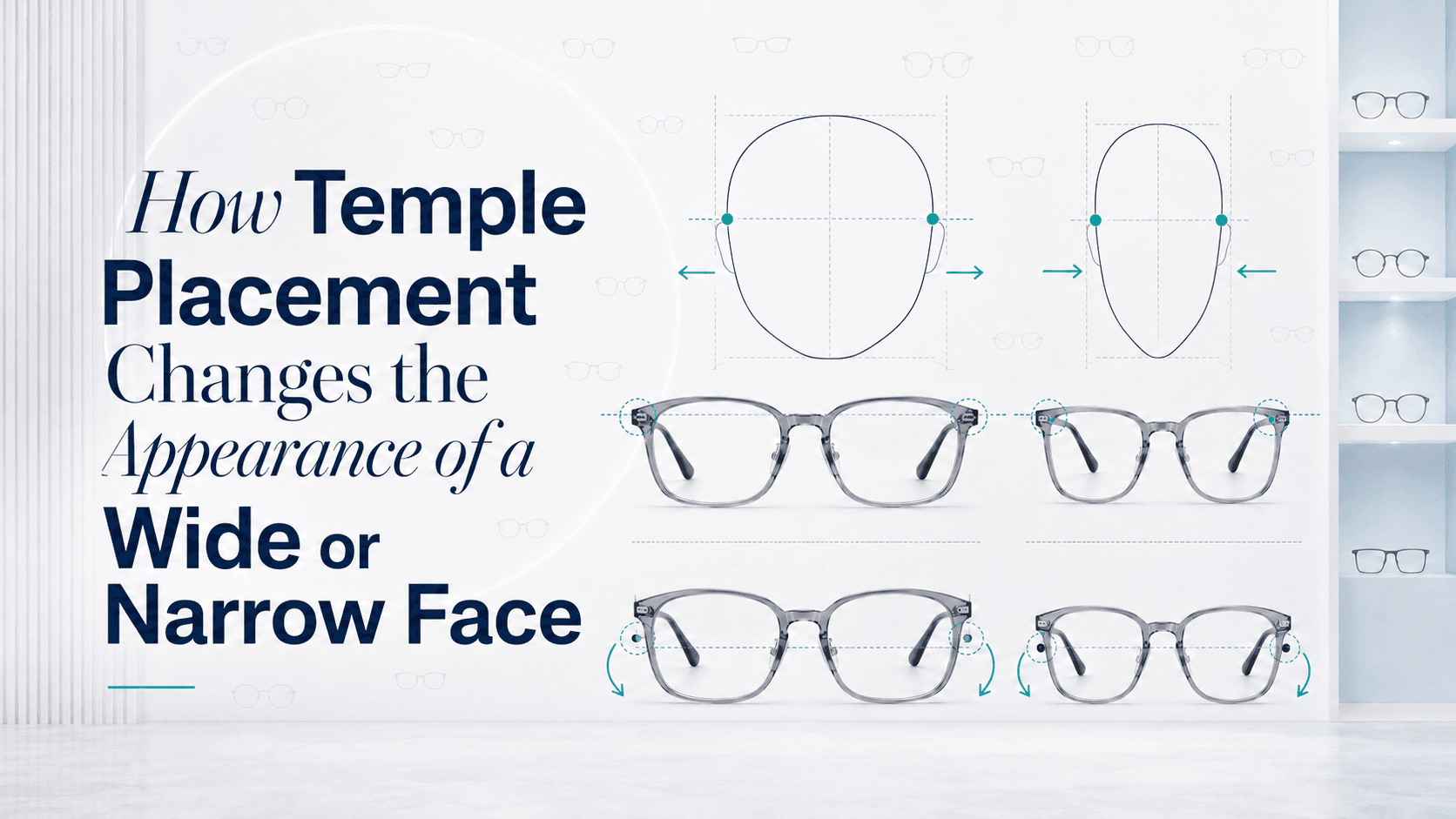
Temple placement — where the arms of your glasses attach to the frame front — is one of the most overlooked factors in how eyewear flatters your face. High-set temples visually elongate and slim a wide face, while low-set temples add perceived width to a narrow face. Getting this detail right can make your glasses look custom-made for your features.
What Exactly Is Temple Placement?
The temple (or arm) of a frame connects at the hinge, which sits at the outer edge of the lens. Placement refers to how high or low this hinge sits relative to the lens height. A hinge positioned near the top of the lens is called a high temple; one near the midpoint or bottom is a low temple. This single measurement shifts where the eye is drawn first when someone looks at your face.
How High Temple Placement Slims a Wide Face
If your face is wider at the cheekbones or jaw — think square, round, or diamond shapes — frames with high-set temples draw the eye upward and create a vertical visual line. This reduces the perceived width of the lower half of your face. Rectangular and cat-eye frames, which typically feature high hinges, work especially well for this reason. The upward sweep at the outer corners adds lift rather than horizontal spread.
How Low Temple Placement Adds Width to a Narrow Face
For oblong or narrow oval faces, frames with low-set temples anchor the gaze at mid-face level, creating the illusion of greater horizontal breadth. Round and oval frames with hinges positioned at the lens midpoint naturally achieve this effect. Browline and aviator styles, where the temple meets the frame at a lower point, also help by distributing visual weight across the cheekbones.
Temple Angle Matters Too
Beyond height, the angle at which the temple extends from the front of the frame influences face shape perception. Temples that flare outward slightly beyond the face width make a narrow face look broader. Temples that sit flush or taper inward keep the profile compact, flattering wider faces by not adding extra horizontal lines at eye level.
Wide vs. Narrow Face: Quick Comparison
Wide face — choose high temples, rectangular or cat-eye shapes, frames no wider than your face
Narrow face — choose low to mid temples, round or oval shapes, frames that extend slightly beyond the face
Square face — high temples with rounded lenses balance angular jaw
Oblong face — low temples with decorative or bold top bars add vertical balance
Round face — high temples with geometric lenses add structure
Other Frame Details That Work Alongside Temple Placement
Temple placement does not work in isolation. Frame width, lens shape, and bridge width all contribute to the final effect. A high temple on an overly wide frame will still add horizontal bulk to a wide face. Combine the right temple height with a frame that sits no wider than your cheekbones for the most flattering result. When in doubt, try frames virtually or visit an optician who can assess hinge position in relation to your specific proportions.
Understanding temple placement gives you a precise, practical tool beyond the usual broad advice about face shapes. Once you know what to look for, even a quick glance at the hinge position on a frame tells you whether it will work for your face.
