
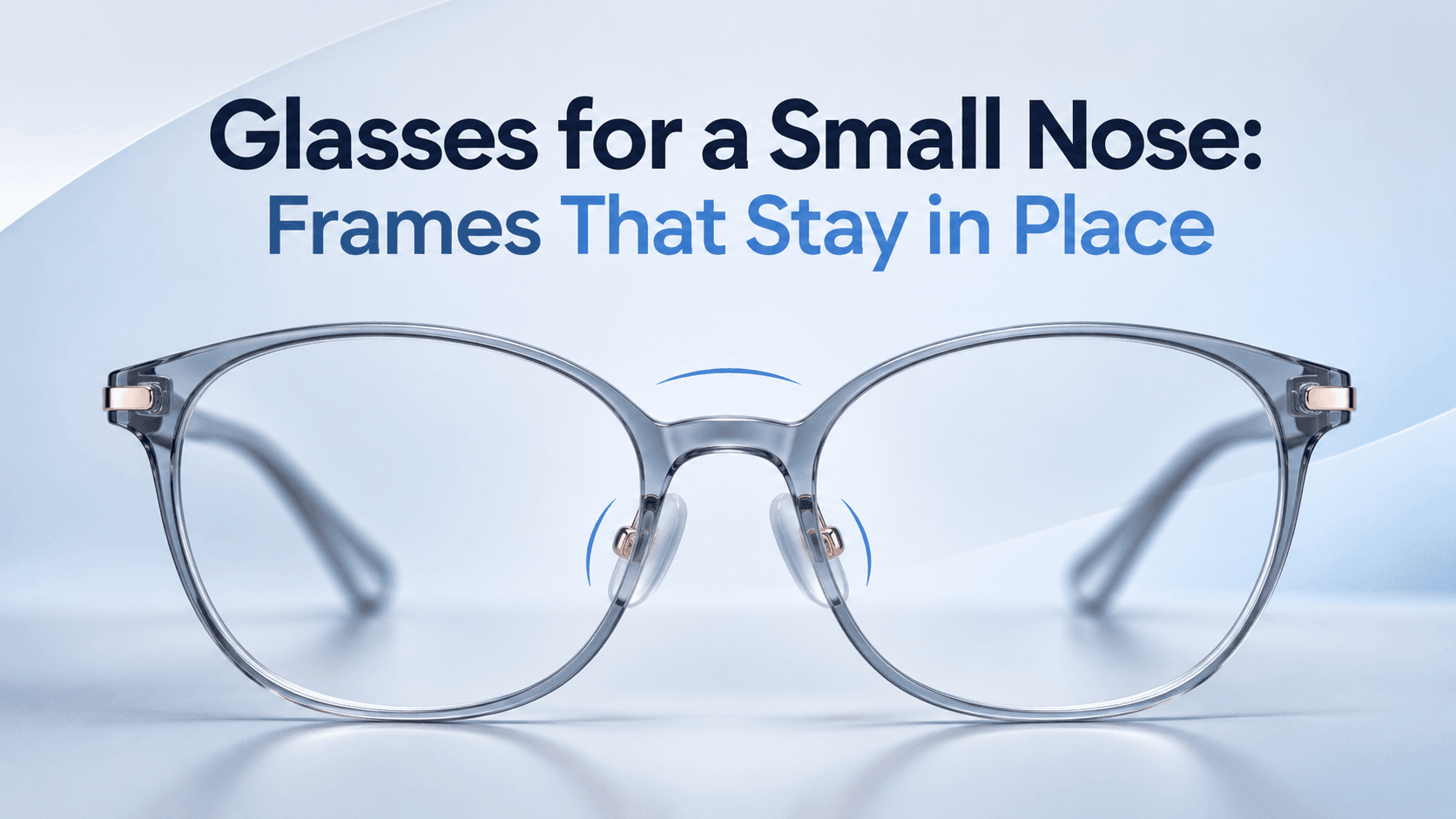
If your glasses constantly slide down your nose or sit unevenly on your face, the problem is almost certainly the nose bridge fit — not your prescription. People with a small or low nose bridge need frames designed to sit higher and grip without pinching. The right frame shape, bridge width, and nose-pad style make all the difference between glasses that stay put and glasses you are forever pushing back up.
Why Do Glasses Slide on a Small Nose?
Standard frames are designed with a nose bridge height of roughly 18–21 mm, which suits a prominent, high-set nose. If your nose bridge sits lower or is narrower than average — common across many South Asian face types — the frame rests on flat cartilage rather than on a bony ridge, giving it nothing to grip. The result is constant slipping, uneven sitting, and red marks on the sides of your nose.
What Frame Features Should You Look For?
Low or Zero-Gap Nose Bridge
Frames labelled low bridge fit or universal fit are built with a shorter distance between the lenses so the bridge makes contact with your nose instead of floating above it. This single feature alone prevents most of the slipping people with small noses experience.
Adjustable Silicone Nose Pads
Metal frames with adjustable silicone nose pads can be bent inward to grip a narrow bridge firmly. An optician can angle them to match your exact nose width in under two minutes. Avoid frames with moulded plastic nose pieces that cannot be adjusted at all.
Lightweight Frames
Heavier frames put more downward pressure on a flat bridge, accelerating the slide. Opt for lightweight materials — titanium, thin acetate, or TR-90 — to reduce that force. Lighter frames also mean less red-mark pressure on the sides of your nose.
Keyhole and Saddle Bridge Designs
A keyhole bridge dips down in a rounded notch shape and rests naturally on a low, rounded nose. A saddle bridge spans both sides of the bridge continuously, distributing weight evenly. Both designs outperform a standard flat bridge on a small nose.
Frame Styles That Work Best
Beyond technical fit features, certain silhouettes complement a small nose visually while also staying stable:
Round and oval frames add soft width without overwhelming a small nose.
Cat-eye shapes draw attention upward, balancing petite nose features beautifully.
Rimless and semi-rimless frames are lighter and reduce visual bulk on a narrow face.
Smaller frame widths (less than 130 mm total) prevent frames from sliding outward on a narrow nose.
Frames to Avoid
Oversized or very wide frames shift the centre of gravity outward and slide more readily on a small nose. Thick, heavy acetate frames with no adjustable nose pads are also poor choices. Very heavy geometric frames — especially square styles with thick corners — tend to tilt and sit unevenly.
Quick Fixes While You Shop
While you search for the ideal pair, anti-slip nose-pad grips (small silicone stickers) can be added to existing frames and cost under ₹100. Temple arms with a tighter curl behind the ear also reduce sliding. These are short-term fixes; the right frame fit is always the long-term solution.
At Rimloo, you can filter by bridge width and nose-pad style to find frames built for your face from the start — no adjustments required.
