
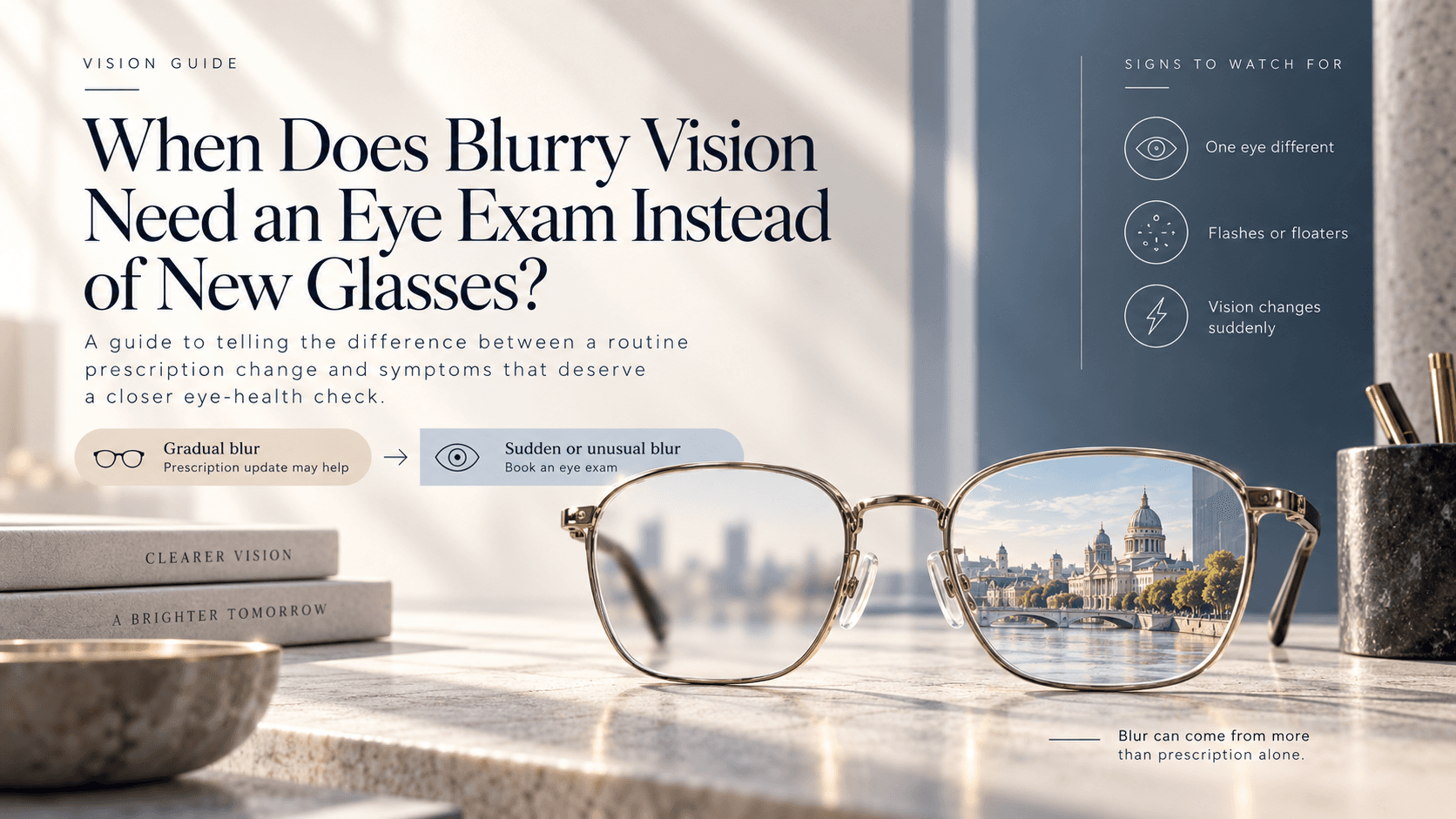
When Does Blurry Vision Need an Eye Exam Instead of New Glasses?
You notice that road signs are no longer quite as sharp.
Small print requires more effort.
Or perhaps your current glasses simply do not seem as clear as they used to.
The natural reaction is:
“I probably need stronger glasses.”
Sometimes that is exactly what is happening.
Nearsightedness, farsightedness, astigmatism and presbyopia are refractive errors that can cause blurry vision, and updated eyeglasses are often the appropriate solution. The National Eye Institute identifies blurry vision as the most common symptom of refractive errors and notes that these conditions are diagnosed during an eye exam.
But blur is a symptom, not a diagnosis.
Sometimes the more important question is not:
“What prescription should I order?”
It is:
“Why has my vision changed?”
When Blurry Vision Probably Does Point Toward a Prescription Change
A refractive change often follows a fairly predictable pattern.
Distance Is Gradually Getting Softer
If you are nearsighted, you may start noticing that:
road signs are harder to read
subtitles look slightly fuzzy
faces across a room seem less defined
you squint more frequently
Nearsightedness causes distant objects to appear blurry and is commonly corrected with eyeglasses or contact lenses.
Close Work Is Becoming Harder
If you have entered your 40s or beyond, gradually increasing difficulty with close-up vision may be related to presbyopia.
You might:
hold your phone farther away
increase text size
need more light for reading
experience fatigue after close work
Presbyopia typically develops gradually as the eye loses some of its ability to focus at near distances.
These situations still require an eye examination to establish the correct prescription, but the final solution may indeed be updated glasses.
Once your prescription and lens needs have been determined, you can explore eyeglasses at Rimloo while considering frame fit, lens type and your everyday visual needs.
Blurry Vision While Wearing Glasses Deserves a Check
Suppose your current glasses once gave you crisp vision.
Now they do not.
A prescription change is possible, but it should not simply be assumed.
The National Eye Institute specifically advises seeing an eye doctor if you are not seeing in focus even while wearing your glasses or contacts.
An examination can distinguish between:
a refractive change
dry-eye-related blur
lens or frame positioning
cataract development
retinal or other eye-health changes
This matters because stronger glasses cannot correct every cause of reduced vision.
Sudden Blur Is Different From Gradual Blur
One of the most important clues is speed.
A prescription usually does not transform dramatically within a few minutes.
If your vision suddenly becomes blurry, hazy or significantly reduced, especially in one eye, that is not something to solve by ordering another pair of glasses.
Mayo Clinic recommends urgent medical assessment for sudden vision changes, particularly when associated with symptoms including vision loss, double vision, severe eye pain, flashes, floaters, severe headache, nausea or neurological symptoms.
The rule is simple:
Gradual blur → arrange an eye exam.
Sudden major blur → seek prompt medical evaluation.
New Floaters or Flashes Are Not a Glasses Problem
A few longstanding floaters may be familiar to many people.
But a sudden shower of new floaters, flashing lights or a sudden reduction in vision can indicate a retinal problem.
Mayo Clinic recommends immediate attention for sudden floaters, flashes or reduced vision because these can be warning signs of serious retinal disease.
Changing your prescription will not address a retinal problem.
Pay Attention to Distorted Vision
Blur and distortion are not exactly the same.
Blur means something looks out of focus.
Distortion can mean:
straight lines look wavy
text appears bent
part of an image seems stretched
a central area appears missing or warped
Those symptoms deserve an eye examination rather than a casual glasses update.
Retinal conditions can cause blurred or distorted vision, visual-field defects and vision loss.
Why Diabetes Changes the Conversation
If you have diabetes and your vision changes, an eye examination becomes particularly important.
Blood-glucose changes can temporarily affect the eye's focusing system, while diabetes can also damage retinal blood vessels over time.
The CDC lists blurry vision among possible diabetes-related visual symptoms and recommends regular dilated eye examinations because diabetic retinopathy can develop and threaten vision.
If your prescription seems to fluctuate repeatedly, simply ordering different lenses each time may miss the underlying reason.
Could It Just Be Dry Eyes?
Yes.
Dryness can make vision fluctuate throughout the day.
A common pattern is:
blurry → blink → clearer → blurry again
That happens because your tear film forms part of the eye's optical surface.
You may notice more blur:
after long screen sessions
in air-conditioning
toward the end of the day
while driving
when blinking less
If this pattern happens frequently, mention it during your eye examination rather than assuming you need stronger lenses.
One Eye Blurry, One Eye Clear?
Do not ignore this.
A normal prescription change can certainly affect one eye more than the other, but a significant new difference between the two eyes should be professionally assessed.
Try looking at an object with:
both eyes → right eye only → left eye only
If one eye is dramatically blurrier, distorted or missing part of the image, arrange an eye examination.
A Comprehensive Exam Checks More Than Your Prescription
A refraction determines what lens power gives you the clearest vision.
But an eye examination can also evaluate structures inside the eye.
During a comprehensive dilated examination, an eye-care professional can check for refractive errors and signs of conditions including cataracts, glaucoma, macular disease and diabetic eye disease.
That is why there is an important difference between:
“getting stronger glasses”
and
“finding out why vision changed.”
Once an eye-care professional confirms that a refractive update is the main issue, you can browse eyewear at Rimloo for frames that work with your prescribed lens requirements.
When Should You Book an Eye Exam?
Arrange an eye examination if:
your glasses no longer give clear vision
blur keeps returning
distance or near vision is progressively worsening
one eye is significantly blurrier
halos or glare have noticeably increased
you frequently experience eye strain or headaches
reading or driving has become difficult
straight lines appear distorted
your prescription seems to change unusually often
you have diabetes and notice a vision change
Seek urgent medical attention for:
sudden vision loss
sudden significant blur
sudden double vision
new flashes and many floaters
severe eye pain
major blind spots
sudden neurological symptoms with visual change.
The Bottom Line
Blurry vision does not automatically mean:
“I need stronger glasses.”
Sometimes it does.
A gradual change in nearsightedness, farsightedness, astigmatism or presbyopia can often be corrected with an updated prescription.
But blur can also come from the surface of the eye, the natural lens, the retina or other health conditions.
The most useful question is:
“Is my eye simply focusing incorrectly—or is something affecting how the eye sees?”
An eye examination can answer both questions.
Get the cause checked first.
Then choose the glasses that correct what actually needs correcting.
