
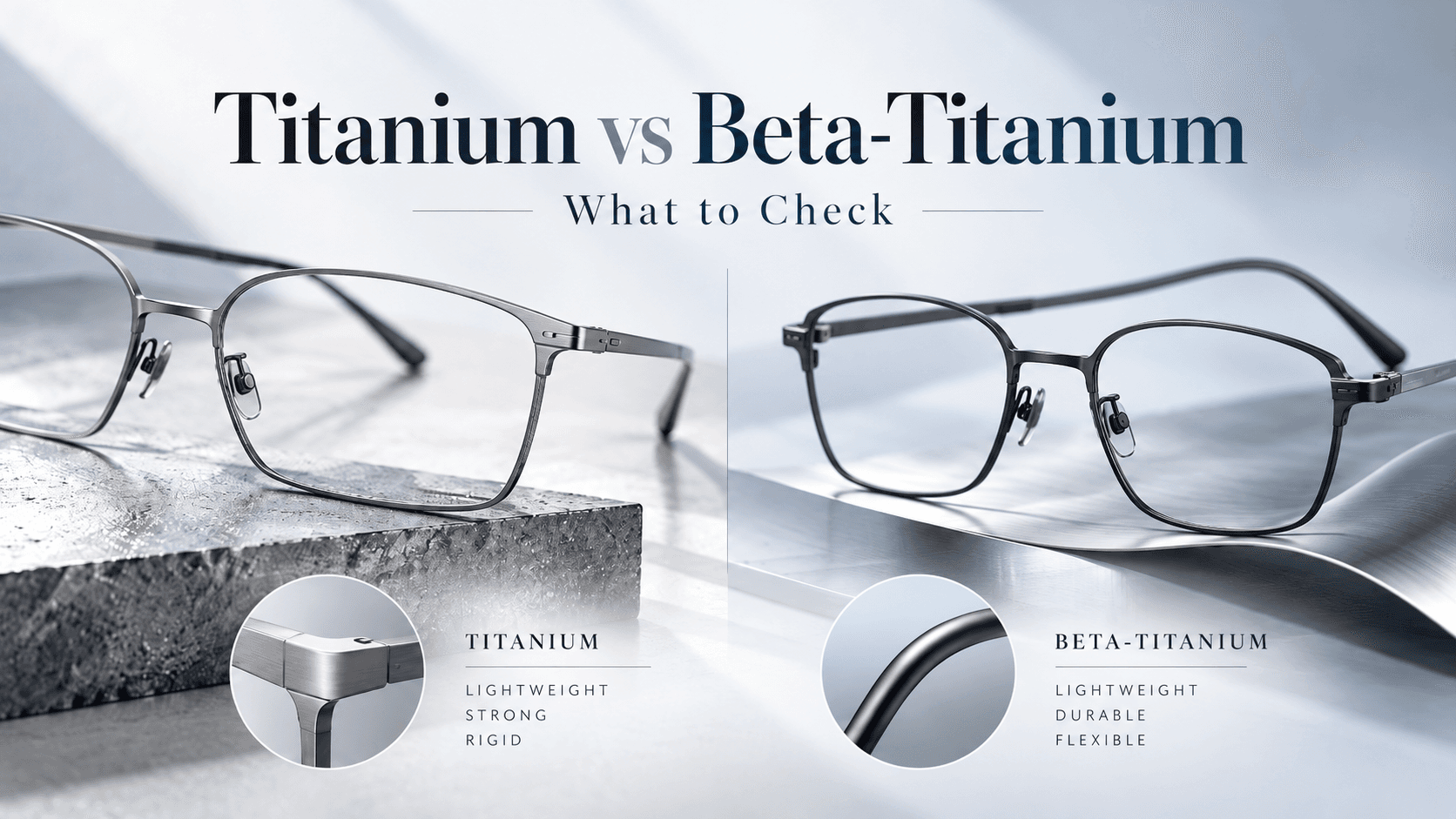
Titanium and beta-titanium frames are both excellent choices for long-term wear, but they are not the same material. Pure titanium is stiffer and highly corrosion-resistant, while beta-titanium is an alloy that adds flexibility and springiness. If you want maximum rigidity and hypoallergenic assurance, go with pure titanium. If you need a frame that bends back into shape after accidental stress, beta-titanium is the smarter pick.
What Exactly Is Pure Titanium?
Pure titanium (often marked Ti-P on the temple) contains at least 99% titanium. It is roughly 45% lighter than steel, completely nickel-free, and resists sweat and salt water corrosion better than most metals. The trade-off is that it is relatively rigid — an optician needs tools to adjust the fit, and a hard drop can cause a permanent bend.
What Is Beta-Titanium and How Is It Different?
Beta-titanium is a titanium alloy that typically mixes small amounts of vanadium or molybdenum into the metal matrix. The result is a frame that is up to 40% more flexible than pure titanium. It springs back to its original shape after mild deformation, making it ideal for active lifestyles or for people who frequently remove their glasses with one hand. It is still nickel-free and hypoallergenic, so skin sensitivity is rarely a concern.
Key Differences at a Glance
Flexibility: Beta-titanium flexes and recovers; pure titanium holds its shape rigidly.
Weight: Both are ultralight, though beta-titanium alloys can be marginally heavier depending on the blend.
Adjustability: Pure titanium requires professional adjustment; beta-titanium temples adjust more easily.
Durability under impact: Pure titanium can bend permanently; beta-titanium rebounds from mild stress.
Cost: Pure titanium is generally less expensive to produce than high-grade beta-titanium alloys.
Hypoallergenic rating: Both are nickel-free and safe for sensitive skin.
When Should You Choose Pure Titanium?
Pure titanium suits wearers who prefer a structured, stable fit throughout the day — especially for high-prescription lenses that need precise optical alignment. It is a strong match for office professionals, older wearers, and anyone who keeps their glasses on a stand rather than stuffing them into a bag. The stiffness that limits flexibility also means the frame holds its exact geometry for years.
When Should You Choose Beta-Titanium?
Beta-titanium is better for active adults, frequent travellers, and anyone with a narrower or wider face who struggles to find a perfect off-the-shelf fit. The self-adjusting spring quality means minor misalignments correct themselves. It is also the preferred choice for rimless and semi-rimless constructions, where the frame must flex slightly at the drill points without cracking.
What to Check Before You Buy
First, look for a Ti-P (pure titanium) or β-Ti (beta-titanium) stamp on the inside of the temple arm — reputable manufacturers always mark this. Second, check whether the hinge is a spring hinge; beta-titanium frames without spring hinges lose their chief advantage. Third, verify the nose pads are also metal or silicone rather than plastic, since plastic pads are more likely to fail before the frame does. Finally, confirm the lens retention method — beta-titanium works best with screwless or nylon-cord retention in rimless styles, while pure titanium suits full-rim and half-rim constructions equally well.
Both materials represent the upper tier of eyewear engineering. The right call depends on your daily routine, face geometry, and how you handle your glasses. Get those details right and either frame will last you well over a decade.
