
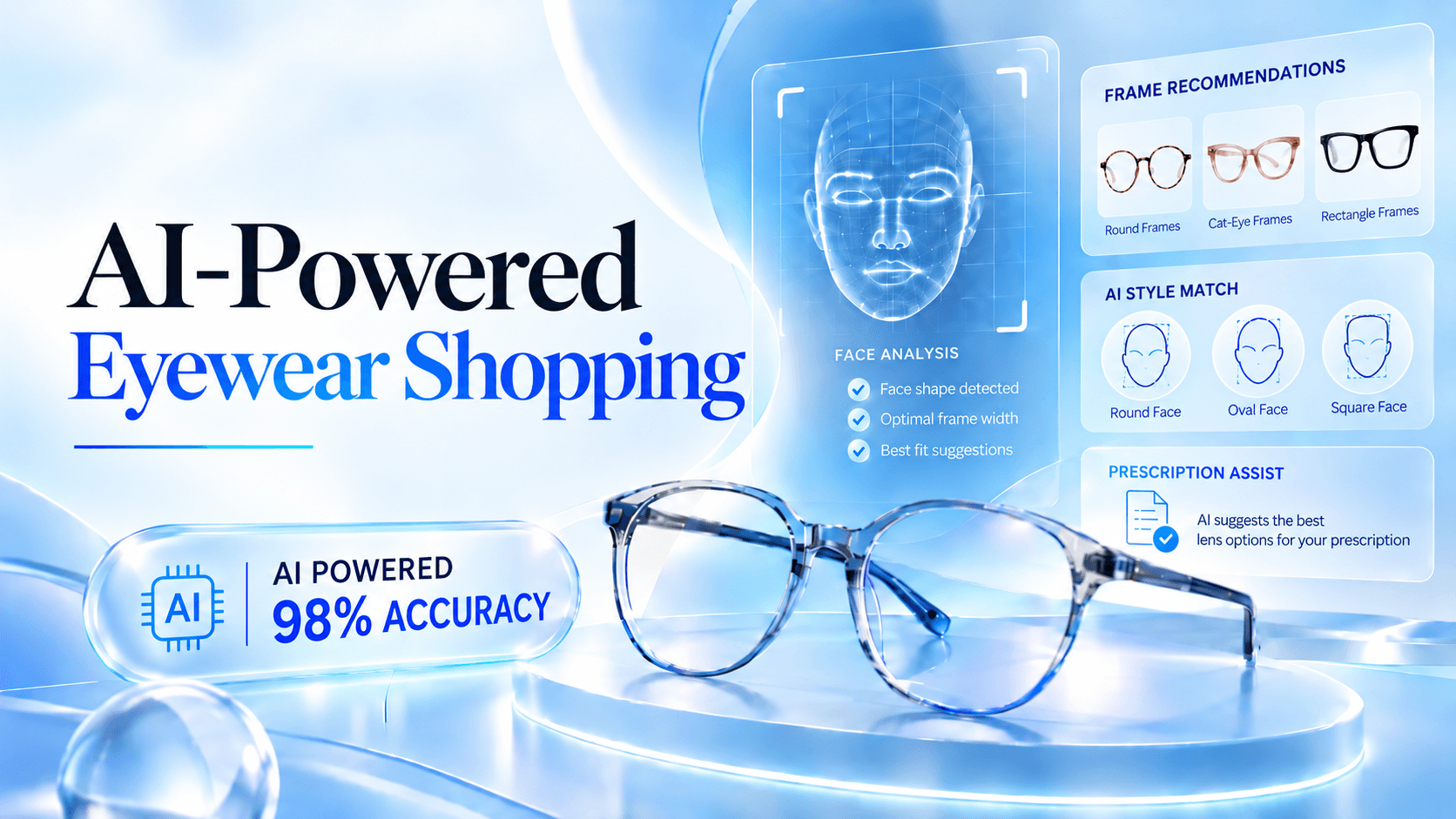
AI has fundamentally changed online eyewear retail by automating three things that once required an optician in the room: reading your face geometry, matching frames to it, and recommending the correct lens based on your prescription and lifestyle. The result is a smarter, faster shopping experience that cuts guesswork and returns.
How Does AI Face Analysis Work for Eyewear?
When you upload a selfie or use your phone's front camera on an AI-powered eyewear platform, the system maps dozens of facial landmarks—the width of your forehead, the distance between your pupils, the angle of your jawline, and the prominence of your cheekbones. These measurements are then compared against a database of frame geometries to surface styles that will balance and complement your specific face shape.
The technology draws on computer vision models trained on thousands of face-frame pairings, learning which combinations look proportional and which feel off. For Indian consumers, where face profiles vary significantly across regions, this kind of data-driven matching is far more reliable than a generic style guide.
Virtual Try-On vs. Static Product Images: Why It Matters
Traditional online shopping asks you to mentally project a frame onto your face from a flat product photo. Virtual try-on powered by augmented reality (AR) and AI overlays the actual frame—scaled to your facial dimensions—in real time. You see depth, width, and proportion rather than guessing. Studies consistently show that virtual try-on reduces return rates and increases purchase confidence, both critical metrics for eyewear where fit is everything.
AI-Driven Lens Recommendations: Beyond the Basics
Choosing the right lens is at least as important as choosing the right frame, and this is where AI adds serious value. By analysing your uploaded prescription, your stated screen time, your outdoor habits, and even your geographic location, an AI recommendation engine can suggest:
Anti-reflective coatings for heavy screen users
Blue-light filtering lenses for those logging long hours on laptops and phones
Photochromic lenses for commuters who move between indoor and outdoor environments frequently
High-index lenses for stronger prescriptions where thinner, lighter material matters
UV400 sunglasses lenses matched to the UV index of your city
This kind of contextual recommendation was previously only possible in a well-staffed optical store. AI brings it to a mobile screen at midnight.
What Rimloo Is Building
At Rimloo, we believe technology should serve clarity—literally. Our platform integrates face-shape guidance with curated frame recommendations, and our prescription upload flow is designed to catch errors before your lenses are cut. We are investing in AI tools that make the gap between an online purchase and a perfectly fitted pair of glasses as small as possible. The goal is not novelty; it is accuracy.
The Honest Limitation
AI is powerful, but it is not yet infallible. Screen lighting, selfie angles, and camera quality all affect the accuracy of face analysis. Prescription interpretation still benefits from a licensed optometrist's review for complex cases like high cylinders or prism corrections. Use AI as a strong first filter, not as a replacement for professional optical advice when your vision demands it.
