
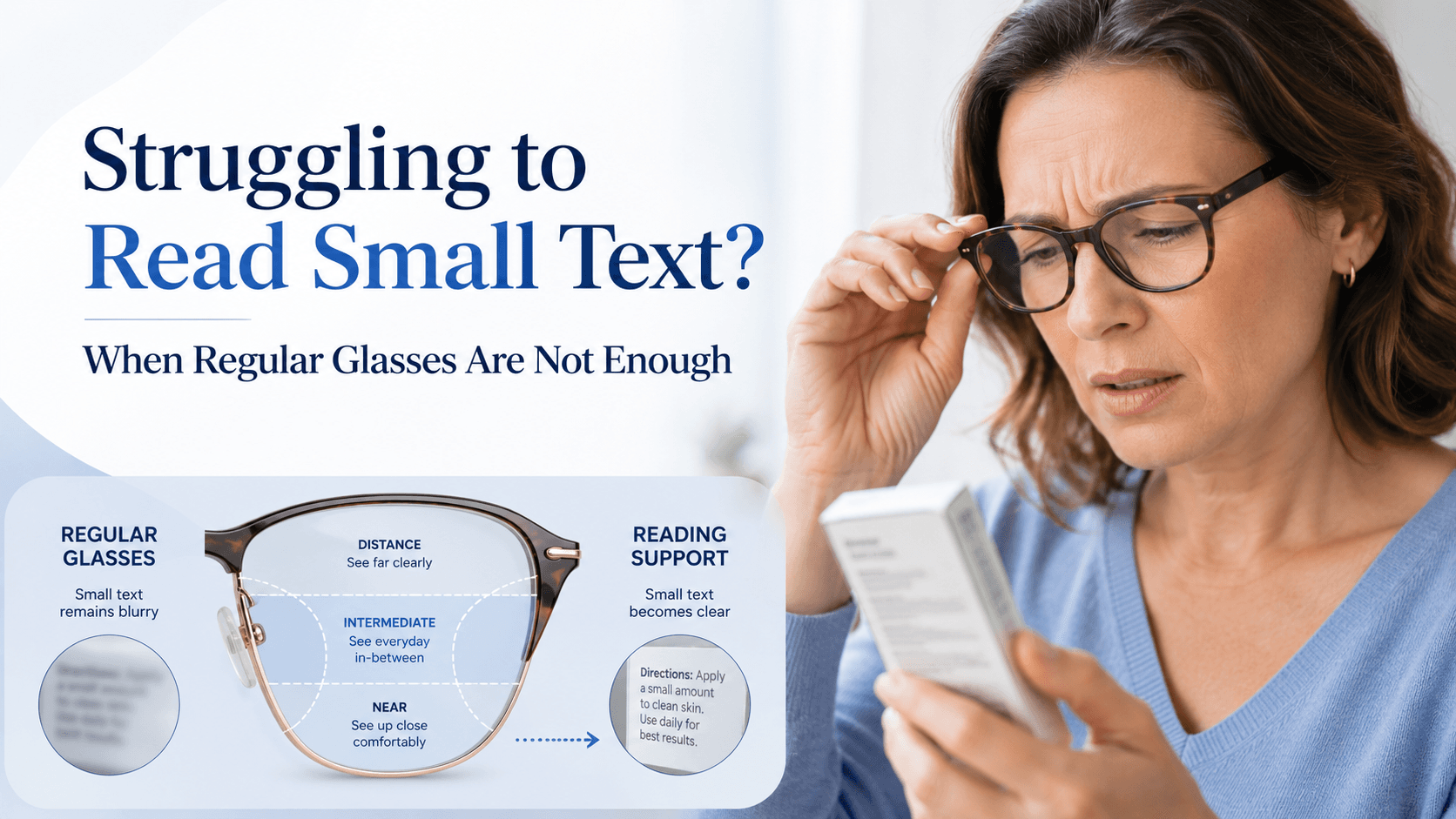
If you wear glasses but still struggle to read small text — on your phone, a medicine label, or a restaurant menu — your lenses are probably not the right type for close-up work. Most adults over 40 develop presbyopia, an age-related loss of near-focus ability that single-vision distance glasses cannot correct on their own. The fix is a reading prescription, progressive lenses, or dedicated reading glasses, depending on your lifestyle and existing correction.
Why Do Your Glasses Stop Working for Small Text?
Your eye contains a flexible lens that changes shape to focus at different distances — a process called accommodation. From your mid-40s onward, this lens gradually stiffens. Even if your distance vision is perfect with your current glasses, your eye can no longer flex enough to bring close objects into sharp focus. This is presbyopia, and it is completely normal.
Presbyopia is separate from short-sightedness (myopia), long-sightedness (hyperopia), or astigmatism. You can have all of these conditions at the same time, which is why your glasses prescription has multiple values and why a one-size solution rarely works once presbyopia sets in.
Signs Your Current Glasses Are Not Enough for Near Vision
You hold your phone, book, or newspaper farther away than you used to
You remove your glasses entirely to read fine print
Text looks clear at first but blurs after a few minutes of reading
You get headaches or eye fatigue after close work
Bright light helps you read — but should not have to
You find yourself enlarging font size on every app
Single-Vision Reading Glasses vs Progressive Lenses: Which Is Right for You?
Single-vision reading glasses are optimised for one fixed distance — typically 33–40 cm (the standard reading distance). They are affordable, widely available, and excellent if you only need near correction and do not already wear distance glasses. Their limitation: everything beyond arm's length will be blurry while you wear them.
Progressive lenses (also called no-line bifocals) have a gradient of powers built into a single lens — distance at the top, intermediate in the middle, near at the bottom. They let you see clearly at all distances without switching glasses. They do require a short adaptation period and cost more than single-vision lenses, but for anyone who needs both distance and near correction, they are the most convenient option.
Bifocal lenses offer a visible dividing line between the distance and reading zones. They are easier to adapt to than progressives and cost less, but many wearers find the line aesthetically distracting.
What Does a Reading Prescription Actually Look Like?
A reading prescription includes an ADD value — short for addition power — typically ranging from +0.75 to +3.50 diopters. This ADD is added on top of your existing sphere power to boost near focus. Your optometrist measures this during a comprehensive eye exam; you cannot determine your ADD by trial-and-error with over-the-counter reading glasses.
Over-the-counter readers use the same power in both lenses and assume your eyes are equal — which is rarely true. A proper dispensed pair accounts for your individual sphere, cylinder, axis, and ADD, giving you significantly sharper, more comfortable near vision.
Can You Use Over-the-Counter Reading Glasses?
OTC readers are a convenient, low-cost stopgap, and for people with mild presbyopia and no other refractive error they can work reasonably well. However, if you have astigmatism, a significant difference between your two eyes, or moderate-to-high presbyopia, OTC glasses often cause distortion, double vision, or headaches. Think of them as a temporary solution — not a substitute for a proper prescription.
When Should You See an Optometrist?
Book a comprehensive eye exam if you notice any of the following: near-vision blur that appeared or worsened in the last year, eye strain or headaches after reading, difficulty seeing under low light, or sudden changes in any part of your vision. Presbyopia is benign, but sudden vision changes can occasionally signal conditions like glaucoma or early cataract formation that need prompt attention.
Choosing the Right Lenses for Your Reading Glasses
Once you have your prescription, lens choice matters as much as frame style. Consider anti-reflective (AR) coating to cut glare from screens and overhead lighting — essential for comfortable near work. A blue-light filter is worth adding if you read on digital devices for more than two hours a day, as it can reduce screen-related eye fatigue. High-index lenses keep the glasses light and slim even at higher ADD powers.
At Rimloo, you can upload your prescription and select your preferred lens options when ordering — making it straightforward to get a properly dispensed pair without visiting a physical store.
Key Takeaways
Struggling to read small text while already wearing glasses is not a sign that glasses do not work — it is a sign that your glasses are not designed for near vision. Understanding presbyopia, getting an updated eye exam, and choosing the right lens type (progressive, bifocal, reading, or occupational) will restore comfortable, clear near vision.
