
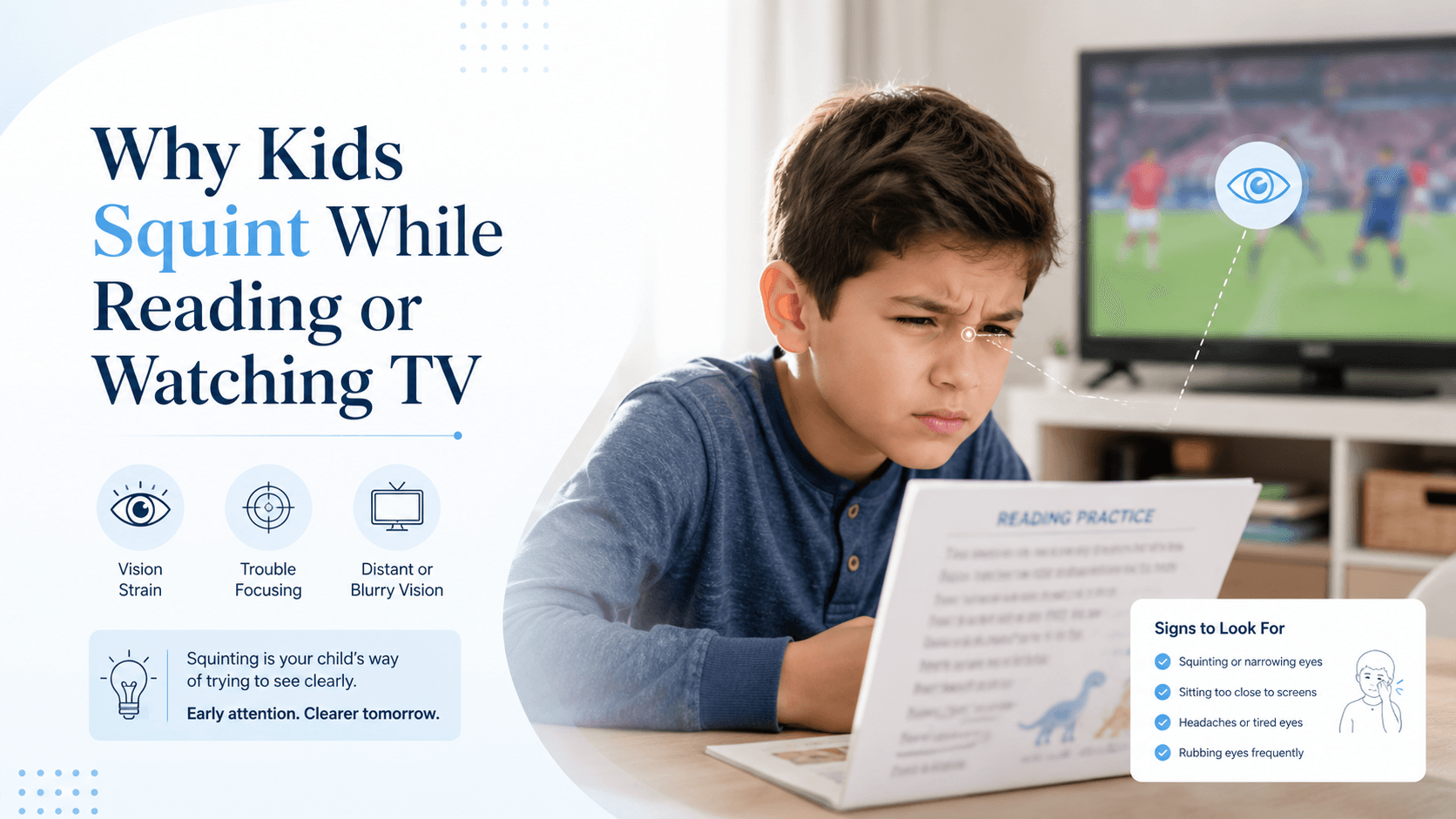
When a child squints while reading or watching TV, it almost always means their eyes are working harder than they should to bring an image into focus. Squinting narrows the pupil opening and temporarily sharpens blurry vision — it is the eye's built-in workaround for refractive errors like myopia, hyperopia, or astigmatism. If you notice it happening regularly, a professional eye exam is the right next step.
What Happens When a Child Squints?
Squinting reduces the amount of light entering the eye and limits the angle at which light rays hit the retina. This mimics the effect of a corrective lens and produces a momentarily clearer image. While it is a clever reflex, habitual squinting is a strong signal that the eyes are not focusing correctly on their own. It is not something children grow out of without addressing the underlying cause.
Common Vision Problems That Cause Squinting in Children
Myopia (Nearsightedness)
Myopia is the most common reason children squint at a TV or whiteboard. Distant objects appear blurry because the eyeball is slightly too long, causing light to focus in front of the retina instead of on it. Myopia in children is rising rapidly in India, with screen time and reduced outdoor activity cited as contributing factors. A child with myopia will squint more at faraway objects and feel perfectly comfortable reading a book held close.
Hyperopia (Farsightedness)
Mildly farsighted children can sometimes compensate naturally using their eye muscles, but moderate to high hyperopia causes blurry vision at close range. These children may squint while reading or doing homework. Because the effort of constant focusing is exhausting, they may also complain of headaches or eye strain after reading sessions.
Astigmatism
Astigmatism occurs when the cornea or lens has an irregular curve, causing light to scatter rather than focus on a single point. Both near and distant objects appear distorted or doubled. Children with astigmatism often squint at all distances and may tilt their head to one side to find a clearer line of sight.
Accommodative Esotropia
In some children, the extra focusing effort required by uncorrected farsightedness triggers one eye to turn inward. This condition, called accommodative esotropia, is different from simple squinting and requires prompt medical attention. If you notice one of your child's eyes drifting inward, see a paediatric ophthalmologist immediately rather than waiting for a routine check-up.
Squinting vs. Normal Eye Blinking — How to Tell the Difference
Occasional blinking or momentary squinting in bright light is completely normal. The pattern that warrants concern looks like this: the child consistently narrows their eyes when looking at the TV, holds reading material very close to their face, loses their place frequently while reading, or complains that letters are blurry. If squinting is paired with headaches, rubbing the eyes, or avoiding reading altogether, treat it as a clear prompt to book an eye test.
At What Age Should Children Have Their First Eye Exam?
The Indian Academy of Ophthalmology recommends an eye check before a child starts school, ideally around age 3 to 5, and then annually once they begin formal education. Many refractive errors are easily corrected when caught early. Delayed diagnosis, on the other hand, can lead to amblyopia (lazy eye) — a condition where the brain starts to ignore input from the weaker eye, reducing vision permanently if not treated before age 7 to 8.
Can Screen Time Make Squinting Worse?
Screens themselves do not cause myopia, but prolonged near-work — including reading and device use — is associated with its progression in children already predisposed to it. The 20-20-20 rule is a practical starting point: every 20 minutes of near work, look at something 20 feet away for 20 seconds. Ensuring children spend at least 1 to 2 hours outdoors daily has been shown in multiple studies to slow the onset and progression of myopia.
What to Do If Your Child Keeps Squinting
Start with a comprehensive eye examination by a qualified optometrist or ophthalmologist. The doctor will measure refractive error, check eye muscle coordination, and assess overall eye health. If a prescription is needed, children's eyeglasses today are lightweight, durable, and available in flexible frames designed for active kids. Early correction not only improves vision immediately but also protects long-term eye development.
Choosing the Right Glasses for Children
Children's frames need to withstand daily wear, so look for frames made from TR-90 or similar flexible materials. Polycarbonate lenses are the standard recommendation for children because they are impact-resistant and significantly lighter than standard plastic. An anti-reflective coating reduces glare from screens and classroom lighting, making it easier for children to focus without strain. If your child spends time outdoors, photochromic lenses that darken in sunlight offer convenient UV protection without needing a separate pair of sunglasses.
When Squinting Is Not About Refractive Error
Less commonly, squinting can signal other conditions: a muscle imbalance (strabismus), a drooping eyelid (ptosis) that partially blocks vision, or in rare cases, more serious conditions like childhood cataracts or retinoblastoma. Any squinting accompanied by a white or yellowish reflection in the pupil in photos, or a visible eye turn, requires urgent medical review — do not delay in favour of a routine appointment.
Key Takeaway for Parents
Squinting is rarely just a habit. It is the eye signalling that something is off with how it is focusing light. Catching and correcting a refractive error early gives your child a significant academic and developmental advantage — and spares them years of unnecessary eye strain.
