
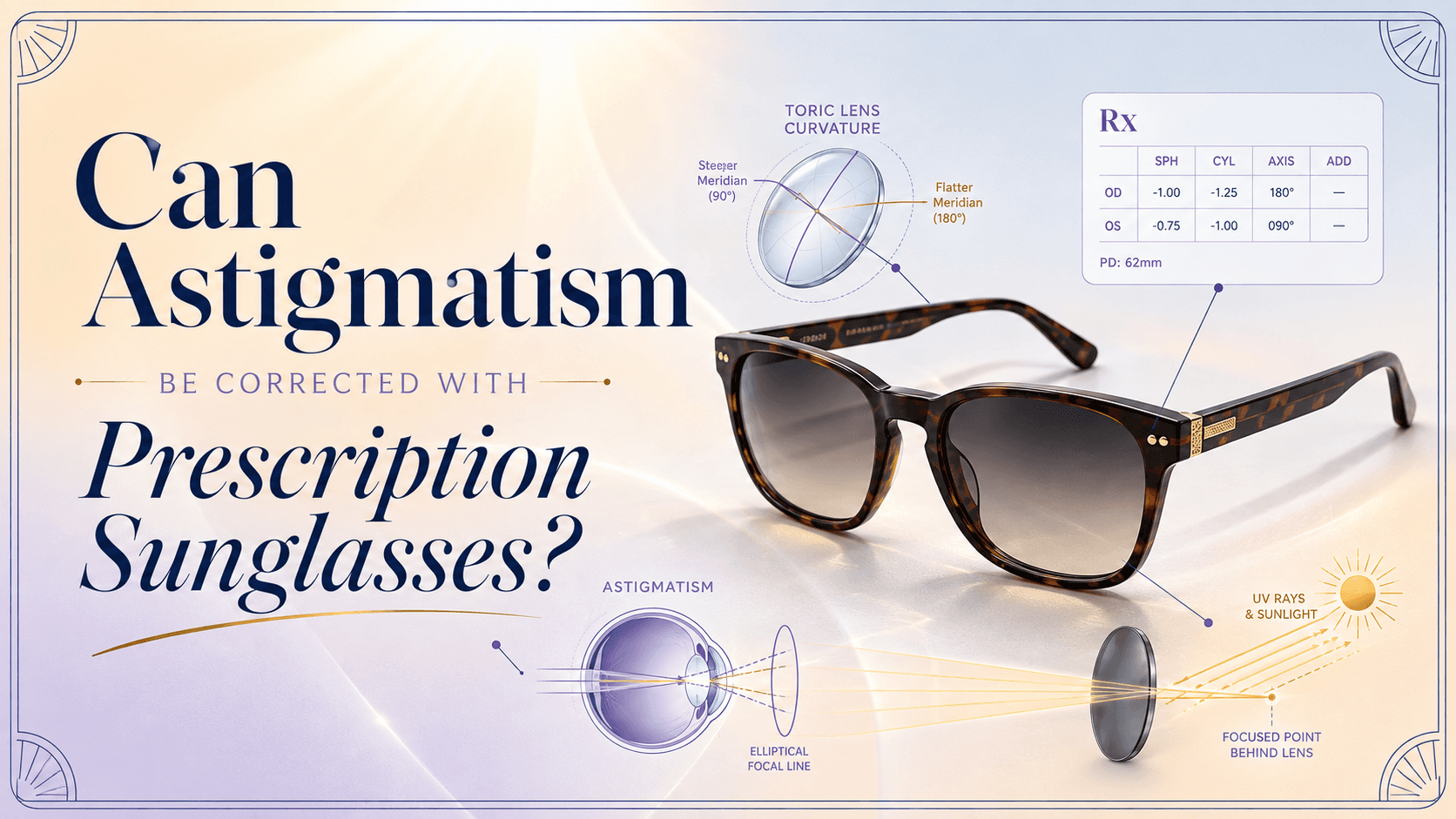
Yes, astigmatism can be fully corrected with prescription sunglasses. Opticians use toric lenses — specially shaped lenses that compensate for the uneven curvature of your cornea or lens — and fit them into sunglass frames of your choice. The result is clear, comfortable outdoor vision without the blur or glare that people with uncorrected astigmatism often experience in bright light.
What Is Astigmatism and Why Does It Affect Your Outdoor Vision?
Astigmatism occurs when the cornea or the eye's internal lens is shaped more like a rugby ball than a perfect sphere. This irregular curvature means light focuses on multiple points instead of one, causing blurred or distorted vision at all distances. Bright sunlight and glare can make this distortion worse, which is why many people with astigmatism find outdoor activities — driving, playing sport, or even a walk in the afternoon sun — particularly uncomfortable without the right correction.
How Do Prescription Sunglasses Correct Astigmatism?
Prescription sunglasses for astigmatism use toric lenses. Unlike standard spherical lenses, a toric lens has two different curvatures ground into it, each targeting a different axis of your astigmatism. Your optometrist measures these axes — captured in the cylinder (CYL) and axis values on your prescription — and the lab cuts the lens accordingly. The lens is then tinted or coated to function as a sunglass lens, without compromising the refractive correction.
What Lens Options Are Available for Astigmatism in Sunglasses?
When ordering prescription sunglasses for astigmatism, you have several lens choices:
Tinted toric lenses — the most straightforward option, available in grey, brown, or green tints that reduce brightness while correcting your vision.
Polarised toric lenses — ideal if you drive or spend time near water, as the polarised filter eliminates horizontal glare on top of providing astigmatism correction.
Photochromic toric lenses — these darken outdoors and clear indoors, giving you one pair that works in both environments.
High-index toric lenses — recommended for stronger prescriptions (typically above ±4.00 D) because the thinner material keeps the lenses light and cosmetically slim.
Prescription Sunglasses vs Contact Lenses for Astigmatism: Which Is Better Outdoors?
Toric contact lenses are another option for astigmatism correction outdoors, but they come with trade-offs. Contacts can dry out in wind and UV-exposed environments, and they require you to wear non-prescription sunglasses on top. Prescription sunglasses combine correction and UV protection in one step, with no insertion or hygiene routine. For regular outdoor use — especially driving or sport — prescription sunglasses are generally the more practical choice.
How to Read Your Prescription Before Ordering
Your eyeglass prescription will list SPH (sphere), CYL (cylinder), and Axis values for each eye. If your CYL column has a number (positive or negative) and an Axis value between 1° and 180°, you have astigmatism. Share this full prescription with Rimloo when ordering — our optical team uses every value to ensure your sunglasses are ground to your exact specification. A prescription that is less than two years old is ideal for the most accurate result.
Tips for Getting the Most From Your Prescription Sunglasses
Once you receive your prescription sunglasses, give your eyes two to three days to adapt, especially if your previous pair had a different prescription or no correction at all. Keep lenses clean using a microfibre cloth and lens-safe spray to maintain optical clarity and coating integrity. Store them in a hard case when not in use to protect the toric geometry of the lenses from warping or scratching.
