
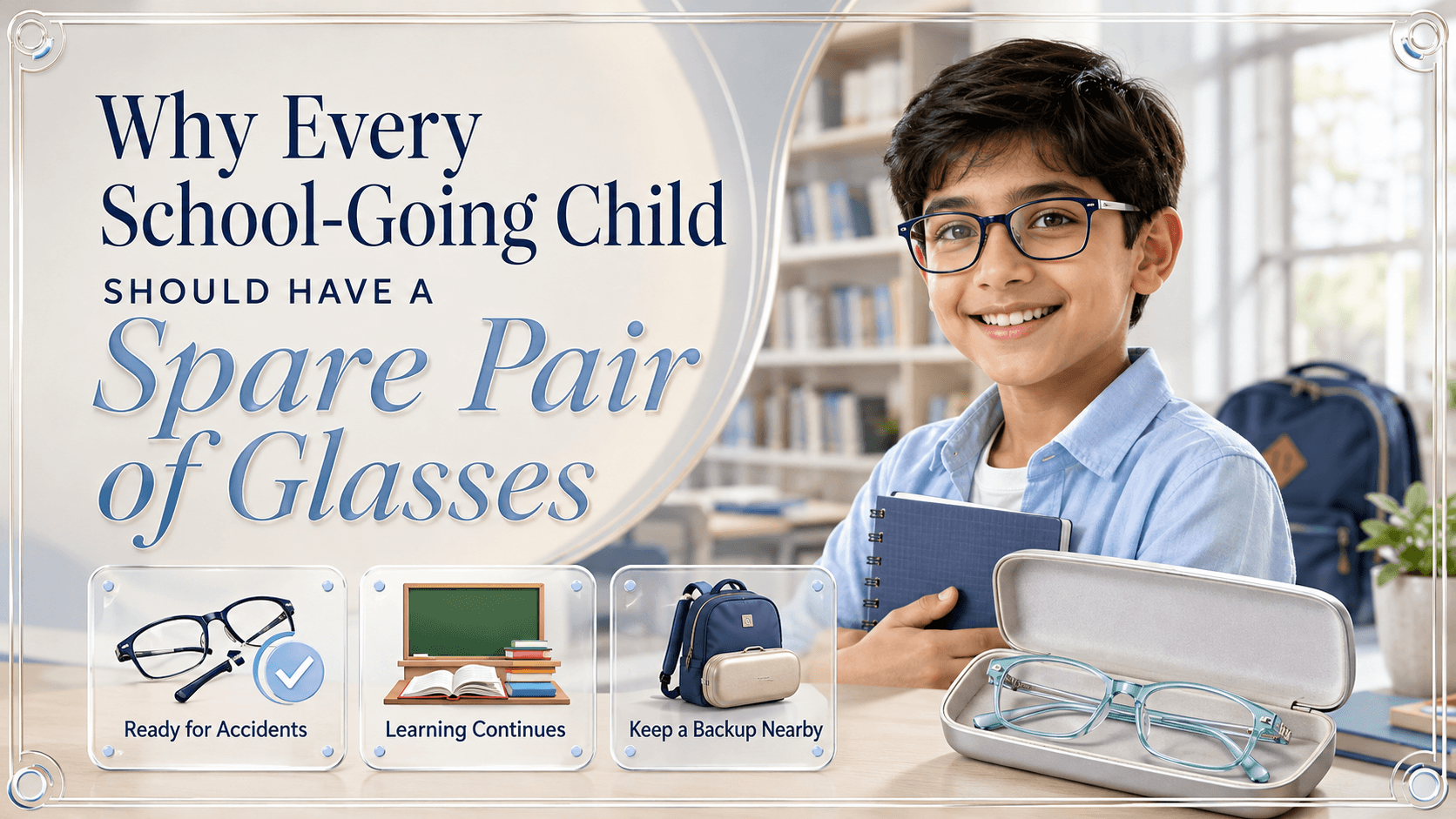
Every school-going child who wears prescription glasses needs a spare pair — full stop. Kids are active, glasses get sat on, dropped, and scratched, and a single day without clear vision can mean missed notes, eye strain, and unnecessary stress. A backup pair is not a luxury; it is a basic part of responsible vision care for children.
What Happens When a Child's Only Pair Breaks?
A cracked frame or a badly scratched lens is not just an inconvenience. For a child with moderate to high myopia or astigmatism, going without glasses even for one school day means blurry blackboards, difficulty reading, and the risk of developing headaches. Repeated episodes of uncorrected vision during school hours can affect academic performance over time. Teachers may also misread a squinting child as inattentive rather than visually impaired.
How Often Do Children Break or Lose Glasses?
Studies on paediatric eyewear consistently show that children break or lose at least one pair of glasses per year on average. School bags, sports periods, lunch breaks, and simple horseplay are all high-risk moments. Frames bend, nose pads pop off, and lenses pop out with far greater frequency for children than for adults. Having a spare pair ready means zero disruption to your child's routine when the inevitable happens.
Spare Pair vs. Primary Pair: How Should They Differ?
Your child's spare pair does not need to be identical to the primary pair, but the prescription must be current and accurate. Consider these practical differences when choosing a backup:
Frame material: Opt for flexible TR-90 or spring-hinge frames for the spare — they survive drops better than acetate.
Lens coating: Anti-scratch and anti-reflective coatings are worth including even on a backup pair to extend lens life.
Blue-light filtering: If your child spends time on a tablet or laptop at home, a blue-light filter on the spare pair used indoors makes practical sense.
Fit: The spare should fit as well as the primary pair. A loose frame slips during physical activity and can cause eye strain.
When Should the Spare Pair Be Updated?
Children's prescriptions can change every six to twelve months, especially between ages six and fourteen when myopia progression is fastest. Both pairs — primary and spare — should be updated whenever your child's eye doctor issues a new prescription. Using an old prescription as a backup is better than nothing in a true emergency, but it is not a long-term solution. Schedule an annual eye exam and treat both pairs as requiring simultaneous upgrades.
Lens Care Tips to Make Both Pairs Last Longer
A spare pair only helps if it is in good condition when needed. Teach your child these habits from the start:
Always store glasses in a hard case — never leave them loose in a school bag.
Clean lenses daily with a microfibre cloth; avoid using shirt fabric or paper tissue, which cause micro-scratches.
Rinse lenses under lukewarm water before wiping to dislodge dust particles.
Never place glasses lens-side down on any surface.
Check screws on both pairs monthly and tighten them with a small eyeglass screwdriver.
Keeping two pairs in good condition requires almost no extra effort once these habits are established. The payoff — uninterrupted clear vision every single school day — is well worth it.
