
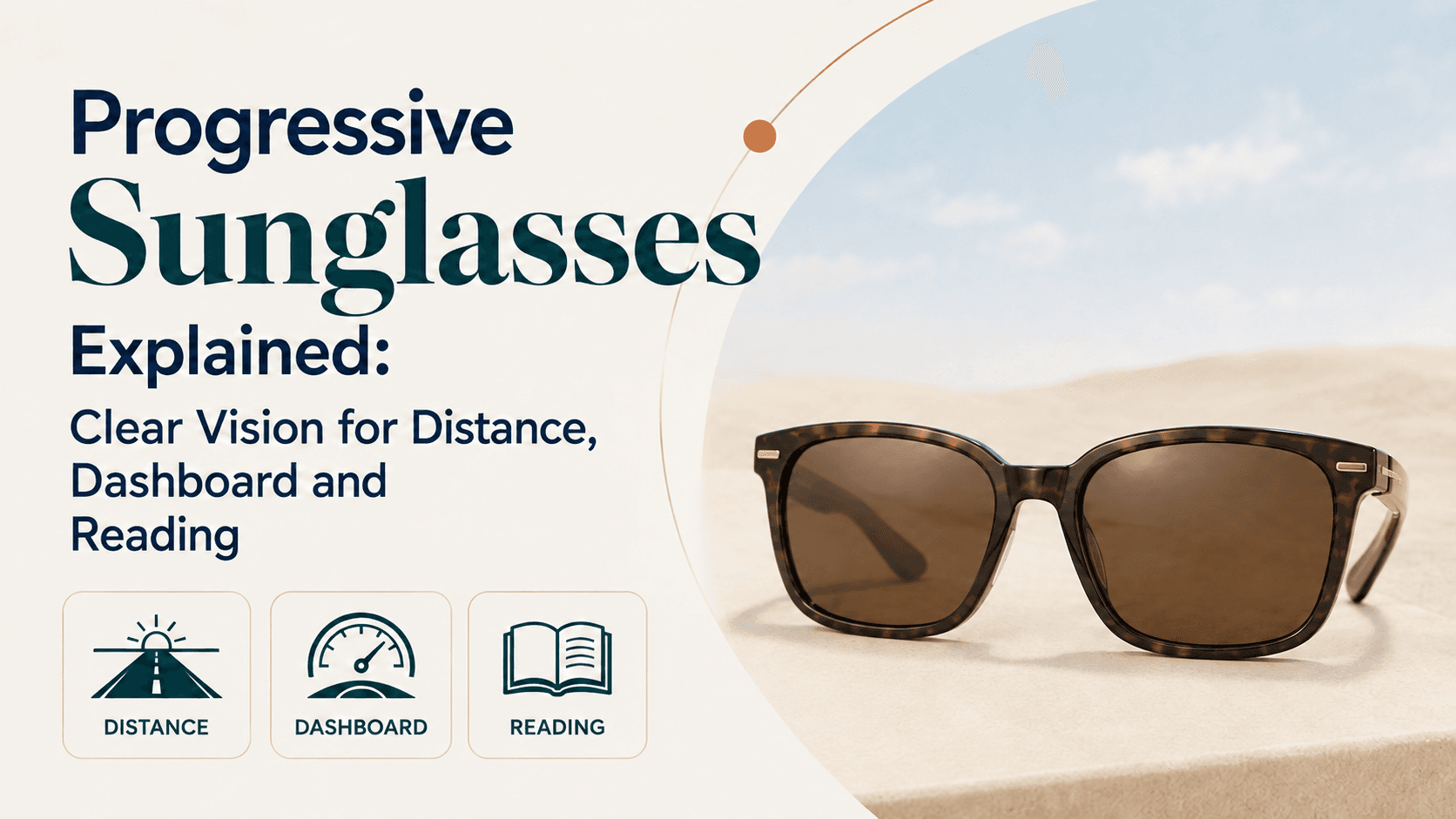
Progressive sunglasses are prescription sunglass lenses that contain three vision zones — distance at the top, intermediate (like your car dashboard) in the middle, and reading at the bottom — blended invisibly into a single lens. They are the ideal solution for anyone over 40 who needs multifocal correction but does not want to carry two pairs of glasses outdoors.
How Do Progressive Sunglass Lenses Work?
Unlike bifocals, which have a visible line separating two zones, progressive lenses use a gradual power change across the lens surface. Your eye naturally looks through the appropriate zone depending on what you are focusing on — far-away traffic, the speedometer, or a menu in bright sunlight. The transition between zones is smooth, which is why they are sometimes called "no-line multifocals."
Who Needs Progressive Sunglasses?
If you are presbyopic — meaning your eyes have started struggling with near focus, typically after age 40 — and you spend meaningful time outdoors or driving, progressive sunglasses are worth serious consideration. They are particularly useful for:
Drivers who need to read the dashboard and GPS while also seeing the road clearly
Outdoor enthusiasts who hike, cycle, or play sport and need UV protection alongside clear vision at all distances
Office-goers who commute under bright sunlight and switch frequently between screens and surroundings
Progressive Sunglasses vs Bifocal Sunglasses: Which Is Better?
Bifocal sunglass lenses offer two zones separated by a visible horizontal line. They are generally less expensive, but the abrupt power jump can cause image jump — a jarring visual skip when your gaze crosses the line. Progressive lenses eliminate this jump and look far more cosmetically appealing. For most wearers, the smoother visual experience of progressives justifies the higher cost, especially in a stylish sunglass frame where the line would also be more noticeable.
What Tint and Coating Options Work Best?
The lens zone for reading sits near the bottom of the frame, which means heavy wrap or curved frames can distort that zone. Opt for frames with a moderate wrap angle. On tints, consider:
Polarised grey or brown tints — reduce glare without distorting colour perception, ideal for driving
Gradient tints — darker at the top for sky glare, lighter at the bottom to make reading easier in outdoor light
Photochromic progressive lenses — adapt to light levels automatically, giving you flexibility between indoors and outdoors
Always add an anti-reflective coating on the back surface of sunglass lenses. This prevents light bouncing off the inner lens surface into your eye, a common issue in India's harsh afternoon sun.
Adapting to Progressive Sunglasses
First-time progressive wearers typically need one to two weeks to adapt. Move your head rather than only your eyes to find the right zone, keep the frame properly fitted at the nose and temples, and resist the urge to tilt your chin down to see distance — look straight ahead through the upper zone instead. Most wearers adjust fully within ten to fourteen days.
How to Care for Progressive Sunglass Lenses
Progressive sunglass lenses often carry multiple coatings — polarised, anti-reflective, and sometimes photochromic layers. Avoid wiping them dry; always rinse with clean water first. Use a microfibre cloth and a lens-safe cleaning solution. Store them in a hard case to protect the large lens surface from scratches that can disrupt any of the three vision zones.
