
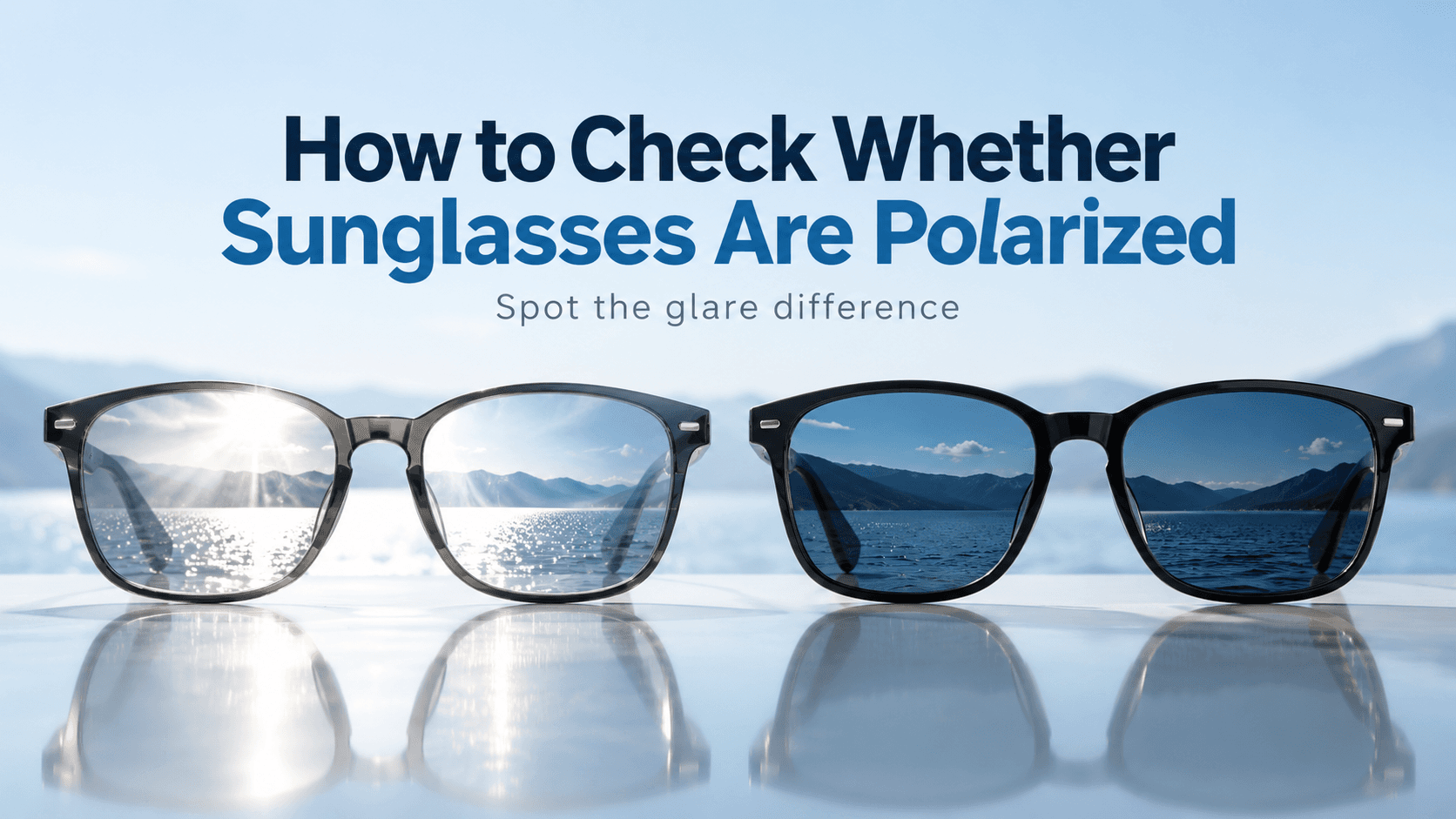
You can check whether sunglasses are polarized in seconds using two methods: the screen test or the lens-rotation test. Hold the lenses up to a phone or laptop screen set to full brightness, then tilt the glasses to about 60–90 degrees. If the lenses go noticeably dark, they are polarized. If there is no change, they are standard tinted lenses.
Why Polarization Matters for Your Eyes
Polarized lenses contain a special chemical filter that blocks horizontally oriented light waves — the kind that bounce off flat surfaces like roads, water, and car bonnets to create harsh glare. Standard tinted lenses only reduce overall light transmission; they do not eliminate glare. For Indian conditions — intense midday sun, coastal drives, and monsoon-wet roads — polarized lenses offer a meaningful upgrade in both comfort and eye safety.
Test 1: The LCD Screen Method (Most Reliable)
This is the easiest and most accurate home test.
Open a plain white image or document on your smartphone or laptop.
Set screen brightness to maximum.
Hold one lens of the sunglasses up to the screen at arm's length.
Slowly rotate the lens from 0 to 90 degrees.
If the lens darkens significantly at around 60–90 degrees, it is polarized.
A non-polarized lens will stay the same shade throughout the rotation.
LCD screens emit polarized light, which is why this test works. OLED screens may give a less dramatic result, so prefer an LCD display if possible.
Test 2: The Two-Lens Rotation Method
If you have two pairs of sunglasses that you suspect are polarized, you can cross-check them against each other.
Hold one pair in front of you at eye level.
Hold the second pair perpendicular (at 90 degrees) in front of the first.
Look through both lenses at a bright light source.
If both are polarized, the overlapping area will turn almost completely black.
If neither or only one is polarized, the view will remain relatively bright.
Polarized vs. UV400 — Are They the Same Thing?
No, and this is a common point of confusion. UV400 means the lens blocks all ultraviolet light up to 400 nanometres, protecting your eyes from UV-A and UV-B rays. Polarization specifically targets glare from reflected light. You can have a lens that is UV400 but not polarized, and vice versa. Ideally, look for sunglasses that offer both — full UV400 protection plus a polarized filter.
When Should You Choose Polarized Sunglasses?
Polarized lenses are especially beneficial in situations where glare is intense or safety is a concern.
Driving: Cuts glare from wet roads and other vehicle windshields.
Water activities: Eliminates surface glare on lakes, rivers, and beaches.
Hill and snow travel: Reduces harsh reflected light from snow or pale rock faces.
City use: Helps in bright, open urban environments where sunlight reflects off glass buildings.
However, polarized lenses can make it harder to read certain LCD dashboards and ATM screens, so keep that trade-off in mind.
How to Tell from the Label or Packaging
Reputable brands mark polarized lenses clearly on the frame arm, the lens itself (look for a small "P" or "POL" etching near the nose bridge), or on the original packaging. If the label only says "UV protection" without mentioning polarization, assume the lenses are not polarized. When shopping online, always check the lens specification section rather than relying on product images alone.
