
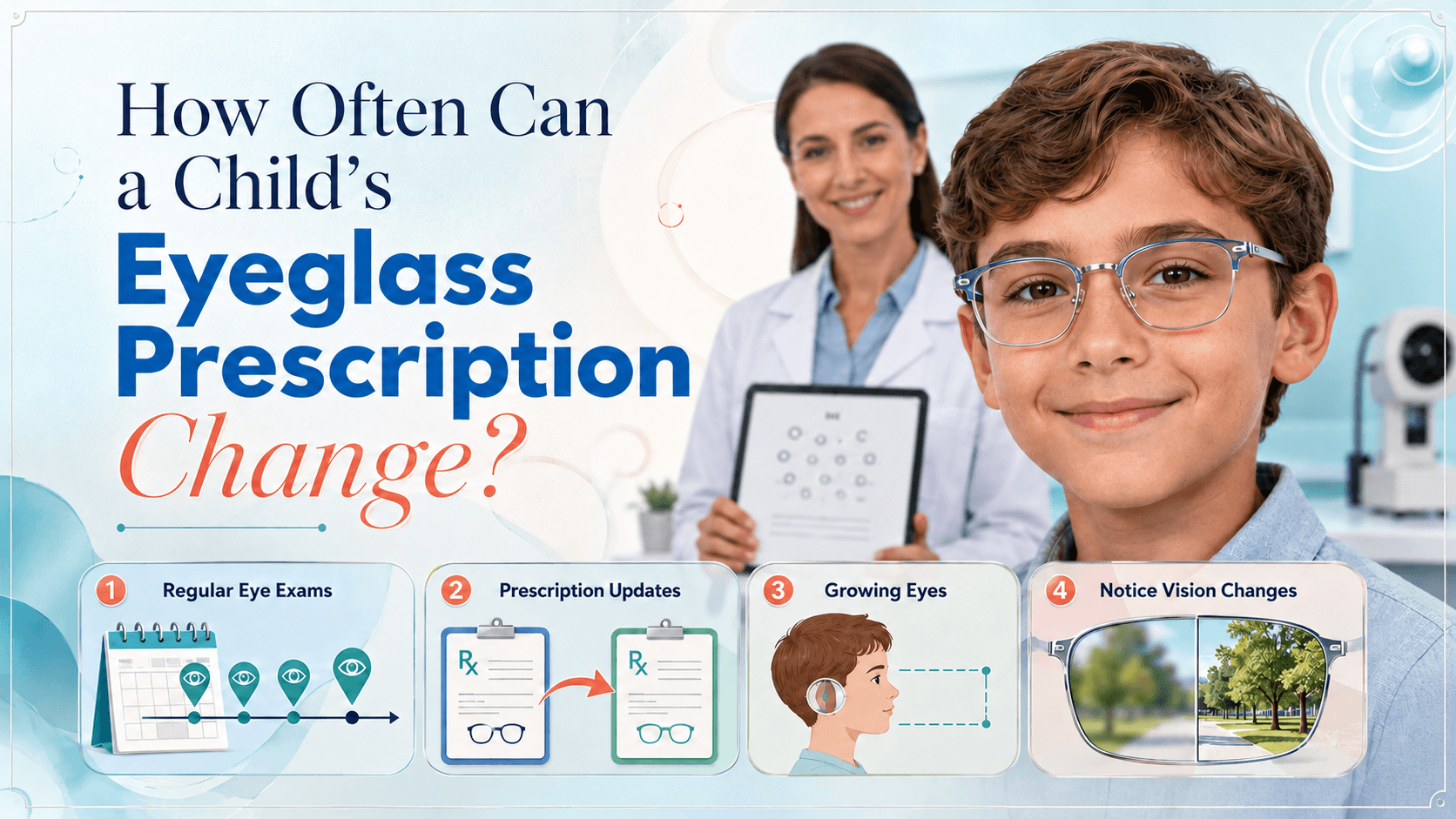
A child's eyeglass prescription can change every 6 to 12 months, especially between the ages of 6 and 16 when the eye is growing fastest. Some children see stable prescriptions for a couple of years, while others — particularly those with moderate to high myopia — may need updated lenses almost every year. Regular eye exams are the only reliable way to keep a child's vision sharp and support healthy visual development.
Why Do Children's Prescriptions Change So Frequently?
The human eye grows throughout childhood, and this physical growth directly affects its focusing power. As the eyeball elongates — the primary driver of myopia (nearsightedness) — the prescription typically increases. Factors that influence how fast a prescription changes include:
Age: Younger school-age children (6–12) often experience the steepest increases.
Family history: A child with two myopic parents has a significantly higher risk of fast-progressing myopia.
Screen time and near work: Prolonged close-up tasks can accelerate myopia progression in predisposed children.
Outdoor time: Research consistently links more time outdoors with slower myopia progression.
How Often Should a Child Have an Eye Exam?
Most paediatric eye specialists recommend an annual comprehensive eye exam for school-age children who already wear glasses. For children with rapidly progressing myopia, a check-up every six months is often advised. Children who pass an initial screening without correction still benefit from an exam every one to two years, as conditions like astigmatism or early farsightedness can develop silently.
Signs That Your Child's Prescription Has Changed
Children do not always verbalise vision difficulties — they simply adapt. Watch for these behavioural clues:
Squinting at the board or the TV screen
Sitting unusually close to screens or books
Frequent headaches, especially after school
Rubbing eyes or complaining of eye strain
A drop in academic performance or reluctance to read
Tilting the head to one side when focusing
Myopia vs. Hyperopia: Which Changes Faster?
Myopia (nearsightedness) tends to progress faster and more predictably throughout childhood, often stabilising in the late teens or early twenties. Hyperopia (farsightedness), on the other hand, can actually decrease as the eye grows — some children even outgrow a mild farsighted prescription. Astigmatism can fluctuate in either direction. Because each condition behaves differently, there is no single update schedule that fits every child; a qualified optometrist or ophthalmologist must guide the decision.
What to Do When the Prescription Changes
Once your child has a new prescription in hand, replacing the lenses promptly matters. Wearing an outdated prescription can cause eye strain, headaches, and — in younger children still in the critical period of visual development — may slow the visual system from reaching its full potential. If your child is hard on frames, this is also a good moment to assess whether the current frame still fits well, since a poor fit affects both comfort and optical accuracy.
At Rimloo, we carry a wide range of kids' eyeglasses designed to be durable, lightweight, and easy to reglaze when the prescription changes. Updating lenses does not always mean buying a new frame — ask our team about reglazing options to keep costs manageable.
