

Astigmatism Glasses: How CYL and AXIS Help You See Clearly
Astigmatism can make words, faces and road signs look blurred or slightly distorted at both near and far distances. At night, lights may appear stretched, star-shaped or surrounded by glare.
The good news is that astigmatism is common and can usually be corrected with properly prescribed glasses. Your CYL and AXIS values, pupillary distance, lens material and frame fit all help determine how clear and comfortable those glasses feel.

What Is Astigmatism?
Astigmatism is a refractive error. It usually happens when the cornea—the clear front surface of the eye—or the lens inside the eye has different curvatures in different directions.
This prevents light from focusing evenly on the retina, causing blurred or distorted vision.
Astigmatism may occur alone or alongside myopia or hyperopia. It is not an infection, and having it does not mean your eyes are weak.

Common Signs of Astigmatism
Possible symptoms include:
Blurred or distorted vision at any distance
Squinting to see details
Headaches or eye strain
Difficulty seeing clearly at night
Glare, halos or starbursts around lights
Tired eyes after reading or screen use
These symptoms do not prove that you have astigmatism. An eye exam is needed to diagnose it and determine the correct prescription.
Seek urgent eye care for sudden vision loss, severe eye pain, new flashes or a sudden increase in floaters.
How Do Glasses Correct Astigmatism?
Glasses for astigmatism use cylindrical correction to bend light differently in specific directions. This helps the eye form a clearer image on the retina while the glasses are worn.

Glasses improve vision, but they do not permanently reshape the eye or make astigmatism worse. If your prescription changes over time, that change comes from your eyes—not from becoming dependent on glasses.
Most regular astigmatism can be corrected with spectacle lenses. Irregular astigmatism may require specialized contact lenses or other treatment recommended by an eye doctor.
What Do CYL and AXIS Mean?
SPH - Main power for nearsightedness (−) or farsightedness (+)
CYL - Amount of astigmatism correction required
AXIS - Direction of the correction, measured from 1° to 180°
PD - Distance between the pupils, used to position the optical centers.
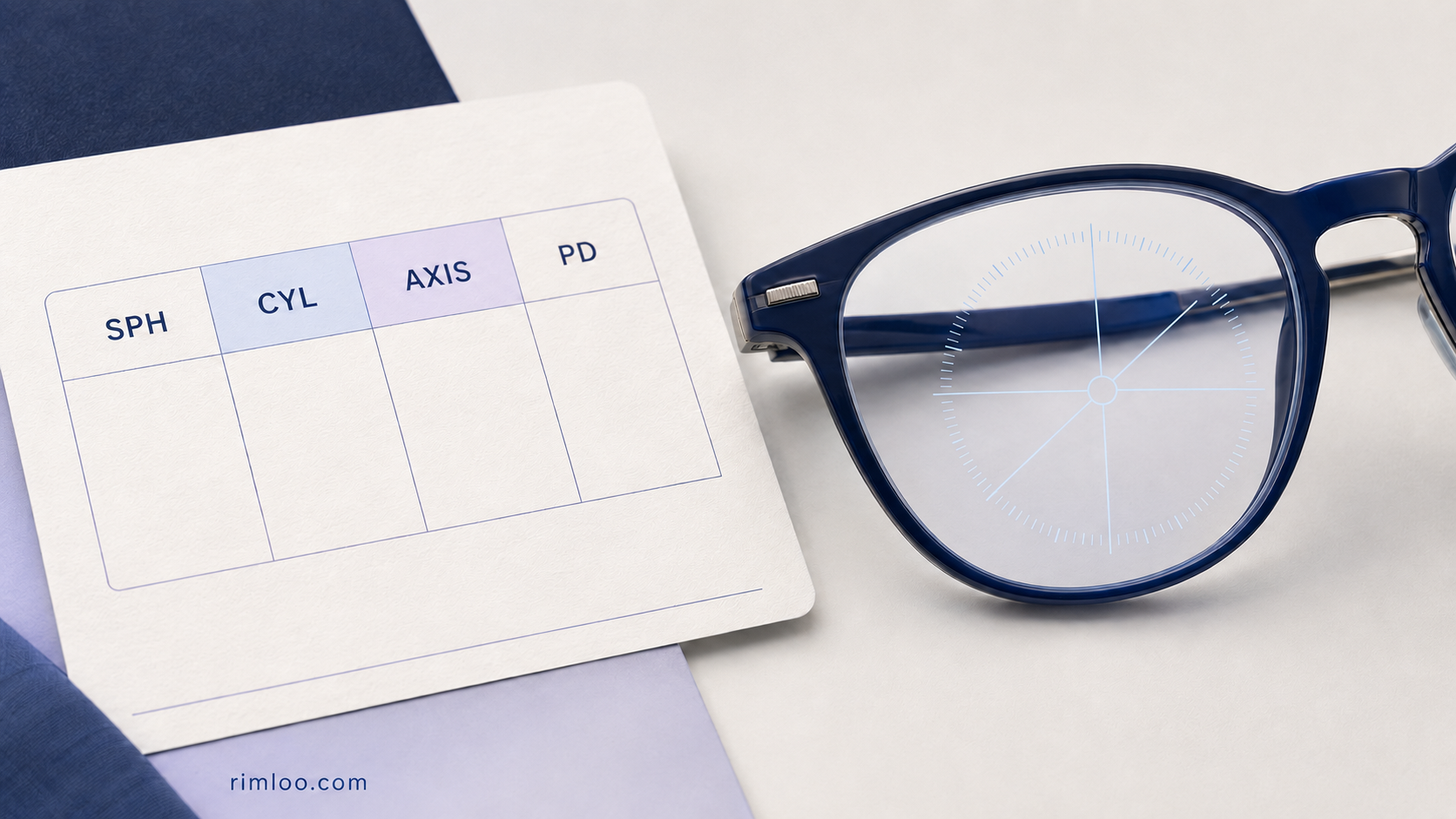
CYL may have a plus or minus sign, depending on how the prescription is written. AXIS represents direction, not prescription strength.
Never change the signs, swap the right and left eyes, or guess an AXIS value. Rimloo’s guide to reading an eyeglass prescription explains every field.
Which Lenses Are Best for Astigmatism?
There is no single best lens material for everyone. The right choice depends on your complete prescription, frame, age and lifestyle.
Standard plastic lenses can provide good clarity for many mild or moderate prescriptions.
Polycarbonate lenses are lightweight and impact-resistant, making them practical for children and active wearers.
High-index lenses can make stronger combined SPH and CYL prescriptions thinner and lighter.
Use Rimloo’s lens-material guide to compare your options. If thickness is a concern, review the high-index vs polycarbonate comparison.
An anti-reflective coating may reduce reflections from lenses, headlights and indoor lighting. However, coatings and blue-light filters cannot replace the correct CYL and AXIS values.
How to Choose Frames for Astigmatism
A stable, properly fitted frame helps keep prescription lenses correctly positioned. For stronger prescriptions, medium-sized frames may also limit lens thickness compared with very oversized styles.

Before ordering:
Compare the lens width, bridge width and temple length with a comfortable pair.
Enter every SPH, CYL and AXIS value exactly as written.
Use an accurate pupillary distance measurement.
Ask for professional guidance if your prescription is strong, unusual or includes prism.
Once your details are ready, you can shop prescription eyeglasses and select lenses that suit your prescription and lifestyle.
When Should You Book an Eye Exam?
Arrange an eye exam if:
Your vision is becoming blurry
You frequently squint
Visual tasks cause headaches
Night driving has become difficult
Your current glasses no longer feel comfortable
Children may not realize that their vision is blurred. Repeated squinting, eye rubbing, headaches or difficulty seeing the classroom board should be professionally checked.
A premium lens material or coating cannot compensate for incorrect SPH, CYL or AXIS values.
Final Thoughts
Astigmatism does not have to limit the frames you enjoy or the activities you do.
Clear results begin with a current prescription, accurate CYL, AXIS and PD details, an appropriate lens material and a frame that remains comfortably aligned.
Choose glasses based on your complete prescription—not on the word “astigmatism” alone. If anything is unclear, confirm it with your eye care professional before ordering.
Recommended References
The medical information was checked against guidance from the American Academy of Ophthalmology, American Optometric Association and Cleveland Clinic.
