
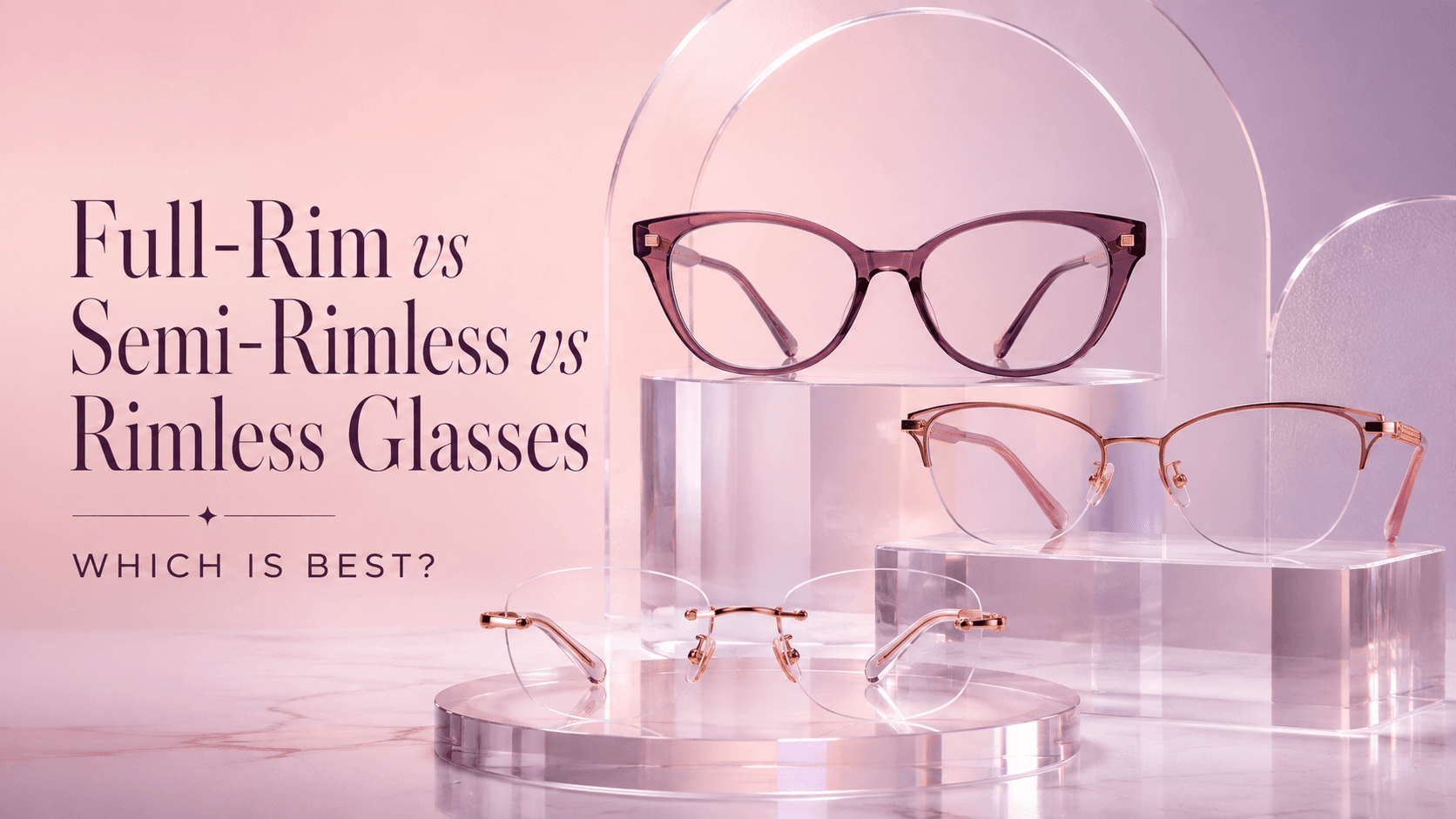
The best frame type depends on your prescription strength, lifestyle, and personal style. Full-rim frames suit strong prescriptions and active lifestyles; semi-rimless offer a lighter, contemporary look for mild to moderate prescriptions; and rimless frames deliver maximum minimalism for those who want eyewear that virtually disappears on their face. Read on for a detailed breakdown of each option.
What Are Full-Rim Glasses?
Full-rim frames encircle the entire lens with a continuous border of metal or acetate. This is the most traditional and widely worn frame style in India, and for good reason — the full surround holds lenses securely, makes the frame more robust, and opens up the widest range of design choices.
Best for: High prescriptions (above ±4.00 diopters), children, people with active lifestyles, and anyone who wants bold style expression.
Maximum durability — the frame protects lens edges from chipping
Compatible with all lens types including thick high-index lenses
Widest variety of colours, shapes, and materials
Easier and cheaper to repair than rimless styles
Can visually define or balance your face shape
What Are Semi-Rimless Glasses?
Semi-rimless frames (also called half-rim or browline frames) have a rim along the top or bottom edge of the lens only. A thin nylon cord or groove holds the lower or upper portion of the lens in place. The result is a frame that feels lighter on the face and looks less visually heavy than a full-rim design.
Best for: Mild to moderate prescriptions, professionals who want a polished yet understated look, and wearers who find full-rim frames too dominant on their face.
Lighter weight than most full-rim acetate frames
Gives an open, airy look that suits oval and heart-shaped faces well
Works with single-vision and standard progressive lenses
The nylon cord can wear out over time but is inexpensive to replace
Less lens-edge protection than full-rim styles
What Are Rimless Glasses?
Rimless glasses have no frame around the lens at all. The temples and nose bridge are mounted directly onto the lens via small screws or a drill-mount system. The lens itself becomes the visual focus, making rimless eyewear the most discreet option available.
Best for: Low to moderate prescriptions, formal or corporate environments, and minimalist wearers who want glasses that blend into their face rather than define it.
Extremely lightweight — ideal for all-day wear
Virtually invisible on the face, letting your features take centre stage
Not recommended for high prescriptions — thicker lenses look odd without a frame to conceal the edges
More fragile than full-rim or semi-rimless options; handle with care
Lens replacement can be costly if the drill hole cracks
Full-Rim vs Semi-Rimless vs Rimless: Side-by-Side Comparison
Use this quick comparison to see which frame type fits your priorities at a glance.
Durability: Full-rim wins, followed by semi-rimless, then rimless
Weight: Rimless is lightest, then semi-rimless, then full-rim
Style range: Full-rim offers the most variety; rimless the least
Prescription range: Full-rim handles all powers; rimless is best kept below ±4.00
Maintenance: Full-rim is easiest to maintain; rimless requires the most care
Price: All three overlap, but rimless repairs tend to cost more
Which Frame Type Suits Your Face Shape?
Your face shape is one of the most practical filters when choosing between these three styles.
If you have a round face, a full-rim rectangular or angular frame adds definition. Semi-rimless with a strong browline also works well. Avoid very thin rimless styles, which can make a round face appear softer.
If you have an oval face, you have the most flexibility — all three styles work. Semi-rimless and rimless frames let your natural facial balance shine without distraction.
If you have a square face, round or oval full-rim frames soften strong jawlines. Rimless round lenses can also be very flattering.
If you have a heart-shaped face, semi-rimless frames with a lighter lower half draw attention downward and balance a wider forehead.
How Does Your Prescription Affect the Choice?
This is arguably the most important practical factor. High-power lenses — especially those with a strong minus (myopia) prescription — have thicker edges that are best hidden inside a full-rim frame. Rimless frames expose every millimetre of the lens edge, which can look bulky at higher powers and also put the drill-mount points under greater stress.
For prescriptions between 0 and ±3.00, all three styles are genuinely viable. Above ±4.00, full-rim is the safest choice. If you are between ±3.00 and ±4.00, pair a semi-rimless or rimless design with a high-index lens to keep thickness in check.
Lifestyle and Durability Considerations
Beyond face shape and prescription, think honestly about how you use your glasses. If you play sport, travel frequently, have kids at home who might grab your frames, or simply have a history of sitting on your glasses, full-rim is your most resilient option. Semi-rimless is a reasonable middle ground for everyday office and social use. Rimless frames reward careful, consistent wearers who store their glasses in a hard case every time they take them off.
Which Should You Choose?
There is no universally superior frame type — the right answer is personal. Choose full-rim if durability and style variety matter most. Choose semi-rimless if you want a lighter, modern look without sacrificing too much robustness. Choose rimless if invisibility and minimal weight are your top priorities and your prescription allows it. When in doubt, try all three styles virtually or in-store before committing.
