
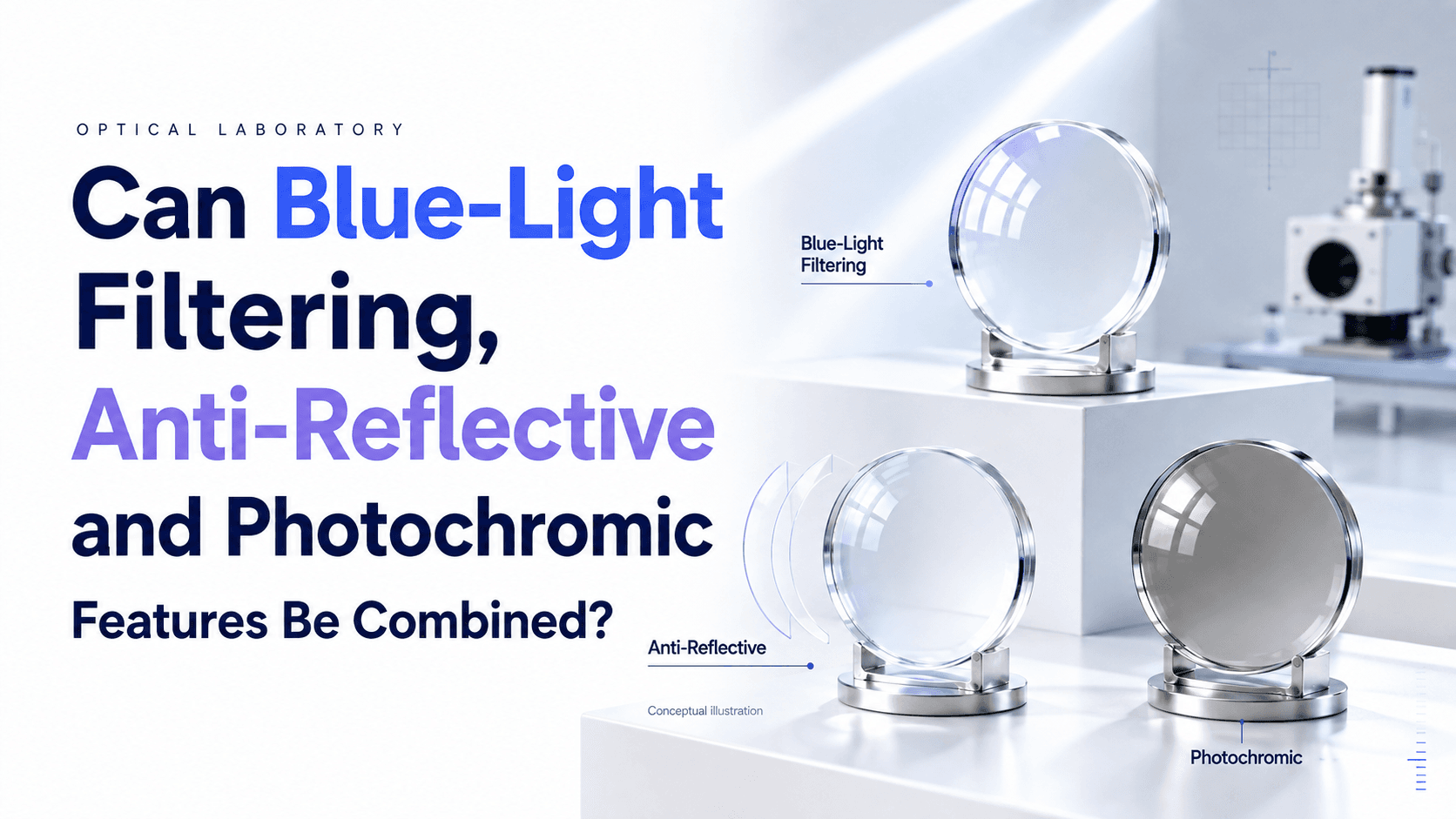
Yes, blue-light filtering, anti-reflective (AR) coating, and photochromic technology can all be combined into a single lens. Most premium optical labs in India now offer this combination, so you do not have to choose between screen protection, glare reduction, and automatic light adaptation. However, the compatibility depends on the lens material, the specific brand of photochromic dye used, and your prescription strength.
What Does Each Feature Actually Do?
Before combining them, it helps to understand what each coating or technology contributes to your vision experience.
Blue-light filtering selectively blocks or absorbs high-energy visible (HEV) blue light emitted by screens, LED lighting, and the sun. It is designed to reduce digital eye strain and potential disruption to your sleep cycle.
Anti-reflective (AR) coating minimises reflections on both the front and back surface of the lens. This sharpens contrast, reduces halos around lights at night, and makes your lenses look cleaner to anyone facing you.
Photochromic lenses contain light-sensitive molecules that darken automatically in UV-rich environments and clear up indoors. Brands like Transitions are the most well-known, but several other photochromic options are available in India.
Can All Three Work Together Without Conflict?
Technically, yes — but with one important nuance. Photochromic lenses already block nearly 100% of UV light when fully activated, and most also provide partial blue-light filtering in their darkened state. Adding a dedicated blue-light filter layer ensures you get that protection even when the lens is in its clear (indoor) state, which is when you are most likely staring at a screen. The AR coating sits on top of everything and does not interfere with either the photochromic chemistry or the blue-light filter beneath it.
The combination is especially useful for people who move frequently between an air-conditioned office with bright screens and outdoor environments with strong sunlight — a very common scenario across Indian metros.
Blue-Light + AR + Photochromic vs Separate Pairs: Which Is Better?
A combined lens is more convenient and cost-effective than carrying two pairs. However, standard photochromic lenses do not darken adequately inside a car because windshields block most UV light. If you spend long hours driving, a dedicated pair of prescription sunglasses or polarised driving lenses may still make sense as a second pair.
What Lens Materials Support This Combination?
Polycarbonate and 1.60 or 1.67 high-index lenses are the most commonly recommended materials for this triple combination. They are thin enough for most prescriptions, impact-resistant, and compatible with the photochromic dye integration process used by major labs. Trivex lenses are another excellent option, particularly for rimless or semi-rimless frames where lens strength matters.
Is There Any Downside?
The primary trade-off is cost — combining three technologies does raise the lens price. Some wearers also notice a very faint residual tint indoors, though this has improved significantly with newer photochromic generations. Finally, in regions with intense year-round sunlight like South India, the lenses may take slightly longer to fully clear indoors compared to cooler climates.
Who Should Consider This Combination?
This setup works best for working professionals and students who spend 6 or more hours daily on screens and also commute or spend time outdoors. It is a single-pair solution that covers most lighting situations without compromising on optical clarity or UV protection.
