
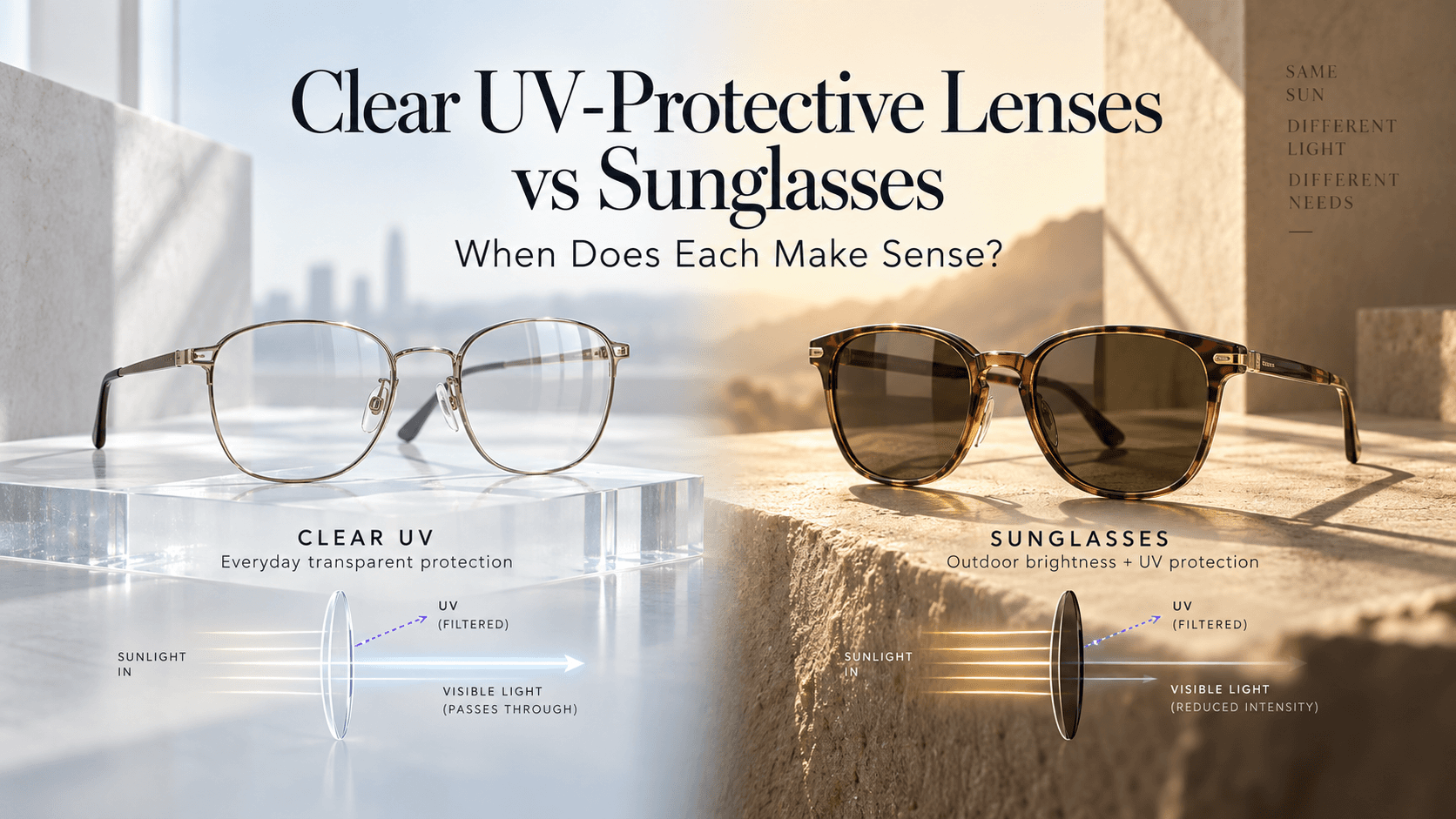
Clear UV-Protective Lenses vs Sunglasses: When Does Each Make Sense?
If a pair of clear eyeglass lenses blocks ultraviolet radiation, do you still need sunglasses?
It sounds like a simple question.
But it mixes together two different jobs:
protecting the eyes from UV radiation and making bright sunlight more comfortable to look through.
A lens does not necessarily have to look dark to filter UV radiation. Some clear ophthalmic lens materials and coatings can significantly reduce UV transmission.
Sunglasses, meanwhile, typically combine UV protection with a reduction in visible light. Depending on the design, they may also reduce reflected glare.
That means clear UV-protective lenses and sunglasses are not necessarily competing products.
They often solve different parts of the same outdoor-vision problem.
First: UV Protection and Darkness Are Not the Same Thing
One of the biggest misconceptions about sunglasses is:
“The darker the lens, the more UV it blocks.”
That is not necessarily true.
The FDA specifically advises consumers not to judge UV protection by lens darkness. Light-colored lenses can offer strong UV protection, while a dark lens should not automatically be assumed to block UV unless its protection is specified.
Think of the two properties separately.
UV filtration
This controls how much ultraviolet radiation passes through the lens.
Visible-light tint
This controls how bright the world appears through the lens.
A clear lens can therefore filter UV while still looking nearly transparent.
A sunglass lens can filter UV and reduce visible brightness.
That distinction explains when each makes sense.
What Are Clear UV-Protective Lenses?
Clear UV-protective lenses are ordinary-looking ophthalmic lenses made from materials or treatments designed to reduce ultraviolet transmission.
Depending on the lens material, UV absorption may be built into the material itself or enhanced through lens treatment.
EyeWiki notes that several clear ophthalmic materials, including certain clear plastic and coated lenses, can have strong UV-absorbing properties.
These lenses can be useful when you need glasses for:
prescription correction
work
school
reading
commuting
general everyday wear
without wanting your lenses to appear tinted indoors.
If you are comparing everyday prescription eyewear, you can explore eyeglasses at Rimloo while considering frame fit, lens options and how you use your glasses throughout the day.
What Clear UV Lenses Do Not Do
Clear UV protection should not be confused with sun tint.
Clear lenses allow most visible light through so that your surroundings still look normally bright.
That means they may provide UV filtration while doing relatively little to solve:
uncomfortable brightness
squinting in strong sunlight
intense reflections from water
glare from wet roads
brightness around snow or beaches
If brightness is the main problem, sunglasses usually make more sense.
When Do Sunglasses Make More Sense?
Sunglasses are particularly useful when you're spending meaningful time outdoors.
Examples include:
walking during bright daylight
driving
beach trips
outdoor sports
travelling
sightseeing
hiking
sitting outside
spending time near water or snow
CDC guidance recommends sunglasses that block 99–100% of UVA and UVB radiation.
The FDA similarly recommends looking for UV400 or 100% UV protection, which indicates very high ultraviolet filtration.
Sunglasses also reduce visible brightness, something ordinary clear UV-protective lenses are not designed to do.
Clear UV Lenses vs Sunglasses: Quick Comparison

What Does Polarization Add?
Polarization is another feature that is frequently confused with UV protection.
Polarized lenses are designed to reduce reflected glare from surfaces such as:
water
wet roads
snow
glass
other reflective horizontal surfaces
The CDC notes that polarization and mirrored treatments do not inherently provide greater UV protection; their main advantage is reducing reflected light and glare.
So you can have:
UV-protective sunglasses that aren't polarized
or
UV-protective polarized sunglasses.
For driving, water activities and highly reflective outdoor environments, polarization can provide a noticeable comfort advantage.
What About Prescription Sunglasses?
People who require vision correction don't necessarily have to choose between seeing clearly and wearing sunglasses.
Prescription sunglasses combine the required optical correction with a tinted sun lens.
They can be particularly practical for:
driving
outdoor travel
sports and recreation
strong prescriptions
people who wear glasses continuously
If you regularly spend time outdoors, you may want to browse Rimloo eyewear and compare everyday prescription frames with options suitable for sun lenses.
For many glasses wearers, having both a regular clear pair and a dedicated sun pair is the most flexible setup.
Do Sunglasses Need to Be Extremely Dark?
No.
A darker appearance does not automatically equal stronger UV protection.
The FDA recommends checking for an actual UV400 or 100% UV-protection designation rather than judging protection based on tint alone.
This matters because wearing a very dark lens without appropriate UV filtration is not a sensible substitute for genuine UV protection.
Choose sunglasses based on verified protection and suitable comfort—not simply on how black the lenses look.
Does Frame Shape Affect Sun Protection?
Yes.
Light does not enter your eyes only through the center of your lenses.
It can reach them:
from above
below the frame
around the sides
This is why larger frames and wraparound styles can provide additional coverage.
The FDA recommends considering large or wraparound frames, while CDC guidance similarly notes that wraparound designs can help block UV arriving from the sides.
For prolonged exposure to intense sun, frame coverage therefore deserves attention alongside lens specifications.
What About Cloudy Days?
Clouds do not eliminate UV exposure.
The CDC notes that UV exposure remains relevant despite atmospheric conditions and recommends eye protection during daylight outdoor exposure.
That means sunglasses are not only a summer-beach accessory.
Depending on brightness and UV conditions, they can make sense throughout the year.
When Clear UV-Protective Lenses Make the Most Sense
Clear UV lenses are particularly practical when you want:
normal-looking prescription eyewear + everyday UV filtration
They work especially well for people who spend most of their day moving between:
home
office
school
shops
short outdoor walks
transportation
without wanting to constantly switch glasses.
However, they should not automatically be treated as a complete replacement for sunglasses in intense sunlight.
When Sunglasses Make the Most Sense
Choose sunglasses when your priority includes:
UV protection + visible-light reduction + outdoor comfort
They become especially valuable during:
long periods outdoors
strong midday sun
driving
water activities
beach environments
snow
environments with significant reflected glare
For these conditions, the reduction in visible brightness can be just as important for comfort as UV filtration.
The Most Practical Answer May Be Both
You don't necessarily need to decide:
clear UV lenses OR sunglasses.
For someone who wears prescription glasses every day, the most practical combination may be:
Clear UV-protective prescription glasses
for normal indoor and everyday wear
+
UV-rated prescription sunglasses
for prolonged or bright outdoor conditions.
Another alternative is photochromic eyewear, which changes tint according to lighting conditions, although photochromic lenses have their own advantages and limitations.
The best choice depends on your routine rather than one lens being universally “better.”
The Bottom Line
Clear UV-protective lenses and sunglasses can both play an important role in eyewear.
The difference is what happens beyond UV protection.
Clear UV lenses allow you to maintain a normal transparent appearance while filtering ultraviolet radiation.
Sunglasses combine UV protection with visible-light reduction, making bright outdoor environments considerably more comfortable.
So the better question isn't:
“Which protects my eyes?”
Instead ask:
“Do I only need UV filtration, or do I also need protection from brightness and glare?”
For everyday indoor-to-outdoor prescription wear, clear UV-protective lenses can be highly practical.
For sustained time in bright sunshine, appropriately rated sunglasses generally make more sense.
And for many people, having access to both is the most versatile solution.
