
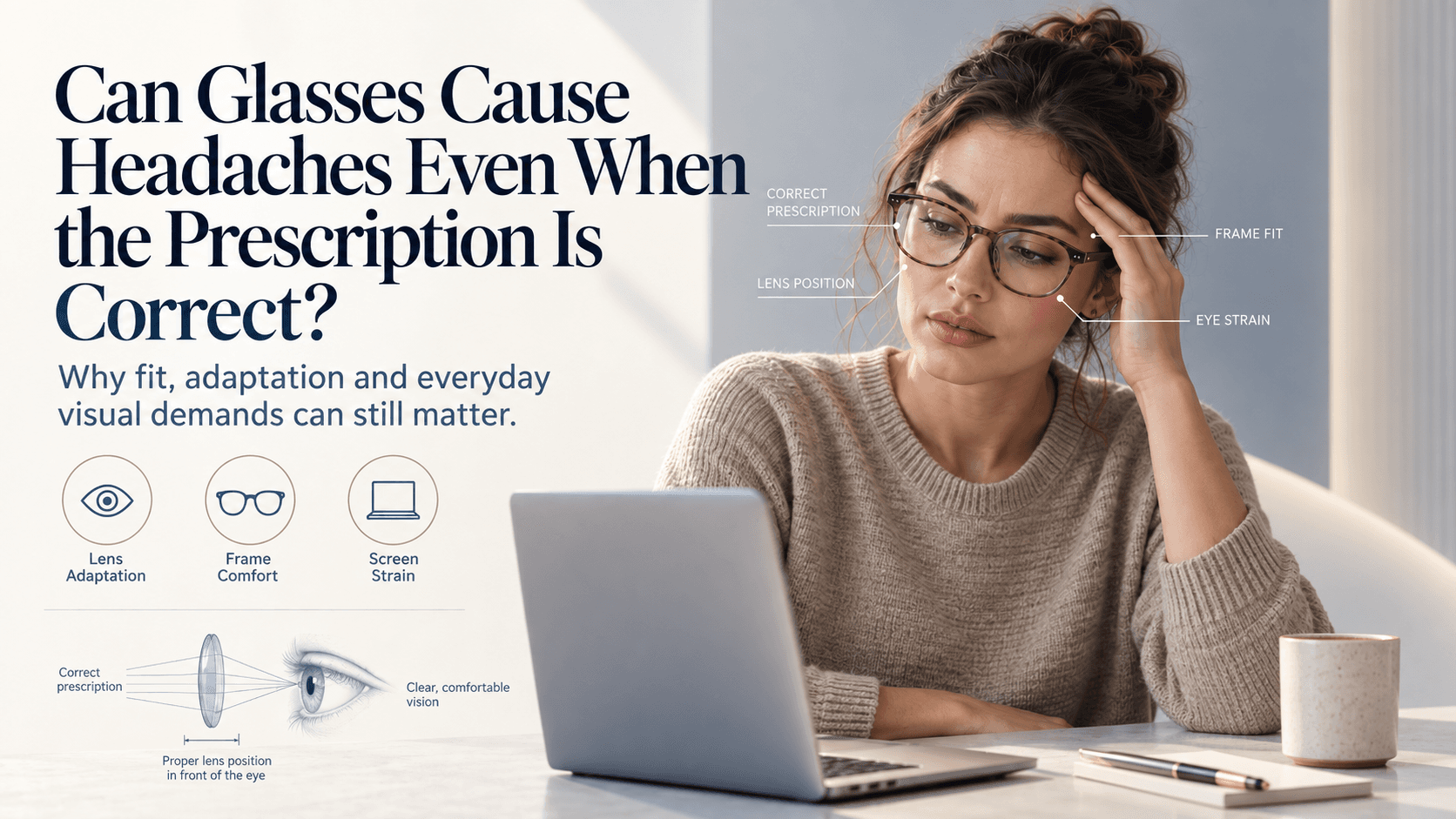
Can Glasses Cause Headaches Even When the Prescription Is Correct?
You had your eyes examined.
Your prescription was checked.
Your new glasses make everything look clear.
So why does your head start hurting after wearing them for a few hours?
It is easy to assume that headaches automatically mean the prescription must be wrong.
That isn't always the case.
Even correctly prescribed eyeglasses may initially feel different, and factors unrelated to the actual sphere, cylinder or axis values can contribute to discomfort.
Frame fit, lens type, adaptation, prolonged near work and even the way you use digital devices can all matter.
Cleveland Clinic notes that new prescription lenses can require an adjustment period and that some eyeglass wearers may experience temporary eye strain or headaches. Frames can also cause discomfort around the nose, ears and temples when they need adjustment.
So before assuming your eye exam was incorrect, it helps to look at the bigger picture.
1. Your Eyes and Brain May Still Be Adjusting to New Glasses
A technically correct prescription can still feel unfamiliar.
When you receive new glasses, your visual system has to adapt to the way the new lenses form images.
This can be particularly noticeable when:
your prescription changed significantly
your astigmatism correction changed
you started wearing glasses for the first time
you switched lens designs
you moved from single-vision lenses to progressives
During the first few days, some people experience:
mild headaches
temporary blur
eye strain
slight dizziness
an unusual sense of depth or movement
Cleveland Clinic explains that headaches and visual distortions can occur during adaptation to new glasses and that progressives or stronger astigmatism changes may take longer to get used to.
The important word is temporary.
If symptoms steadily improve, adaptation may be the explanation.
If they remain unchanged or get worse, the glasses deserve another check.
2. The Prescription Can Be Correct but the Frame May Be Uncomfortable
Sometimes your eyes are perfectly happy with the lenses.
Your head isn't happy with the frame.
Glasses should sit securely without squeezing the sides of your head.
If the temples press firmly around your temples or behind your ears, you may develop physical discomfort that feels like a headache.
Look for clues such as:
tenderness around your temples
red pressure marks
soreness behind your ears
discomfort where the bridge rests on your nose
relief soon after removing the glasses
Cleveland Clinic specifically notes that glasses can cause discomfort around the nose, ears or temples and that frame adjustment can help.
Do not try to solve every fit problem by bending the frame yourself.
An optician can usually make small adjustments much more precisely.
When choosing your next frame, prioritize both appearance and comfortable proportions. You can also explore eyeglasses and frame styles at Rimloo while considering shape, width and everyday wear.
3. Lens Design Can Change How Your Eyes Move
Not every eyeglass lens works the same way.
Single-vision lenses typically provide one primary correction throughout the lens.
Progressive lenses, however, contain multiple viewing zones for distance, intermediate and near vision.
That means new progressive wearers need to learn where to look through the lens for different activities.
Progressives can also have peripheral areas that feel visually different from the central viewing zones.
For some wearers, this initially produces:
visual swimming sensations
eye strain
headaches
awkward head movement
difficulty moving between distances
That does not necessarily mean the prescription is incorrect.
It may mean you are still adapting—or that the frame and lens positioning need to be reviewed.
4. The Glasses May Need a Fitting or Manufacturing Check
A prescription is only one part of making a finished pair of glasses.
The lenses also need to be placed correctly within the chosen frame.
If headaches continue even though the written prescription has been confirmed, ask the optical professional to check the finished glasses themselves.
Cleveland Clinic advises returning to an eye-care professional when symptoms persist so they can confirm both that the prescription is correct and that the glasses were made correctly.
This is especially worth doing when:
one eye feels more strained than the other
the frame sits crooked
symptoms began immediately with the new glasses
the vision seems clear but uncomfortable
you have trouble using a particular part of a progressive lens
5. Correct Glasses Cannot Prevent Every Type of Eye Strain
You can have a perfect prescription and still spend eight hours staring at a laptop.
Glasses correct refractive errors.
They do not eliminate all the demands created by prolonged visual work.
Digital eye strain may cause:
headaches
tired eyes
burning
dryness
blurred vision
difficulty concentrating
neck and shoulder discomfort
Mayo Clinic identifies prolonged digital-device use as a common cause of eyestrain and notes that headache can be one of its symptoms.
If your headache mainly appears after long screen sessions rather than immediately after putting your glasses on, your work habits may be contributing more than the eyewear itself.
Try:
taking regular distance-viewing breaks
increasing text size
reducing screen glare
improving lighting
keeping the monitor at a comfortable position
remembering to blink normally
6. Your Working Distance May Not Match Your Glasses
The correct prescription is also connected to what the glasses were designed to do.
For example, distance glasses may not be ideal for someone spending an entire workday focused at a relatively close monitor.
Likewise, reading glasses designed for close text may not be appropriate for a screen placed farther away.
Mayo Clinic notes that some people benefit from glasses prescribed specifically for tasks such as computer work or reading.
If your headache occurs primarily during one activity, tell your eye-care professional exactly:
how far away your screen is
how many hours you use it
whether you use multiple monitors
whether symptoms happen when reading
whether distance viewing feels comfortable
That information may be more useful than simply saying, “My glasses give me headaches.”
7. Sometimes the Glasses Aren't Causing the Headache at All
Headaches have many potential triggers.
They can occur alongside:
poor sleep
stress
dehydration
skipped meals
muscle tension
poor posture
migraines
illness
You may notice the headache while wearing your glasses simply because you wear those glasses for most of the day.
This is why the timing matters.
Ask yourself:
Does the headache begin shortly after putting on the glasses?
Does it happen mainly after screen use?
Does removing the glasses consistently improve it?
Did it begin exactly when I changed frames or lenses?
Does it happen even on days when I barely wear my glasses?
Patterns like these can help separate an eyewear-related issue from a general headache problem.
How Long Should You Give New Glasses?
Mild adaptation symptoms often improve within several days, although some people need longer—particularly after major prescription or lens-design changes. Cleveland Clinic notes that adjustment to new glasses can sometimes take around a week or two.
You should not, however, force yourself through significant discomfort indefinitely.
Have the glasses checked when:
headaches remain frequent
symptoms are becoming stronger
vision feels distorted
you experience double vision
one eye feels significantly different
the frame causes physical pain
you cannot adapt after a reasonable trial period
When Headaches Need More Than an Eyeglass Adjustment
A mild headache associated with new glasses is very different from a sudden severe headache or significant neurological or visual symptoms.
Seek prompt medical attention if a headache is accompanied by symptoms such as:
sudden or major vision loss
severe eye pain
new double vision
vomiting with severe headache
confusion or weakness
a sudden unusually intense headache
Do not assume serious new symptoms are simply part of adjusting to glasses.
The Bottom Line
Correct prescription does not always mean instant comfort.
Glasses can sometimes coincide with headaches because of adaptation, frame pressure, lens design, fitting issues or the visual tasks you're performing.
If everything becomes more comfortable over the first few days, your visual system may simply have needed time to adapt.
If the headaches continue, don't automatically conclude that you have to live with them.
Have the frame fit, finished lenses and prescription checked—and consider whether screen use, posture or another headache trigger may be contributing.
Good glasses should provide more than clear letters on an eye chart.
They should also work comfortably in your real life.
