
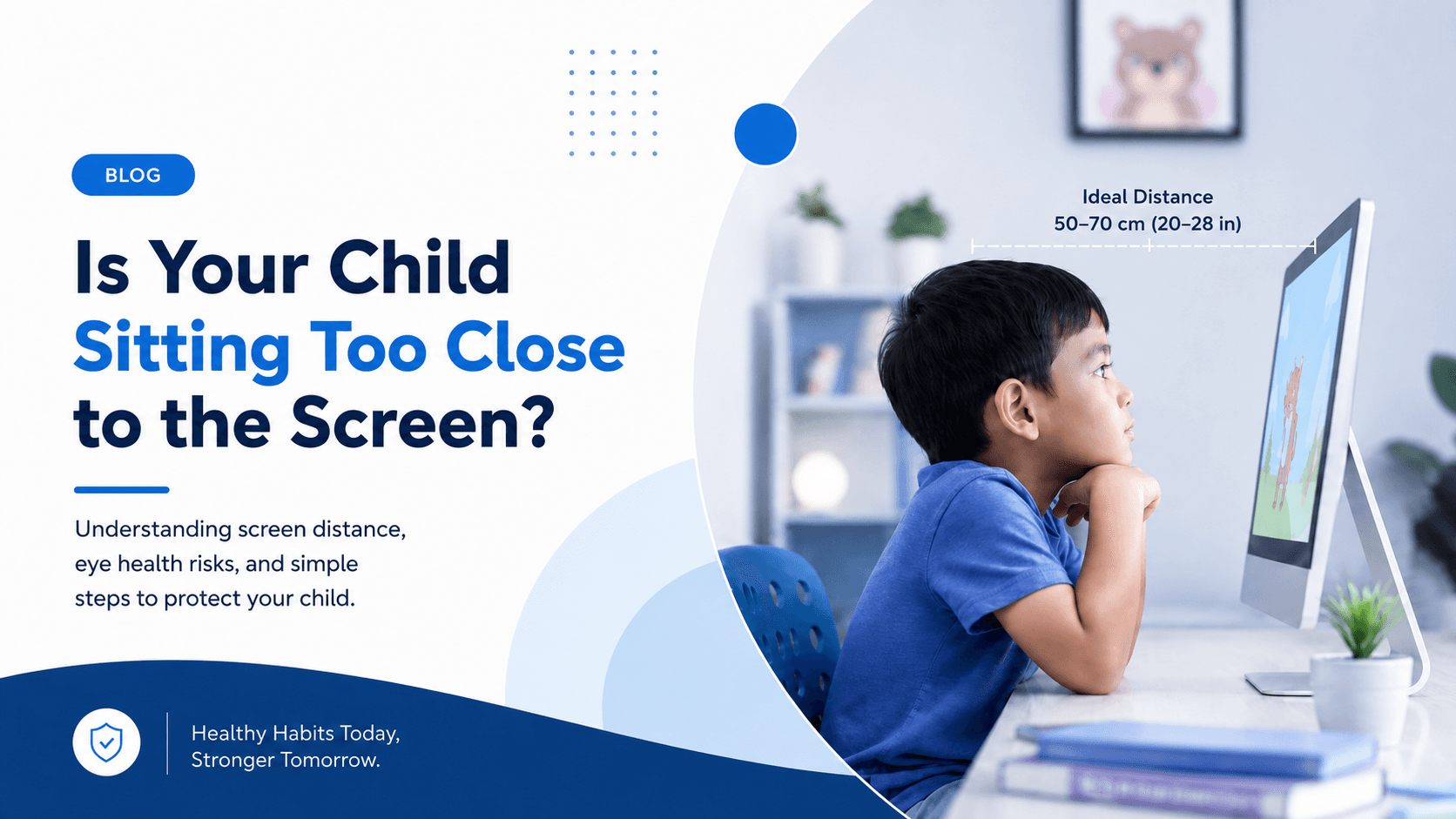
A child sitting too close to a screen is one of the earliest and most reliable warning signs of myopia (nearsightedness). When a child cannot see clearly at a distance, moving closer compensates for blurred vision. If you notice this habit consistently — not just occasionally — it is worth scheduling a professional eye examination rather than dismissing it as a quirk.
Why Do Children Sit So Close to Screens?
The most common reason is uncorrected refractive error, particularly myopia. A child's lens can still partially compensate for mild nearsightedness by straining harder, but as the prescription increases, they instinctively close the gap between their eyes and the screen to make images appear sharper. Other contributing reasons include:
Astigmatism — uneven curvature of the cornea causes blurring at all distances, prompting children to get closer to reduce perceived blur.
Amblyopia (lazy eye) — if one eye has significantly weaker vision, the child may tilt or lean to favour the stronger eye.
Poor screen positioning — screens placed too high, too low, or at an angle can also cause a child to shift posture, though this is less likely to be a sole cause.
Habit or curiosity — in toddlers, closeness is sometimes just engagement, but in school-age children it deserves closer attention.
What Are the Other Warning Signs of a Vision Problem in Children?
Screen proximity rarely appears in isolation. Watch for these accompanying signs that together paint a clearer picture:
Frequent squinting or rubbing of eyes
Complaints of headaches, especially after reading or screen time
Holding books very close to the face
Difficulty reading the classroom board and declining academic performance
Tilting the head to one side while watching TV
Losing their place while reading or skipping lines
Any combination of two or more of these symptoms is a strong prompt for a paediatric eye examination.
How Much Screen Time Is Too Much for Children?
The Indian Academy of Paediatrics and the World Health Organisation recommend no screen time for children under two years (except video calls), no more than one hour per day for ages two to five, and consistent limits with breaks for school-age children. Beyond raw time, how children use screens matters enormously. Passive scrolling and gaming in dim light are more stressful on developing eyes than video calls in a well-lit room.
The widely cited 20-20-20 rule is practical and evidence-backed: every 20 minutes of near work, look at something 20 feet away for at least 20 seconds. Teaching this habit early can reduce eye strain significantly.
Does Screen Time Actually Cause Myopia?
Research published in leading ophthalmology journals consistently links excessive near-work — including screens — with faster myopia progression, though genetics remain the dominant risk factor. A child with two myopic parents has roughly a 1-in-2 chance of developing myopia regardless of screen habits. What screens do is accelerate onset and progression, particularly when combined with reduced outdoor time. Natural daylight is protective: studies suggest children who spend at least 90 minutes outdoors daily have measurably slower myopia progression. This is one of the simplest, zero-cost interventions available to parents.
Blue Light and Children's Eyes: Should You Worry?
Screens emit high-energy visible (HEV) blue light, and children's lenses are clearer than adults', meaning more blue light reaches their retinas. While the long-term retinal damage debate is still ongoing in clinical literature, blue light's role in disrupting melatonin production and sleep cycles is well-established. Poor sleep in turn affects concentration, mood, and academic performance — all of which affect how a child uses their eyes the next day. If your child uses screens within an hour of bedtime, blue light filtering lenses or enabling night mode on devices are reasonable precautions.
When Should a Child Have Their First Eye Test?
Ideally, children should have a comprehensive eye examination:
At 6 months — a basic check for eye alignment and early structural issues
At 3 years — vision acuity and amblyopia screening
Before starting school (age 5-6) — full refraction test
Every 1-2 years thereafter — more frequently if a prescription already exists
Many vision problems in children go undetected simply because children do not know what clear vision looks like — they assume everyone sees the way they do. Routine testing removes the guesswork.
What to Do If Your Child Needs Glasses
A prescription does not have to feel like bad news. Modern children's frames are lightweight, impact-resistant, and genuinely fun. When choosing eyeglasses for a child, prioritise:
Polycarbonate or Trivex lenses — these are up to ten times more impact-resistant than standard plastic, essential for active children.
Spring hinges — flex without breaking under the rough handling children give frames.
Proper fit — frames that slip down the nose or pinch the temples will be taken off and pocketed, defeating the purpose.
Anti-reflective coating — reduces glare from screens and classroom lighting, making the glasses more comfortable to wear all day.
Explore https://www.rimloo.com/eyeglasses/kids for frames designed to handle school life while keeping vision sharp. For children who also spend time outdoors, prescription sunglasses or photochromic lenses offer UV protection without needing a frame swap.
Practical Steps Parents Can Take Today
While an eye test is the definitive action, these habits support healthy vision development in the meantime:
Position screens at arm's length (roughly 50-60 cm) and slightly below eye level.
Ensure the room is adequately lit — screens in the dark increase contrast fatigue.
Enforce the 20-20-20 rule with a phone timer if necessary.
Prioritise at least 60-90 minutes of outdoor play daily.
Limit total recreational screen time on school days to one to two hours.
Schedule annual eye examinations, especially if there is a family history of myopia.
