
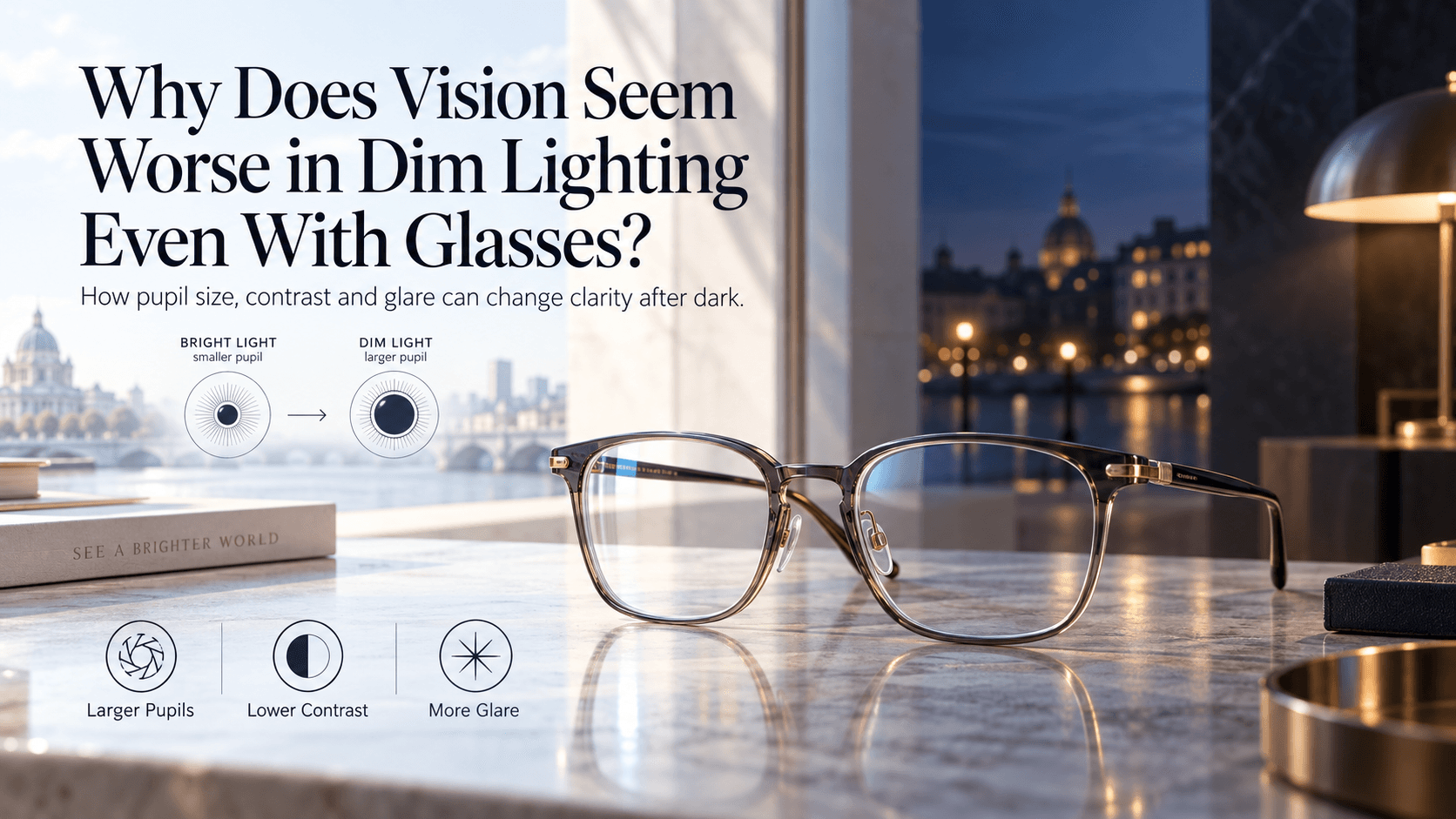
Why Does Vision Seem Worse in Dim Lighting Even With Glasses?
During the day, your glasses may make everything look perfectly sharp.
Then evening arrives.
Street signs become harder to read, headlights seem brighter, objects look less defined and you may feel as if your prescription suddenly isn't strong enough.
So what changed?
Usually, your glasses did not stop working.
Instead, your visual system is operating under much more difficult conditions.
Dim lighting changes the way your eyes gather light, focus images and detect contrast. It can also reveal small optical imperfections that are much less noticeable in bright daylight.
That is why someone can have an accurate prescription and still feel that their vision is worse at night.
Your Pupils Get Larger in Dim Light
One of the biggest changes after dark happens automatically.
Your pupils enlarge.
The pupil is the opening in the center of the iris that controls how much light enters the eye.
In bright conditions, the pupil becomes smaller.
In darkness, it becomes larger to capture more available light.
That sounds helpful—and it is—but there is a tradeoff.
A larger pupil allows light to enter through a wider area of the eye's optical system.
That can make small imperfections in focusing more noticeable.
During bright daylight, a smaller pupil can act somewhat like the aperture of a camera, increasing depth of focus and reducing the effect of minor optical blur.
At night, that advantage becomes weaker.
So your prescription can still be technically correct while your vision feels slightly less crisp.
Low Light Reduces Contrast
Sharpness is not only about your prescription.
It is also about contrast.
Imagine black text printed on a bright white page.
Now imagine grey text printed on a dark grey background.
The letters may be exactly the same size, but the second example is much harder to see.
Something similar happens at night.
The visual system has less contrast information to work with.
Edges become less obvious.
Faces are harder to recognize from a distance.
Road markings may appear less distinct.
Dark objects can blend into dark backgrounds.
That is why an eye-chart result in a well-lit examination room does not perfectly predict how comfortable you will feel on a dark road.
Astigmatism Can Feel More Noticeable at Night
Astigmatism occurs when the optical system of the eye does not focus light evenly in all directions.
Glasses can correct astigmatism very effectively.
However, even small residual errors may become more noticeable when your pupils enlarge.
You may notice:
lights appearing stretched
starbursts around headlights
slight ghost images
halos
reduced sharpness around illuminated signs
If these effects are mild and have always been present, they may simply reflect normal low-light optics.
If they are new or worsening, your prescription deserves a recheck.
Headlight Glare Makes the Problem Harder
Night driving creates one of the most demanding visual situations.
Your eyes are trying to adapt to darkness while simultaneously dealing with:
bright headlights
illuminated signs
dashboard lights
reflections from wet roads
rapidly changing light levels
A bright headlight can temporarily reduce your ability to see low-contrast objects around it.
This is one reason night vision can feel worse even when your distance prescription is accurate.
If you wear glasses, reflections from the front and back surfaces of your lenses may add to the problem.
This is where lens quality and coatings become important.
You can explore eyeglasses at Rimloo while considering frame fit, lens options and coatings for your everyday visual needs.
Anti-Reflective Coatings May Improve Comfort
Anti-reflective coatings are designed to reduce reflections from the surfaces of eyeglass lenses.
This can be particularly helpful in environments with many point light sources, such as:
headlights
streetlights
illuminated signs
office lighting
screens
An anti-reflective coating does not improve the actual prescription power of a lens.
But by reducing distracting reflections, it can make vision feel cleaner and more comfortable.
This is particularly noticeable at night.
Dirty or Scratched Lenses Matter More After Dark
A small smudge may barely bother you during daylight.
At night, the same smudge can scatter light from headlights across the lens.
That creates:
haze
glare
streaks
halos
Scratches can produce similar effects.
Before assuming your prescription is wrong, clean your lenses carefully with a clean microfiber cloth and an appropriate lens-cleaning method.
If your lenses are heavily scratched or the coating is damaged, replacement may provide more improvement than changing the prescription.
Dry Eyes Can Make Night Vision Fluctuate
Your tear film forms the first optical surface that light encounters when entering the eye.
If that tear film becomes unstable, the image entering the eye becomes less consistent.
You may experience:
clear → blurry → blink → clear again
This can be particularly noticeable around lights at night.
Dryness may also increase after:
long screen sessions
air-conditioning
driving with airflow directed toward the face
reduced blinking
extended contact-lens use
If blinking noticeably improves the blur, dry-eye symptoms may be contributing.
Why Night Vision Can Feel Worse With Strong Prescriptions
People with stronger prescriptions may sometimes notice more nighttime visual effects because of:
thicker lens edges
increased optical distortion away from the center
lens reflections
sensitivity to lens positioning
Lens material and design can therefore matter alongside prescription strength.
High-index lenses may be useful for some stronger prescriptions because they can reduce thickness, although the most appropriate lens depends on the prescription, frame and individual needs.
Frame choice matters too.
A well-positioned frame helps keep the optical centers of the lenses aligned appropriately with your eyes.
If you're comparing frame styles, you can also browse eyewear at Rimloo with fit and lens compatibility in mind.
Could Your Prescription Still Be the Problem?
Yes.
Although low-light vision naturally becomes more difficult, your prescription can still contribute.
Possible reasons include:
your prescription has changed
mild astigmatism is undercorrected
one eye has changed more than the other
progressive lens positioning is not ideal
the optical centers are not aligned correctly
the frame sits differently than intended
A useful clue is whether your daytime vision has changed too.
If signs that used to look sharp during the day now seem slightly soft, schedule an eye examination.
Is Poor Night Vision Normal With Age?
Some reduction in low-light performance can occur as people get older.
The visual system may require more light to perform the same task, and adaptation between bright and dark environments can feel slower.
Age-related changes inside the eye can also increase glare.
One example is cataract formation, where the natural lens of the eye becomes cloudy and scatters light.
Early cataracts may cause symptoms such as:
increased nighttime glare
halos around lights
reduced contrast
frequent prescription changes
difficulty driving after dark
These symptoms need professional assessment rather than simply stronger glasses.
When Should You Have Your Vision Checked?
Consider booking an eye examination if:
nighttime vision has noticeably worsened
headlights suddenly seem much more dazzling
one eye sees worse than the other
halos or starbursts are increasing
you struggle to read road signs at night
daytime vision is also becoming less sharp
your prescription is several years old
your glasses are badly scratched
you experience double vision
Seek prompt medical attention for sudden major vision loss, severe eye pain or abrupt new visual symptoms.
What Can You Do for Better Vision in Dim Lighting?
A few practical changes can improve comfort.
Keep lenses clean
Remove oils, dust and smudges before driving or working in low light.
Check your prescription
An accurate prescription is especially important for night driving.
Consider anti-reflective lenses
Reducing lens reflections can help with nighttime visual comfort.
Reduce interior glare
When driving, keep the dashboard brightness only as high as necessary.
Treat dryness appropriately
If dryness is contributing, ask an eye-care professional about suitable management.
Give your eyes time to adapt
Moving suddenly from a brightly lit room into darkness can temporarily reduce visibility.
The Bottom Line
Your glasses can be perfectly accurate while dim-light vision still feels worse.
That happens because nighttime vision is not determined by prescription alone.
Larger pupils, lower contrast, glare, dry eyes, lens reflections and subtle optical imperfections all become more important in darkness.
A small drop in clarity after sunset can therefore be normal.
But if night vision is becoming progressively worse, glare is unusually intense or you are struggling to drive safely, the answer should not simply be “stronger glasses.”
Have your eyes, prescription and lenses evaluated.
The goal is not only to see clearly on an eye chart.
It is to see comfortably in the real-world lighting conditions you actually experience.
