
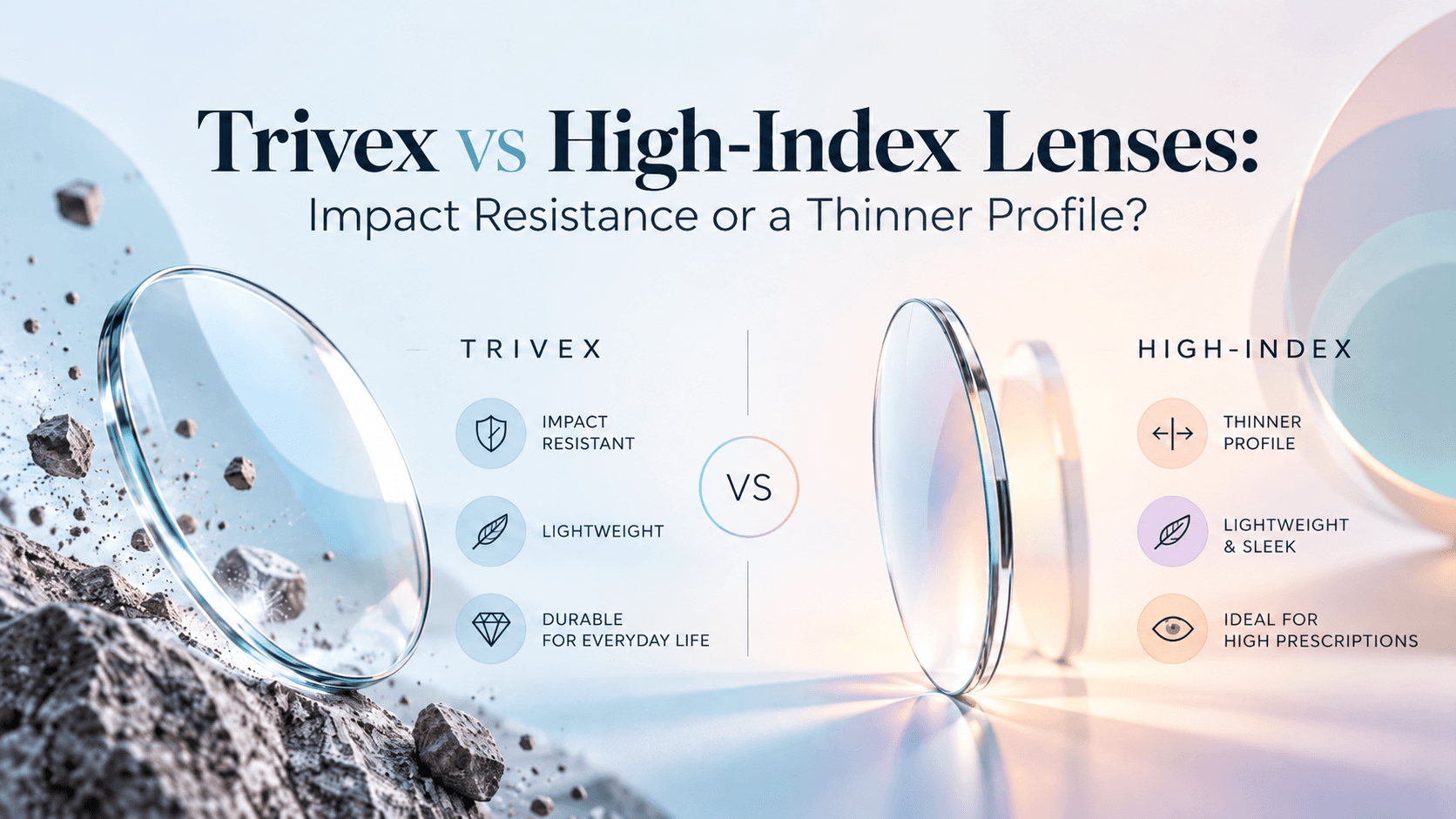
Trivex lenses offer superior impact resistance and optical clarity, making them the safer choice for active lifestyles and rimless frames. High-index lenses, on the other hand, are engineered to be thinner and lighter for strong prescriptions, prioritising a sleek look over toughness. The right pick depends on your prescription strength, daily activities, and what you value most in a pair of glasses.
What Are Trivex Lenses?
Trivex is a urethane-based lens material developed originally for military and law-enforcement visors. It carries an ANSI Z87.1 impact-resistance certification, meaning it can withstand significant force without shattering. Despite being tough, Trivex lenses are surprisingly lightweight — often lighter than standard polycarbonate. Their Abbe value (a measure of optical clarity) sits around 43-45, which is notably higher than polycarbonate's 30, resulting in sharper, less distorted peripheral vision.
What Are High-Index Lenses?
High-index lenses are made from dense optical plastics that bend light more efficiently, allowing manufacturers to grind them thinner. Common high-index values range from 1.60 to 1.74. The higher the index number, the thinner the finished lens — a genuine cosmetic advantage for prescriptions above ±4.00 diopters. However, their Abbe value drops as the index rises (as low as 30-33 for 1.74), meaning slight chromatic aberration can appear at the edges of strong prescriptions.
Trivex vs High-Index: How Do They Compare?
Impact resistance: Trivex wins decisively. High-index lenses are more brittle and can crack under sharp impact.
Lens thickness: High-index is the clear winner for strong prescriptions (above ±4.00D). Trivex lenses are comparable to 1.60 high-index for mild to moderate prescriptions.
Optical clarity: Trivex has a better Abbe value, delivering sharper peripheral vision with less colour fringing.
Weight: Trivex has a lower specific gravity (around 1.11) than most high-index materials (1.30-1.47), so it is lighter even when lens thickness is similar.
UV protection: Both materials block 100% UV-A and UV-B rays inherently — no separate coating required.
Cost: High-index 1.74 lenses are generally the most expensive option. Trivex sits in the mid-to-premium range but is often more affordable than the highest index tiers.
When Should You Choose Trivex?
Trivex is the smarter pick if you lead an active lifestyle, play contact sports, or work in environments with flying debris. It is also the recommended material for children's eyeglasses because of its safety profile. Rimless and semi-rimless frames benefit from Trivex too, since the drill points are less likely to crack under stress compared to high-index alternatives.
When Should You Choose High-Index?
If your prescription is high — typically above ±4.00 diopters — and aesthetics matter to you, high-index lenses will noticeably reduce the "thick-lens" look. They suit full-rim frames best, where the frame edge hides any minor peripheral distortion. Frequent glasses-wearers who prioritise a slim, modern silhouette often find high-index lenses worth the premium.
Caring for Either Lens Type
Both Trivex and high-index lenses require an anti-reflective (AR) coating to perform at their best — without it, surface reflections reduce clarity and comfort. Clean them with a microfibre cloth and a lens-safe solution; avoid paper towels or rough fabrics that can scratch coatings. Store your glasses in a hard case when not in use. High-index lenses can be slightly more heat-sensitive, so avoid leaving them on dashboards in summer.
