
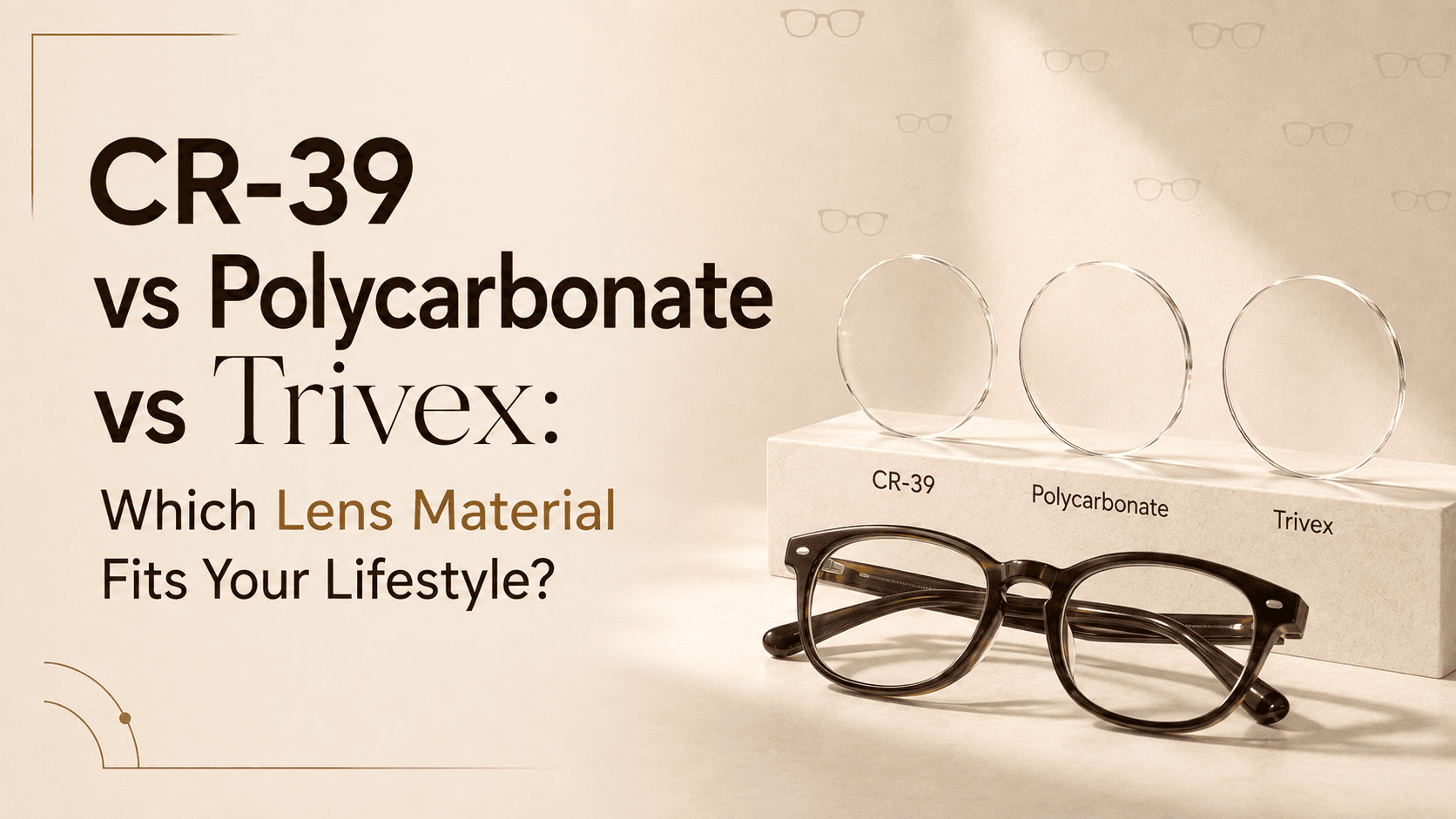
The best lens material for you depends on your prescription strength, activity level, and budget. CR-39 plastic delivers the sharpest optics at the lowest price and suits mild prescriptions. Polycarbonate is the go-to for active lifestyles and children because it is impact-resistant and lightweight. Trivex combines the optical clarity of CR-39 with the toughness of polycarbonate, making it ideal for demanding daily use — at a slightly higher cost.
What Is CR-39 and Who Should Choose It?
CR-39 is a lightweight plastic resin developed in the 1940s and still the most widely used ophthalmic lens material globally. It offers excellent optical clarity, easy tinting for sunglasses, and the most affordable price point among the three materials.
Best for: Adults with low to moderate prescriptions (roughly -4.00 to +4.00) who prioritise sharp vision and value for money. Because CR-39 is thicker than polycarbonate or Trivex at higher prescriptions, it is less ideal if your power goes beyond that range.
What Is Polycarbonate and Who Should Choose It?
Polycarbonate lenses are made from a thermoplastic originally engineered for spacecraft windows and safety shields. They are roughly 10 times more impact-resistant than CR-39, inherently block 100% of UV rays, and are about 20% lighter.
Best for: Children, athletes, people with rimless or semi-rimless frames, and anyone who works in physically demanding environments. Polycarbonate is also the standard recommendation for high prescriptions because it is naturally thinner. The trade-off is a slightly lower Abbe value (around 30), meaning some users notice mild colour fringing at extreme gaze angles.
What Is Trivex and Who Should Choose It?
Trivex is a urethane-based monomer introduced in 2001. It matches polycarbonate's impact resistance and UV protection while offering a significantly higher Abbe value (around 43-45), which translates to noticeably crisper peripheral vision.
Best for: Professionals and adults who spend long hours in front of screens or driving, people with mid-to-high prescriptions who want both safety and optical quality, and those who found polycarbonate lenses uncomfortable for extended wear. Trivex is typically priced 15-25% higher than polycarbonate.
CR-39 vs Polycarbonate vs Trivex: A Quick Comparison
Optical clarity (Abbe value): CR-39 ~58 | Trivex ~43-45 | Polycarbonate ~30
Impact resistance: Polycarbonate = Trivex (both very high) | CR-39 (moderate)
Weight: Trivex (lightest) | Polycarbonate | CR-39 (heaviest at high prescriptions)
UV protection: Built-in for polycarbonate and Trivex; requires coating for CR-39
Cost (India): CR-39 most affordable | Polycarbonate mid-range | Trivex premium
Tintability: CR-39 easiest to tint | Trivex good | Polycarbonate more difficult
How to Maintain Your Lenses Regardless of Material
No matter which material you choose, proper care extends lens life considerably. Always rinse lenses under lukewarm water before wiping to remove abrasive dust particles. Use a microfibre cloth — never tissues or clothing — and a lens-safe cleaning solution. Store glasses in a hard case when not in use. Polycarbonate and CR-39 surfaces scratch more easily than glass, so an anti-scratch coating is strongly recommended for all three materials. For screen-heavy routines, pairing any of these lenses with a blue-light filter coating adds a practical layer of protection without affecting optical performance.
