
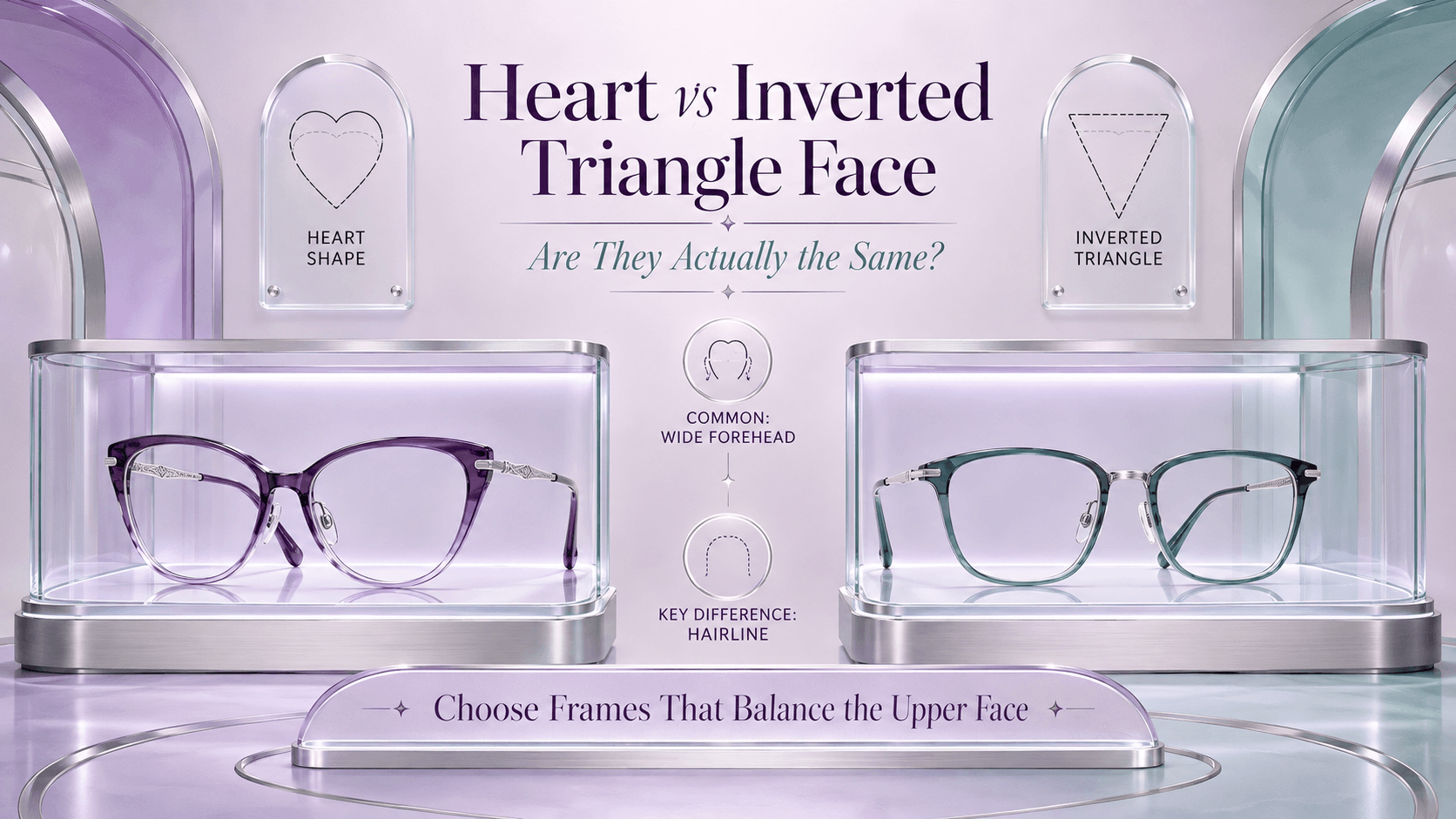
Heart and inverted triangle face shapes are often used interchangeably, and for good reason — both feature a wider forehead and cheekbones that taper down to a narrower chin. The key difference is the hairline: heart-shaped faces have a softer, sometimes V-shaped hairline (including a widow's peak), while inverted triangle faces have a straighter, broader forehead with sharper angularity. In practical terms, the best eyewear strategies for both shapes overlap significantly.
What Makes a Heart Face Shape?
A heart-shaped face is characterised by a wide forehead, prominent cheekbones, and a narrow, pointed chin. The face curves gently inward toward the chin, giving it a romantic, soft outline. A widow's peak hairline is a common (though not universal) marker. Think of it as top-heavy but with softer edges.
What Makes an Inverted Triangle Face Shape?
The inverted triangle face also has a broad forehead and narrow chin, but the overall structure feels more angular and geometric. The jawline is sharper, the cheekbones are more pronounced, and the face lacks the gentle taper of a heart shape. If your face looks like a triangle flipped upside down when you sketch it, this is your shape.
Heart vs Inverted Triangle: The Core Differences
Jawline: Heart faces have a soft, rounded jaw; inverted triangle faces have a sharper, more defined jaw.
Chin: Heart chins are delicately pointed; inverted triangle chins are narrow but often more flat or squared.
Hairline: Heart shapes may feature a widow's peak; inverted triangles typically have a straight, broad hairline.
Overall feel: Heart is soft and curved; inverted triangle is bold and angular.
Which Frames Work Best — and When to Choose What
Because both shapes share a wider top and narrower bottom, the goal with frames is the same: add width and visual weight to the lower half of the face to create balance.
Best Frames for Heart-Shaped Faces
Light, rimless or semi-rimless frames that don't add bulk to the upper face
Round and oval frames that echo the face's natural softness
Frames with detailing or colour on the lower half
Cat-eye styles worn lower on the nose to balance the forehead
Best Frames for Inverted Triangle Faces
Wider frames at the bottom to counterbalance the broad forehead
Rectangular or geometric frames that complement the angular structure
Aviators, which widen toward the bottom — a near-perfect match
Bold, full-rim frames that add presence to the lower face
Where Both Shapes Agree: Frames to Avoid
For either shape, avoid oversized square frames that amplify the forehead's width, or tiny frames that sit high on the face and draw attention upward. Heavy brow-bar styles can also make the upper face feel even wider.
A Simple Way to Tell Your Shape at Home
Stand in front of a mirror, pull your hair back fully, and trace the outline of your face on the mirror with a dry-erase marker or lip liner. If the outline curves gracefully to a soft point at the chin, you likely have a heart face. If the sides drop more steeply and the chin feels flatter or more angular, lean toward inverted triangle. When in doubt, heart is the softer read, inverted triangle is the sharper one.
Either way, the frame families that flatter you are almost identical — so you have a wide, stylish runway to explore.
