
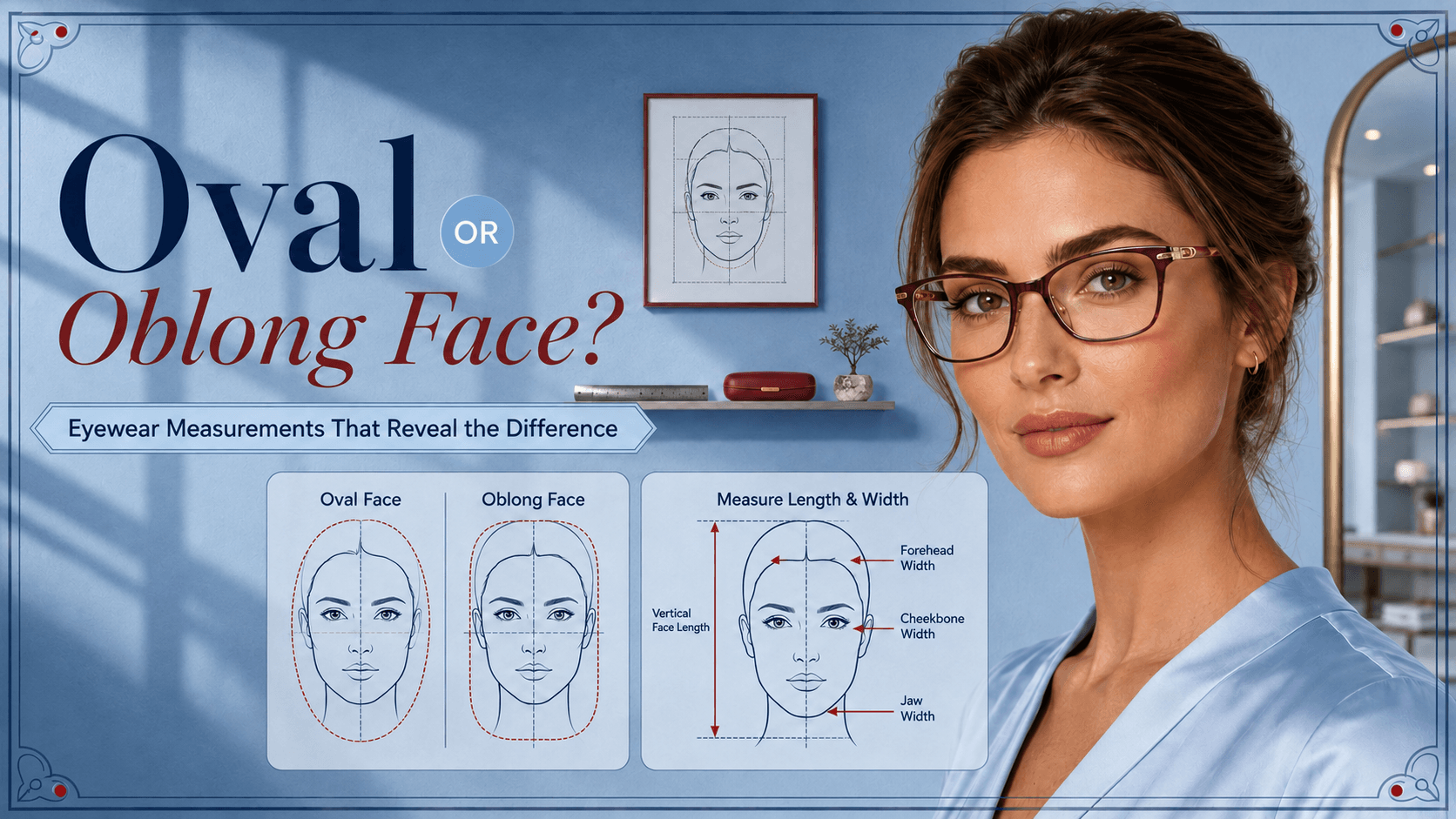
If your face is longer than it is wide and gently curved at the jaw and forehead, you likely have either an oval or oblong face shape. The quickest way to tell them apart: measure your face length against its width. An oval face has a length roughly 1.5 times its width, while an oblong face is noticeably longer — often with a flatter, less tapered jaw. That single ratio guides every frame-buying decision you will make.
How to Take the Two Key Measurements
You need only a soft tape measure and a mirror. Take these two readings:
Face length: Hairline at the centre of your forehead straight down to the tip of your chin.
Face width: Cheekbone to cheekbone across the broadest part of your face.
Divide length by width. A result between 1.4 and 1.6 points to an oval face. A result above 1.6 — especially if your chin and forehead are roughly the same width — indicates an oblong face.
Oval vs Oblong: What Actually Looks Different?
An oval face has balanced proportions, a slightly narrower forehead than cheekbones, and a gently rounded chin. An oblong face shares that elongated shape but tends to be straighter along the sides, with less curve at the jaw. Think of it as oval's taller, flatter-sided cousin. Because the key difference is curvature and length, the frame styles that flatter each shape diverge in one important direction: how much visual width a frame adds.
Best Frame Styles for an Oval Face
Oval is considered the most versatile face shape because its balanced proportions suit almost any frame. That said, a few styles look especially sharp:
Classic wayfarers and geometric squares that maintain symmetry
Thin metal rounds that complement the natural curves
Aviators with a slight drop at the lower rim
Oversized frames — the balanced face carries them well without looking overwhelmed
The main caution: avoid frames that are too narrow from top to bottom, as they can make an oval face look longer than it is.
Best Frame Styles for an Oblong Face
The goal with an oblong face is to add the illusion of width and break up the vertical length. Frames that do this well include:
Wide rectangles and oversized squares — the broad horizontal line is your best friend
Clubmaster or browline frames, which draw the eye upward and across
Round and oval frames with a wide bridge, which soften the long silhouette
Bold temples and thick rims, which add visual mass at the sides
Avoid very tall or narrow frames, rimless styles, and anything with strong vertical detailing — they all amplify length.
One Quick Comparison Table in Plain Terms
Oval: Balanced length-to-width ratio (≈1.5x) · Rounded jaw · Works with nearly any frame shape · Avoid overly narrow frames.
Oblong: Higher length-to-width ratio (>1.6x) · Straighter sides · Needs width-adding frames · Avoid narrow, tall, or rimless styles.
Use Frame Measurements to Double-Check Fit
Once you know your face shape, check the frame's listed measurements before buying online. The lens width (the first number stamped inside most frames, e.g. 52-18-140) should be 48 mm or above for oblong faces to ensure adequate coverage. For oval faces, that number is more flexible — anywhere from 46 mm to 54 mm works depending on your preference. The bridge width (middle number) affects how centred the frame sits, so keep it within 2–3 mm of your own bridge measurement for the best fit.
