
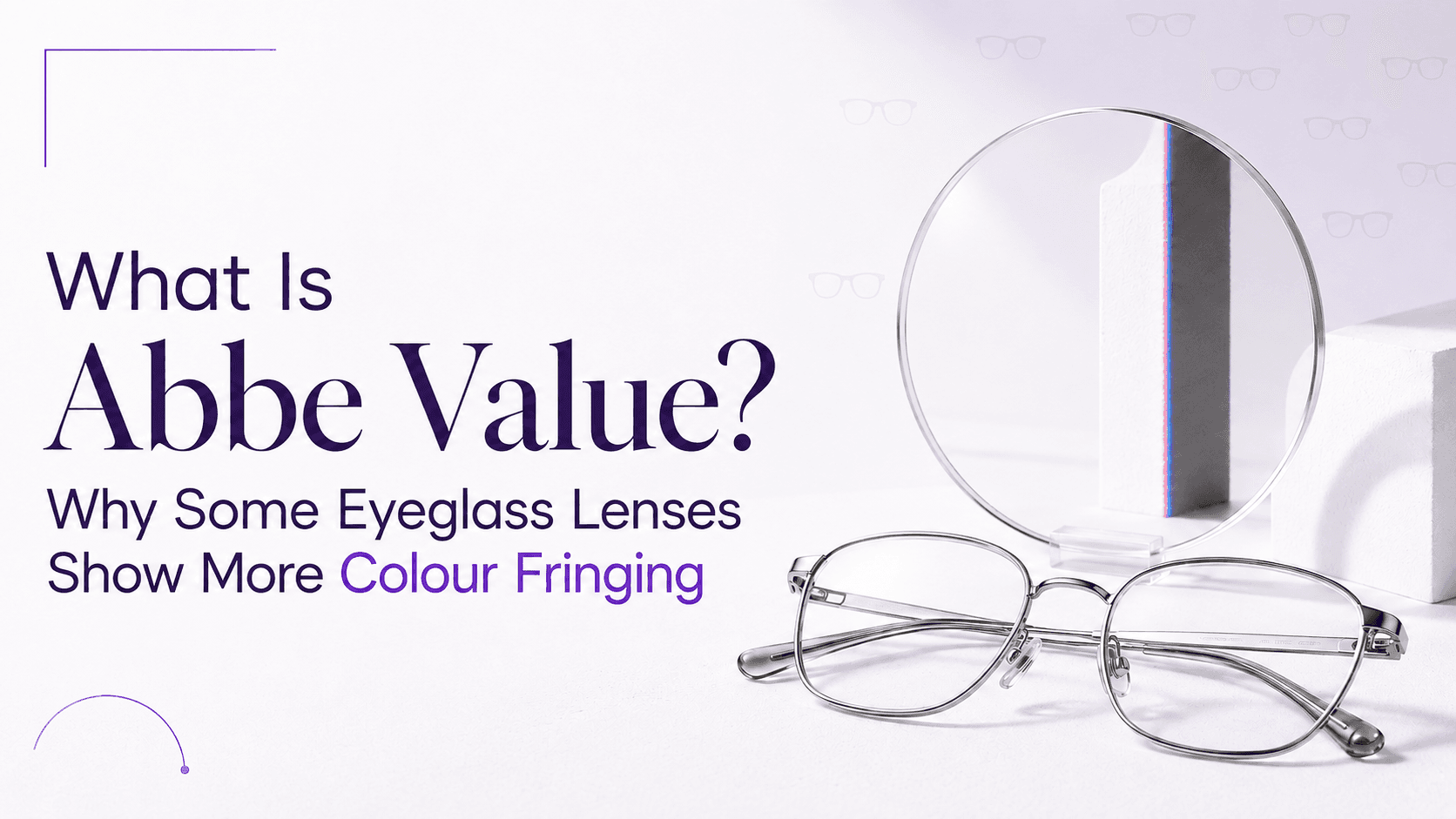
Abbe value is a number that tells you how much a lens material disperses light into its component colours. The higher the Abbe value, the less colour fringing (chromatic aberration) you will notice when looking through the edges of your lenses. Most everyday wearers never hear this term, yet it directly affects visual comfort — especially for people with stronger prescriptions.
What Exactly Is Abbe Value?
Named after German physicist Ernst Abbe, the Abbe value (also called the V-number) is a unitless figure that ranges roughly from 20 to 60 for common ophthalmic lens materials. A higher number means the material keeps colours tightly focused together. A lower number means white light splits more easily, producing faint rainbow fringes at the periphery of your vision.
Why Does Colour Fringing Happen in Lenses?
When light passes through any transparent material, different wavelengths (colours) bend at slightly different angles — a phenomenon called chromatic aberration. In eyeglass lenses, this appears as a subtle colour fringe, most visible when your eyes shift toward the edges rather than the optical centre. The effect grows more noticeable with stronger prescriptions because the lens is doing more bending work across a wider area.
Abbe Values of Common Lens Materials
Understanding where your lens material sits on the scale helps you make a smarter choice:
Crown glass (Abbe ~59): Excellent optical clarity but heavy and fragile. Rarely used today.
CR-39 plastic (Abbe ~58): The gold standard for optical quality among plastic lenses. Light, affordable, and low dispersion.
Polycarbonate (Abbe ~30): Impact-resistant and thin, but noticeably higher chromatic aberration. Popular for children's and safety eyewear despite the trade-off.
Trivex (Abbe ~45): A strong middle ground — impact-resistant like polycarbonate but with much better optical clarity.
High-index 1.67 (Abbe ~32): Thinner lenses for strong prescriptions, but chromatic aberration increases.
High-index 1.74 (Abbe ~33): The thinnest option available, with similar optical limitations to 1.67.
High-Index vs CR-39: Which Should You Choose?
If your prescription is mild (below ±3.00 D), CR-39 offers outstanding Abbe value and is typically the most optically pure choice. If your prescription is strong (above ±4.00 D or ±5.00 D), high-index lenses reduce thickness and weight considerably — the comfort gain often outweighs the slight increase in colour fringing that most wearers barely notice in daily use. Trivex is worth considering if you want impact resistance without the optical penalty of polycarbonate.
Does Lens Coating Affect Abbe Value?
No. Anti-reflective coatings, blue-light filters, and UV treatments do not change the base Abbe value of a lens material. However, a good anti-reflective coating does reduce internal reflections that can make chromatic aberration feel more pronounced, so pairing a high-index lens with quality AR coating is always recommended.
Practical Tips for Minimising Colour Fringing
Choosing the right lens material is the primary lever, but a few other factors help. Ensure your pupillary distance (PD) is measured accurately — a centring error pushes your eyes off the optical axis, worsening aberration. Smaller, well-fitted frames also keep your gaze closer to the optical centre, naturally reducing peripheral distortion. Ask your optician to note Abbe value alongside index when comparing lens options for your next pair.
