
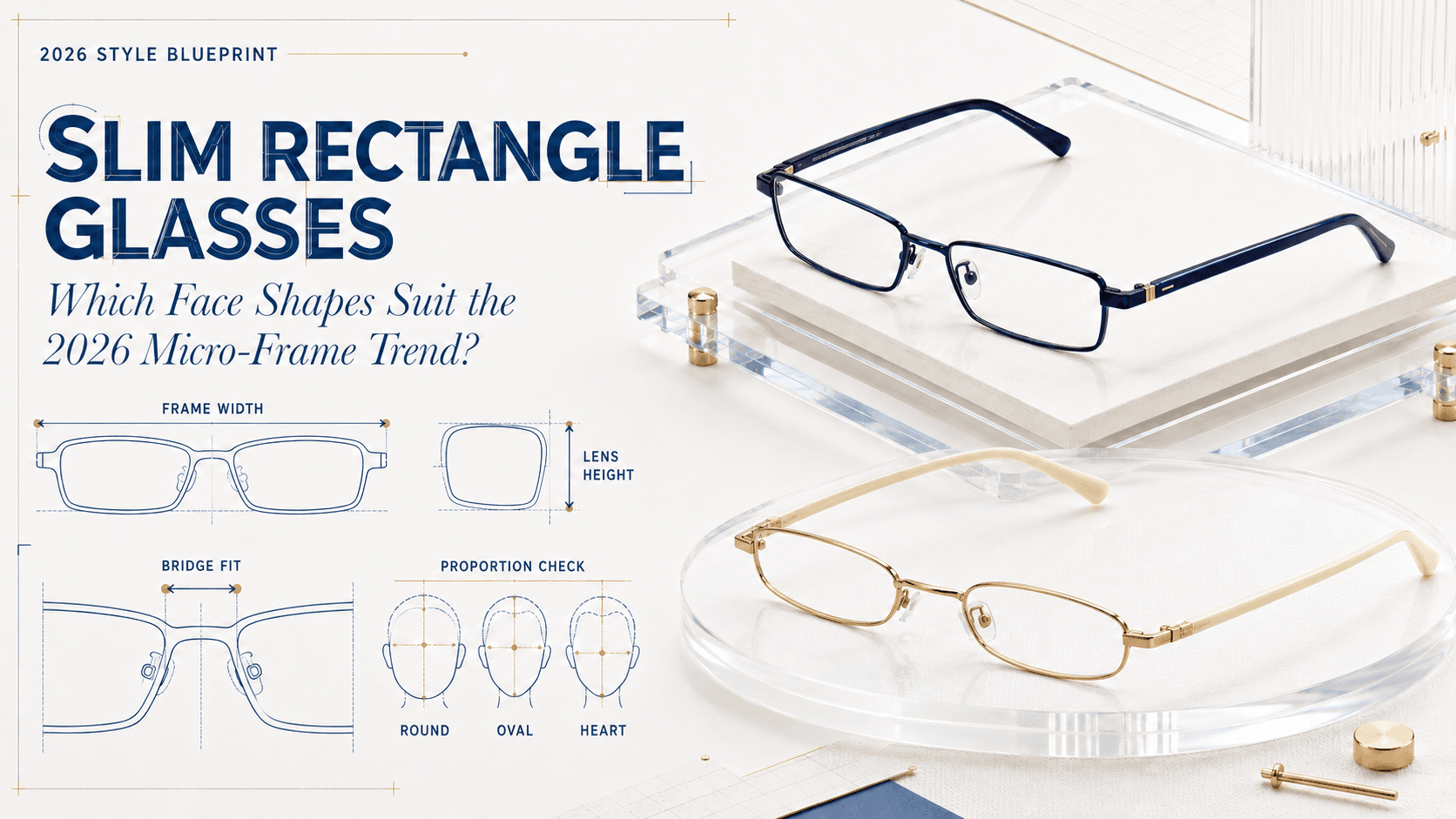
Slim rectangle glasses — narrow, low-profile frames with clean horizontal lines — suit oval, oblong, and diamond face shapes best. In 2026, the micro-frame revival pushes proportions even smaller, making frame selection more important than ever. If your face is round or heart-shaped, you can still wear them with the right fit adjustments.
What Exactly Is the 2026 Micro-Frame Trend?
The micro-frame trend describes eyeglass frames that sit noticeably smaller than the eye socket — think slim rectangular lenses, ultra-thin metal or acetate temples, and a deliberately understated silhouette. Influenced by late-90s minimalism and seen across global runways, the style has arrived in Indian fashion circles with a distinctly modern edge. Frames are flatter, lighter, and often feature rimless or semi-rimless constructions.
Which Face Shapes Suit Slim Rectangle Glasses?
Oval Face — Best Match
An oval face has balanced proportions and a gently tapered jawline. Slim rectangle frames complement this shape without overpowering it. Almost any micro-frame width works, but frames that sit just within the cheekbone width look most refined.
Oblong / Long Face — Strong Suit
Narrow frames add horizontal emphasis to a long face, which actually shortens its appearance optically. This is the one face shape where micro-frames deliver a genuine corrective benefit alongside the fashion statement.
Diamond Face — Surprisingly Good Fit
A diamond face has narrow forehead and jaw with wide cheekbones. A slim rectangle frame draws the eye centrally and balances the broader mid-face. Choose frames whose width does not extend past the cheekbones.
Round Face — Proceed Carefully
Round faces benefit from angular frames in theory, but micro-frames can look too small relative to fuller cheeks. If you have a round face, size up slightly to a medium-slim rectangle rather than the smallest micro option, and ensure the frame bridge sits high for length.
Heart Face — Choose the Right Width
A wider forehead and narrow chin mean you need a frame that does not add width at the top. Opt for slim rectangles with a low bridge and minimal brow bar so attention stays balanced rather than top-heavy.
Square Face — Use With Intention
Strong jaw angles and a broad forehead are not the natural home for sharp rectangular frames. That said, rimless or semi-rimless micro-rectangle styles soften the look enough to make it work. Avoid thick, fully acetate versions.
Micro-Frames vs. Standard Rectangle Frames: What Changes?
Standard rectangle glasses typically cover the full height of the eye area, providing generous lens space for progressive or bifocal prescriptions. Micro-frames, by contrast, have a reduced lens height — often 28–32 mm — which limits the corridor length for multifocal wearers. If you use progressive lenses, always confirm lens height compatibility with your optician before ordering. Single-vision wearers have far more flexibility and can embrace the trend without optical compromise.
How to Style Slim Rectangle Glasses in 2026
The micro-frame trend pairs naturally with minimalist Indian workwear, structured kurtas, and clean western casuals. Titanium and stainless-steel finishes in matte silver, gunmetal, or warm gold are the dominant choices this season. Tortoiseshell acetate in slim cuts also reads as premium without looking retro. Keep lens tint neutral — clear, light grey, or subtle amber — to maintain the understated aesthetic the trend demands.
Fit remains the deciding factor. A frame that sits correctly on the nose bridge and does not slide down the face will always look better than a trend-perfect silhouette that is the wrong size.
