
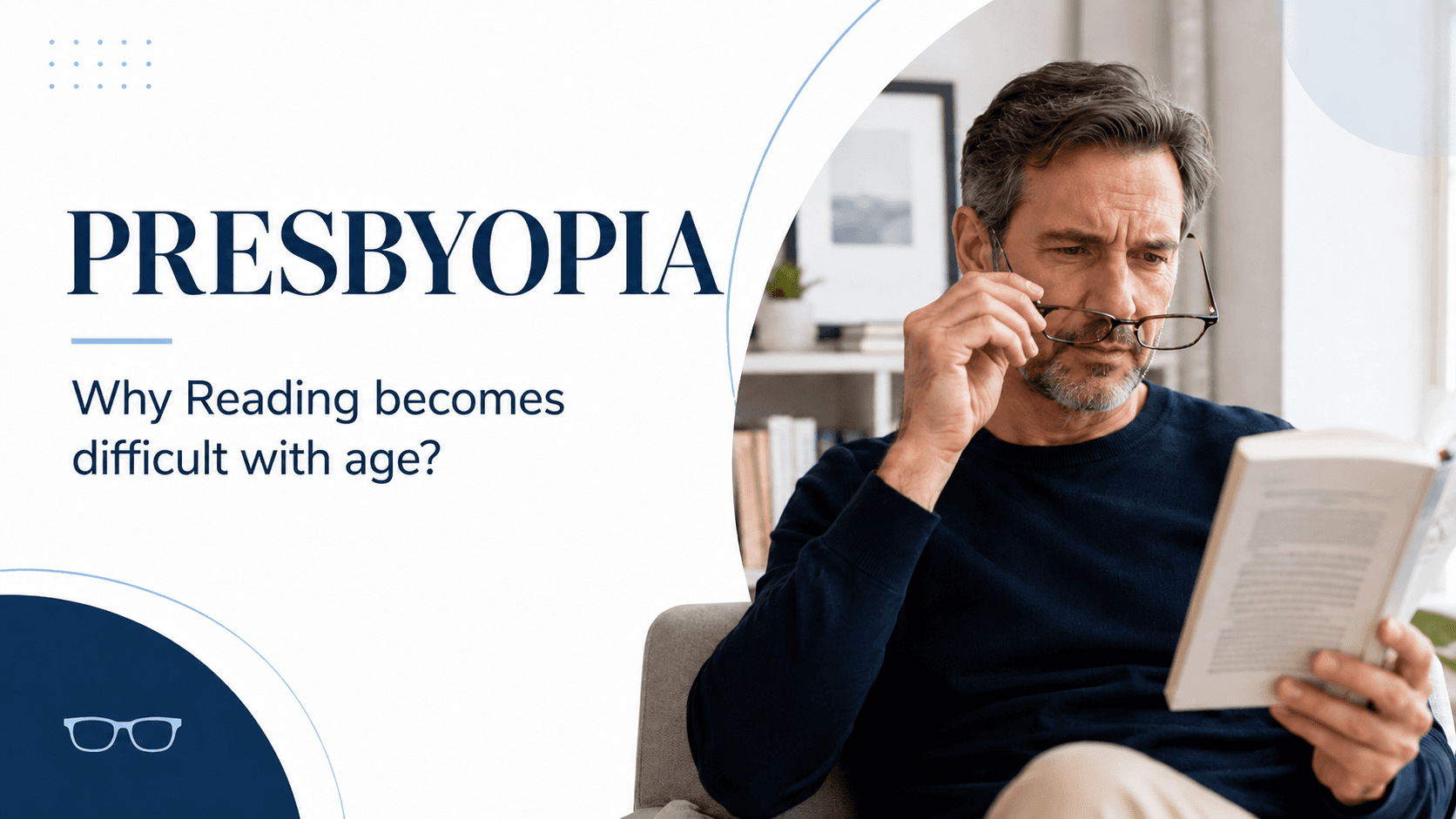
Presbyopia is the gradual loss of your eye's ability to focus on nearby objects, caused by the natural hardening of the eye's lens with age. It typically starts between 40 and 45, affects virtually everyone eventually, and is not a disease — it is a predictable part of ageing. The good news: it is fully correctable with the right prescription lenses.
What Exactly Is Presbyopia?
Your eye contains a flexible, crystalline lens sitting just behind the iris. In your younger years, tiny muscles called ciliary muscles squeeze and release this lens to change its shape — a process called accommodation. This is how your eye snaps from reading a WhatsApp message to looking across the room in an instant.
As you age, the lens gradually loses its elasticity. By your early 40s, it becomes stiff enough that those ciliary muscles can no longer bend it sufficiently for close-up tasks. The result: text looks blurry, you hold your phone at arm's length, and reading in dim light becomes genuinely exhausting.

Common Early Signs of Presbyopia
Most people first notice presbyopia in everyday situations rather than during an eye test. Watch for these signals:
Holding your phone, book, or menu further away to see it clearly
Needing brighter light to read comfortably
Eye strain or headaches after reading or screen use
Blurry vision at normal reading distance (30–40 cm)
Difficulty switching focus quickly between near and far objects
Fatigue after tasks like reading, stitching, or using a laptop
Is Presbyopia the Same as Myopia or Hyperopia?
No — and the distinction matters for your prescription. Myopia (nearsightedness) means distant objects are blurry; hyperopia (farsightedness) means the eye struggles to converge light from near objects even in youth. Presbyopia is specifically about the loss of accommodative flexibility with age. You can have myopia and presbyopia simultaneously — which is why many people over 40 find that their existing single-vision glasses no longer work for reading, even if distance vision is fine.
How Is Presbyopia Diagnosed?
A standard eye examination is all it takes. Your optometrist will measure your near vision using a reading chart and perform a refraction test to determine the add power — the extra magnification needed on top of your distance prescription to restore comfortable near vision. Add powers typically start around +0.75 D and can increase to +3.00 D or more as the condition progresses through your 50s and 60s.
What Are Your Lens Options?
Once presbyopia is confirmed, you have several corrective options depending on your lifestyle and budget:
Reading Glasses (Single-Vision Near)
The simplest solution. A dedicated pair of glasses optimised for near distance — great for reading, but you will need to take them off for anything beyond arm's reach. These are available with your exact prescription at Rimloo in a wide range of frames.
Bifocal Lenses
Classic bifocals have a visible line dividing the lens: the upper portion corrects distance, the lower portion corrects near vision. They are affordable and effective, but the abrupt switch between zones can feel jarring, and the line is cosmetically noticeable.
Progressive Lenses (No-Line Multifocals)
Progressives are the most popular modern choice. They offer a seamless gradient from distance at the top, through intermediate in the middle, to near at the bottom — no visible line, natural transitions. There is a short adaptation period of one to two weeks, but most wearers adjust quickly and prefer them for all-day use. If you spend significant time on screens, look for progressives designed with an extended intermediate zone to ease digital eye strain.
Office / Computer Progressives
A specialised category optimised for intermediate (50–70 cm) and near distances — ideal for desk workers who switch between a monitor and documents. Not suited for driving.
Presbyopia and Screen Use: A Double Challenge
For many Indian professionals over 40, presbyopia collides with long hours on laptops and smartphones. Digital eye strain — already caused by reduced blinking and blue-light exposure — becomes significantly worse when the lens can no longer accommodate efficiently. A combination of a correct progressive prescription and blue-light filtering lenses can meaningfully reduce end-of-day fatigue. Ask your eye doctor specifically about your working distance when getting your prescription, as the right add power depends partly on how far you sit from your screen.
Will Presbyopia Keep Getting Worse?
Yes, but only up to a point. Add power requirements typically plateau around age 60–65 once the lens has fully hardened. Expect to update your prescription every one to two years through your 40s and 50s. Regular eye examinations are important during this period — not just to fine-tune your correction, but to rule out other age-related conditions like glaucoma, cataracts, or macular changes that can appear in the same window of life.
Can Presbyopia Be Prevented or Reversed?
Currently, no lifestyle change or eye exercise reverses presbyopia — the lens hardening is biological and universal. Surgical options such as LASIK monovision, refractive lens exchange, or corneal inlays exist but involve trade-offs and are best discussed in depth with an ophthalmologist. For the vast majority of people, well-fitted corrective lenses remain the safest, most cost-effective long-term solution.
Choosing Frames for Your First Presbyopia Glasses
If this is your first prescription pair, frame choice matters more than you might expect. For progressive lenses specifically, the lens height (the vertical measurement of the frame) should ideally be at least 28–30 mm to accommodate all three vision zones comfortably. Very narrow, fashionable frames may not provide enough depth for a usable near zone. A Rimloo optician can advise you on frame compatibility before you buy.
