
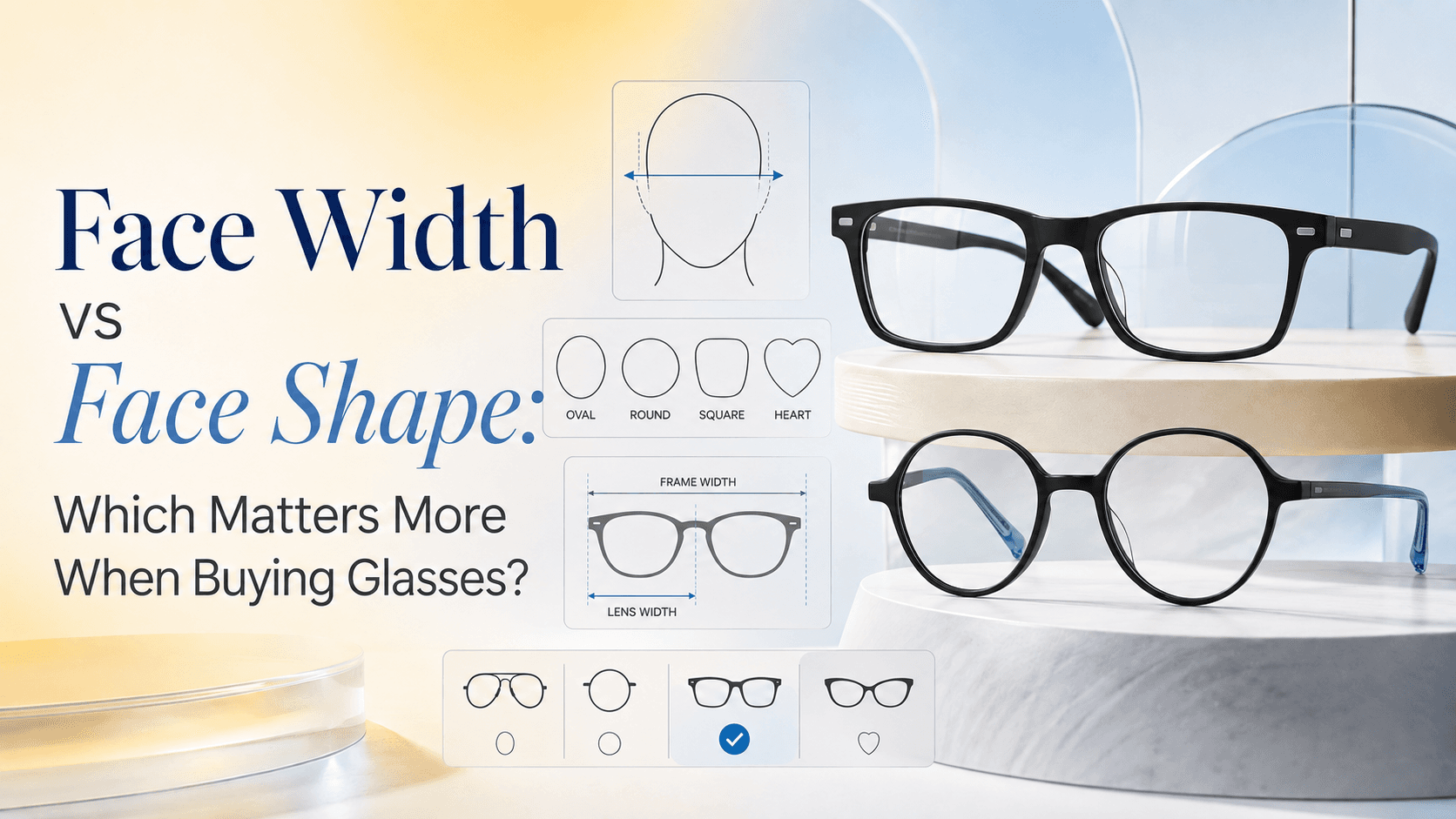
When buying glasses, face width matters just as much as face shape — arguably more for achieving a comfortable, proportional fit. Face shape tells you which frame styles flatter you aesthetically; face width tells you whether those frames will actually sit on your face without pinching your temples or sliding off your nose. The smart move? Use both together.
What Is Face Shape and Why Does Everyone Talk About It?
Face shape — oval, round, square, heart, diamond, or oblong — has been the go-to guide for glasses shopping for decades. The idea is simple: certain frame geometries balance your natural features. Oval faces suit almost anything, round faces benefit from angular frames, square faces soften with rounded edges, and so on.
It's genuinely useful advice. But here's the catch: two people can share the same face shape and have very different head sizes. A pair of frames that looks stunning on one person can look comically oversized on another. That's where face width steps in to save the day.
What Is Face Width and How Do You Measure It?
Face width is the horizontal distance across the widest part of your face — usually your cheekbones or temples. You can measure it at home with a soft tape measure or even a ruler held up to a mirror. Most adults fall somewhere between 125 mm and 150 mm.
Frame manufacturers encode this in the frame size numbers printed on the inner arm of every pair of glasses — something like 52-18-140. The first number is lens width, the second is bridge width, and the third is temple length. Add the first two numbers together and you get a rough idea of the total frame front width. Compare that to your face width measurement, and suddenly sizing makes a lot more sense.
Face Width vs Face Shape: Which Should You Prioritise?
Think of it this way: face shape is your style filter, and face width is your fit filter. Start with face width to narrow down which frame sizes will physically work on your face, then apply face shape guidance to choose the most flattering style within that size range.
If you skip face width entirely, you might fall in love with a beautiful round frame only to discover it's 10 mm too wide and makes you look like you're wearing someone else's glasses. Not the vibe.
Quick Guide: Matching Both Factors at Once
Narrow face (under 130 mm): Look for frames with a combined lens + bridge width under 130 mm. Cat-eye and oval shapes add width without overwhelming.
Average face (130–145 mm): Most standard frames will fit. Focus on face shape guidance to pick your flattering style.
Wide face (over 145 mm): Seek frames with a combined width of 145 mm or more. Rectangular and geometric frames balance broader features well.
The Best Approach: Try Before You Commit
Rimloo's virtual try-on tool lets you see frames on your actual face in real time — which means you're evaluating both fit and style simultaneously, exactly as you should. Browse prescription eyeglasses or sunglasses and use the size guide on each product page to cross-check frame width against your measurement.
Face shape is the map. Face width is the compass. Use both, and you'll never buy ill-fitting glasses again.
