
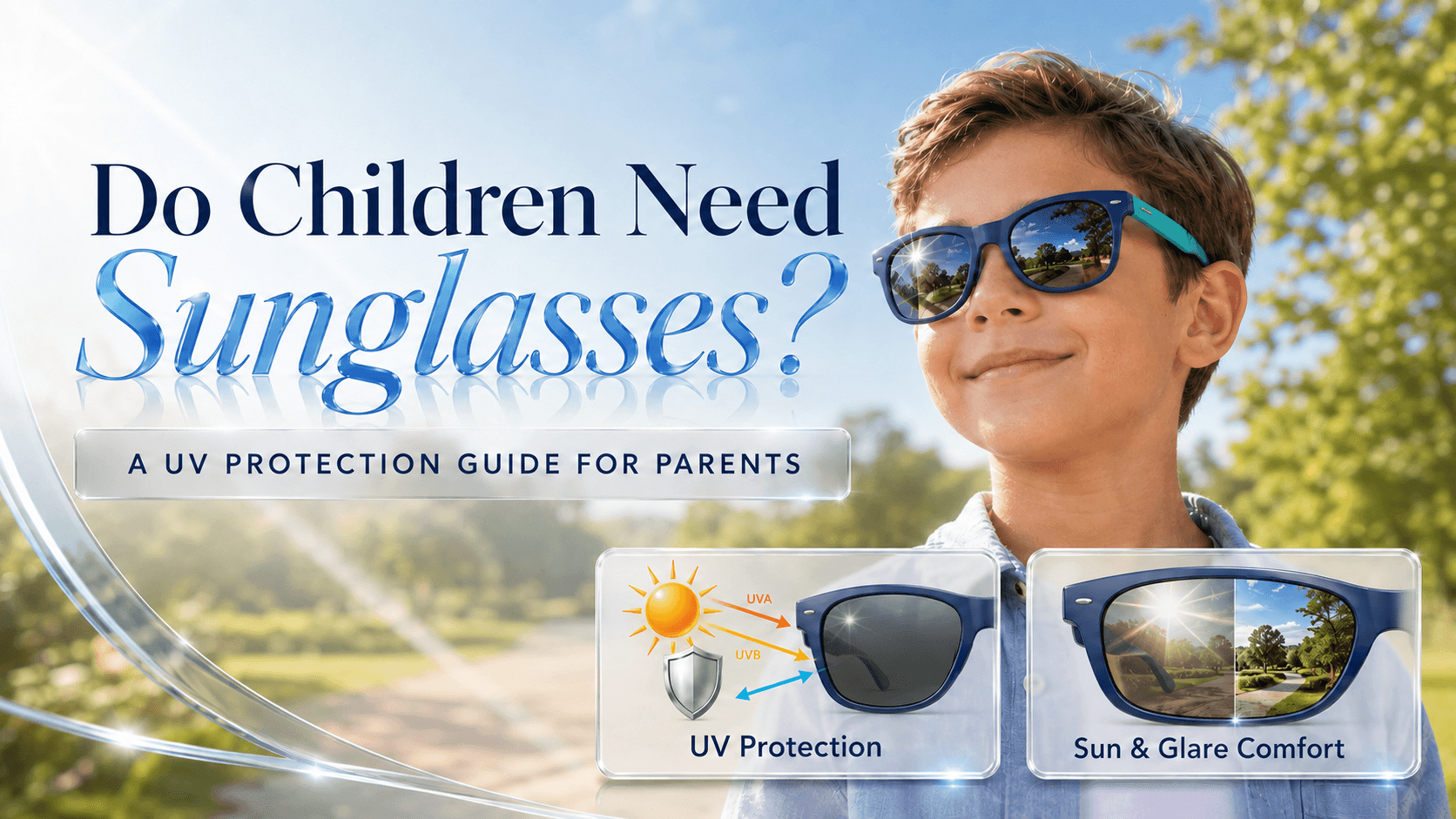
Yes, children absolutely need sunglasses. A child's crystalline lens is more transparent than an adult's, meaning significantly more UV radiation reaches the retina. Because cumulative UV exposure drives conditions like cataracts and macular degeneration later in life, protecting young eyes early is one of the best long-term investments a parent can make for their child's eye health.
Why Are Children's Eyes More Vulnerable to UV Damage?
Adult eyes develop a natural yellow pigment in the lens over time that absorbs a portion of UV and blue-light radiation. Children under 10 lack this pigment almost entirely, making their retinas far more susceptible to photochemical damage. Add to that the fact that kids in India often spend two to four hours outdoors daily — at school, on playgrounds, or during sports — and the cumulative UV dose climbs quickly.
At What Age Should Children Start Wearing Sunglasses?
Eye care professionals generally recommend UV-protective eyewear from as young as six months for prolonged outdoor exposure. By the time a child is three to four years old and spending significant time outside independently, proper sunglasses should be a non-negotiable part of their routine — much like sunscreen or a hat.
What to Look for When Buying Kids' Sunglasses
UV Protection Rating
Always choose lenses marked UV400 or labelled 100% UVA and UVB protection. Tint darkness alone does not indicate UV filtering ability — a dark lens without UV coating can actually be worse than no sunglasses at all, because the pupil dilates in shade while UV still passes through.
Lens Material
Polycarbonate lenses are the gold standard for children. They are impact-resistant, lightweight, and have inherent UV protection built into the material. Avoid glass lenses for kids entirely — they shatter on impact and pose a serious injury risk.
Fit and Coverage
Look for wraparound or wide-frame styles that limit UV from entering around the edges. The frame should sit close to the face without pressing on the nose or cheeks. A secure fit matters because children move vigorously — loose sunglasses get discarded quickly.
Polarised vs Non-Polarised
Polarised lenses reduce glare from reflective surfaces like water, roads, and cricket pitches, making them excellent for outdoor sports and beach trips. They do not add UV protection on their own but significantly improve visual comfort, which means children are more likely to keep the glasses on.
Indian Conditions: Why UV Risk Is Higher Here
India sits closer to the equator than most of Europe or North America, which means UV index levels frequently reach 8–11 (very high to extreme) between March and September. Peak hours — roughly 10 a.m. to 4 p.m. — are precisely when school breaks and outdoor play happen. Haze and overcast skies do not block UV meaningfully, so protection is needed even on cloudy days.
Helping Children Build the Sunglasses Habit
Compliance is the real challenge. Let your child choose the frame colour or style so they feel ownership over their eyewear. Keep a dedicated pair in the school bag and one at home near the door. Modelling the behaviour yourself — wearing your own sunglasses consistently — is the single most effective way to normalise the habit for young children.
If your child already wears prescription glasses, consider prescription sunglasses or photochromic lenses that darken automatically in sunlight. Both options eliminate the need to juggle two pairs and ensure UV protection is never skipped.
