
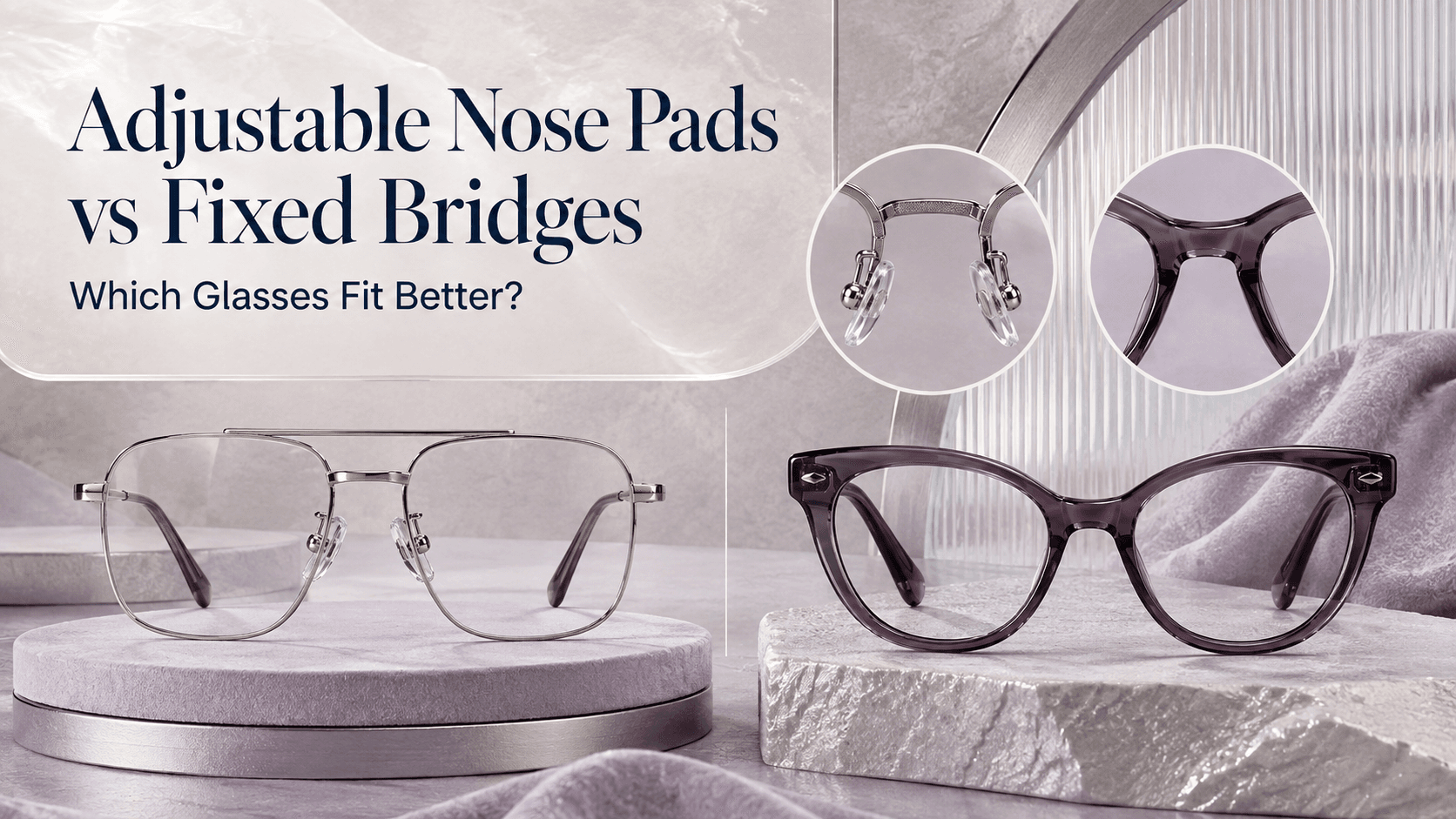
Adjustable nose pads generally offer a more personalised fit because an optician or you can reposition them to match the exact width and height of your nose. Fixed bridges, moulded directly into the frame, work best when the bridge width already matches your anatomy. Neither is universally superior — the right choice depends on your nose shape, face structure, skin sensitivity, and the frame material you prefer.
What Are Adjustable Nose Pads?
Adjustable nose pads are small silicone or acetate cushions mounted on metal arms that extend from the frame front. Because the arms can be bent inward or outward, up or down, the glasses can be fine-tuned to sit at the exact right height on your nose, preventing them from sliding down or digging in. They are most commonly found on metal frames and rimless or semi-rimless styles.
Who benefits most: People with a low or narrow nose bridge, those with high cheekbones that push frames upward, and anyone whose glasses tend to slide during physical activity will usually find adjustable nose pads a game-changer.
What Are Fixed Bridges?
A fixed bridge is part of the frame itself — think of the classic saddle bridge on a round acetate frame or the keyhole bridge on a vintage-inspired pair. There are no separate pads; the frame rests directly on the sides of your nose. Fixed bridges are the standard construction in most acetate, TR-90, and injected plastic frames.
Who benefits most: People with a medium-to-high nose bridge that matches the frame's bridge width, and those who prefer a minimalist, pad-free look with fewer parts to clean or replace.
Adjustable Nose Pads vs Fixed Bridges: A Direct Comparison
Fit Flexibility
Adjustable nose pads win on customisation. If your prescription glasses need to sit at a precise optical centre height — especially important for progressive or bifocal lenses — being able to reposition the pads by even a millimetre can meaningfully improve your vision clarity. Fixed bridges offer zero adjustment; you must rely on the frame's bridge width matching yours from the start.
Comfort Over Long Hours
Silicone nose pads distribute weight across a smaller contact area, which can feel more secure. However, some wearers find that pads leave red marks or indent the skin after extended wear. Fixed bridges spread pressure over a broader surface of the nose and tend to feel gentler for people with sensitive skin — provided the bridge width is correct.
Stability During Activity
For sports, gym sessions, or a humid Indian summer, adjustable nose pads can be positioned to grip the nose more firmly, reducing slippage. Many fixed-bridge frames, particularly lightweight TR-90 styles, also stay put well, but they offer no on-the-fly correction if the fit is slightly off.
Maintenance and Durability
Adjustable nose pads are small components that can loosen, discolour, or wear out over time. Replacing silicone nose pads is inexpensive and straightforward, but it is an extra maintenance step. Fixed bridges have no removable parts, making them simpler to clean and less prone to small-part loss. See our eyewear maintenance guide for cleaning tips that apply to both types.
Aesthetics
Fixed bridges are preferred when you want a clean, uninterrupted frame aesthetic — common in minimalist, retro, and fashion-forward designs. Adjustable nose pads are nearly invisible on thin metal frames but can look slightly clinical on certain styles. If eyewear style matters to you as much as function, this is worth considering before you buy.
How to Know Which Bridge Type Suits Your Nose
Measure your nose bridge width — the distance between the inner corners of your eyes. Most adults fall between 14 mm and 22 mm. If a fixed-bridge frame lists a bridge width within 1-2 mm of your measurement, it should fit well. If you consistently find frames sliding down or sitting too high, adjustable nose pads are the practical solution.
People of South Asian and East Asian descent often have a flatter, lower nose bridge profile. Fixed bridges on frames designed for higher nose bridges will sit too close to the face, causing lashes to brush the lens. In this case, adjustable nose pads are almost always the better starting point.
What About Kids' Glasses?
For children, a secure fit is critical — both for vision accuracy and to prevent the glasses from being knocked off during play. Flexible TR-90 frames with a wide, low fixed bridge are popular for younger children, while older kids can transition to metal frames with adjustable pads that can be readjusted as their face grows.
When to Choose Adjustable Nose Pads
Choose adjustable nose pads if you have a low or flat nose bridge, if your prescription requires precise optical centre alignment (high prescriptions, progressives), if you wear glasses for 8+ hours a day and need a customised fit, or if previous frames have always slipped despite trying multiple sizes.
When to Choose a Fixed Bridge
Choose a fixed bridge if your nose bridge measurement closely matches the frame spec, if you prefer low-maintenance eyewear with fewer small parts, if you have sensitive skin that reacts to silicone pads, or if you are drawn to acetate and plastic frames where fixed bridges are the design norm.
Final Thought
A well-fitting pair of glasses should sit comfortably without adjustment throughout the day, keep the lenses at the correct optical position, and leave no persistent pressure marks. Whether that comes from adjustable nose pads or a fixed bridge depends entirely on your unique facial anatomy. When in doubt, opt for adjustable nose pads — the extra flexibility is always an advantage, never a disadvantage.
