
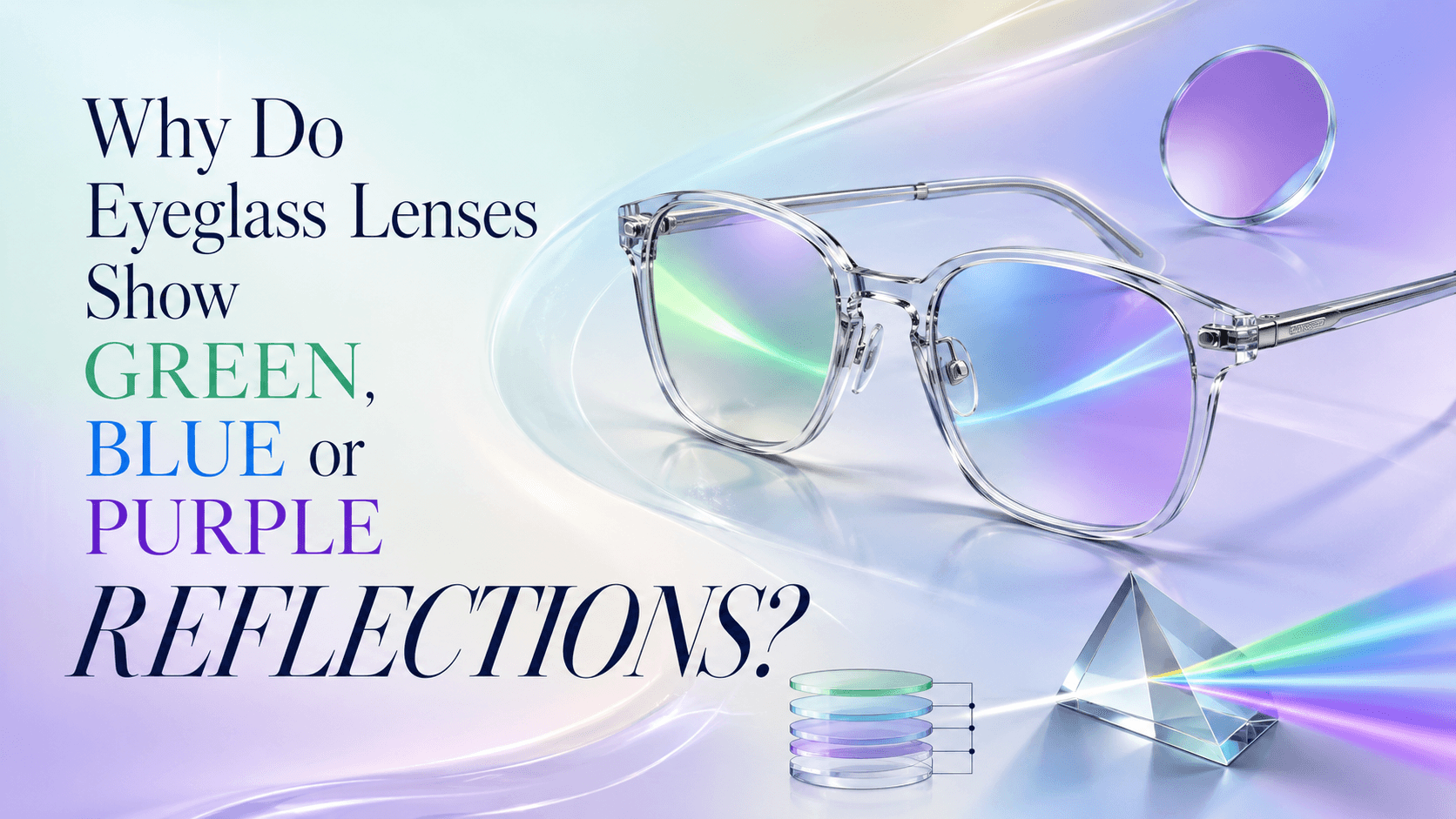
A green, blue or purple reflection on your eyeglass lenses is usually normal. It is commonly the small amount of light—called residual reflection—left behind by an anti-reflective coating.
These colours do not automatically mean your lenses are tinted, defective or better than another pair. The exact reflection depends on the coating design, lighting and viewing angle.Are green reflections on eyeglasses normal?
Why Do Coated Lenses Reflect Different Colours?
An uncoated lens reflects some incoming light, which can create glare and make the lenses more visible. Anti-reflective coatings use several extremely thin layers to reduce these unwanted reflections and allow more light to pass through the lenses.
Light reflecting from different coating layers interacts through a process called thin-film interference. Certain wavelengths are reduced, while a small amount remains visible as green, blue or purple. The apparent colour can shift as the viewing angle changes. OpenStax explains the underlying thin-film interference principle.
What Does a Green Reflection Mean?
Green is a common residual colour in standard anti-reflective coatings. It generally indicates that the coating is managing reflections across the visible spectrum rather than allowing bright white glare to remain.
ZEISS notes that residual reflections are commonly green, although different coating technologies may produce other colours. Read ZEISS’s lens-coating explanation.
Why Do Some Lenses Reflect Blue or Purple?
A subtle blue or purple reflection may come from:
A modern anti-reflective coating
A coating designed to manage selected blue wavelengths
Differences in coating materials and layer thickness
LED lighting, screens or the angle at which the lenses are viewed
Some blue-light-filtering coatings intentionally reflect part of the blue light reaching the lens. HOYA, for example, explains that certain treatments show a blue reflex because some blue light is reflected instead of transmitted. See HOYA’s anti-reflective coating information.
However, a blue reflection does not automatically prove that a lens offers strong blue-light filtering. Some filters are built into the lens material and may show little visible blue reflection.
Does Reflection Colour Indicate Lens Quality?
Not by itself. A premium coating may show green, blue, purple or another subtle residual colour. More useful quality indicators include:
Clear vision with minimal distracting glare
Even coating across both lenses
Good scratch, water and smudge resistance
Comfortable vision in bright light and at night
A coating suited to your prescription and daily activities
Anti-reflective coatings use wave interference to reduce unwanted reflected light, according to Nikon Lenswear.
When Should You Ask an Optician?
Normal coating reflections are smooth, subtle and change with the angle of light. Have your lenses inspected if you notice persistent cloudiness, peeling, cracks, patchy rainbow areas, sudden glare or a major difference between the two lenses. These signs may indicate scratches, heat damage or coating deterioration.
