
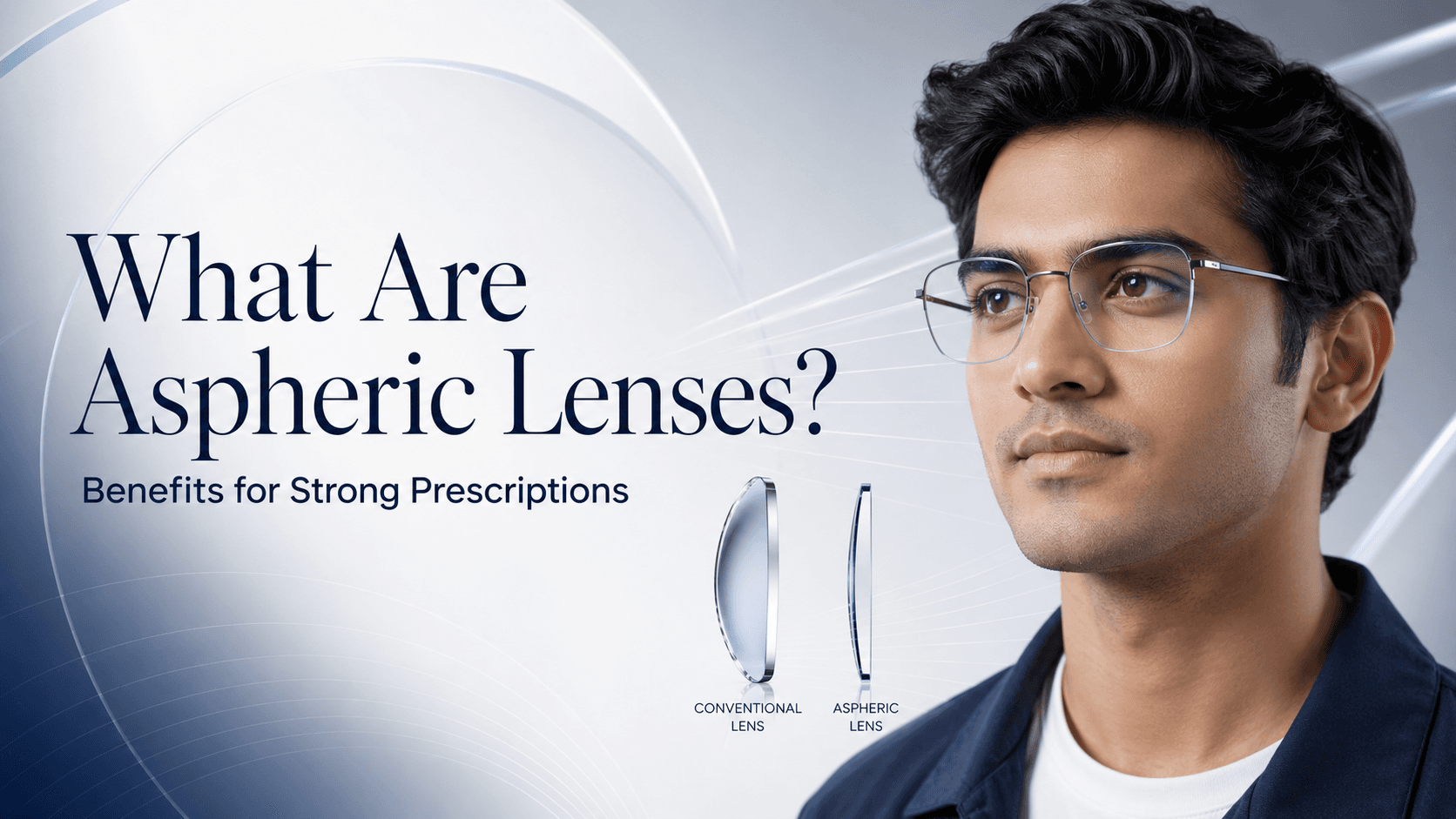
Aspheric lenses have a varying surface curvature that reduces the bulging or hollowing effect common in traditional spherical lenses, resulting in thinner, lighter glasses with sharper peripheral vision. For prescriptions above ±4.00 diopters, they are widely considered the superior choice by optometrists.
What Makes a Lens 'Aspheric'?
A conventional spherical lens curves uniformly like the surface of a ball. An aspheric lens, by contrast, gradually changes its curvature from the centre to the edge. This seemingly small engineering difference has a significant impact on how light is focused onto your retina—and on how your glasses look and feel on your face.
Because the surface profile is more precisely calculated, aspheric lenses can achieve the same refractive correction with far less material. The result is a lens that sits flatter against the frame and does not magnify or minimise your eyes as dramatically as an equivalent spherical lens would.
How Do Aspheric Lenses Compare to Spherical Lenses?
Understanding the difference helps you make a more confident decision at the optician's counter.
Thickness: Aspheric lenses can be up to 25–30% thinner than spherical lenses of the same prescription power.
Weight: Less material means a lighter frame-and-lens combination, reducing nose-bridge pressure during long wear.
Peripheral distortion: Spherical lenses introduce aberrations toward the edges; aspheric designs correct much of this, giving clearer side vision.
Cosmetic appearance: Strong plus lenses no longer magnify your eyes to an uncomfortable degree; strong minus lenses look far less concave from the front.
Price: Aspheric lenses typically cost more than standard spherical lenses, but the optical and cosmetic gains usually justify the investment for higher prescriptions.
Who Benefits Most from Aspheric Lenses?
Anyone can wear aspheric lenses, but the advantages are most pronounced in specific situations.
High Plus Prescriptions (Hyperopia / Farsightedness)
If your prescription reads +3.00 or higher, a spherical lens produces noticeable thickness at the centre and a magnifying-glass effect that makes your eyes appear larger. Aspheric lenses flatten this profile substantially, both optically and aesthetically.
High Minus Prescriptions (Myopia / Nearsightedness)
Minus lenses are thickest at the edges. A strong prescription like −5.00 or beyond creates a characteristic 'coke-bottle' look in spherical form. Aspheric lenses trim edge thickness and reduce the minifying effect that makes eyes look smaller behind the lens.
Progressive and Bifocal Wearers
Many modern progressive lenses already incorporate aspheric or atoric designs in their distance zone. If you are graduating from single-vision to progressive lenses, specifying an aspheric design in the distance segment improves clarity across the entire visual field.
People Sensitive to Peripheral Blur
Some wearers notice swimming or distortion when they move their eyes toward the lens edges—a phenomenon known as spherical aberration. Aspheric lenses minimise this effect, which is especially helpful during driving or sports.
Aspheric vs Atoric Lenses: Is There a Difference?
You may encounter the term atoric when shopping for aspheric lenses. An atoric lens is essentially an aspheric design applied to lenses that also correct astigmatism (cylinder power). If your prescription includes a cylinder value (e.g., −1.50 CYL), an atoric lens ensures that the asphericity is optimised across both principal meridians, delivering sharper vision than a standard aspheric lens would in this context. Ask your optician specifically for an atoric design if your prescription includes significant cylinder correction.
What Lens Index Should You Pair with Aspheric Design?
Aspheric lenses are available across multiple refractive index options. The higher the index, the thinner the lens for the same prescription power.
Index 1.56: Entry-level aspheric; suitable for prescriptions up to roughly ±3.00. Good value for mild-to-moderate corrections.
Index 1.60: A popular mid-range choice for prescriptions up to ±5.00. Noticeably thinner than 1.56 without a dramatic price jump.
Index 1.67: Recommended for prescriptions between ±5.00 and ±7.00. Significantly thinner and lighter.
Index 1.74: The thinnest widely available option; ideal for very strong prescriptions beyond ±7.00 diopters.
Pairing a high-index material with an aspheric design gives you the best of both worlds: the optical correction of the aspheric surface profile and the physical thinness of a dense, high-refractive-index material.
Coatings That Work Well with Aspheric Lenses
Because aspheric lenses are flatter, they can reflect light at different angles compared to spherical lenses, occasionally creating glare. An anti-reflective (AR) coating is therefore strongly recommended—it eliminates surface reflections, improves contrast, and makes your eyes visible to others rather than hidden behind distracting glare. A hard coating adds scratch resistance, which is important since thinner lenses can be slightly more susceptible to surface damage. UV protection is another sensible addition, as high-index materials vary in their natural UV absorption.
Tips for Getting the Most Out of Aspheric Lenses
Ensure your pupillary distance (PD) is measured accurately—aspheric lenses are more sensitive to optical centration than spherical ones.
Choose frames with a moderate eye-size (lens diameter); very large frames amplify edge thickness even in thin lenses.
Always request an AR coating alongside your aspheric lens; the two work together for optimal clarity.
Update your prescription before ordering; an outdated power reduces the optical benefit of any premium lens design.
Ask your optician about atoric design specifically if your prescription includes cylinder correction above 1.00 DC.
