
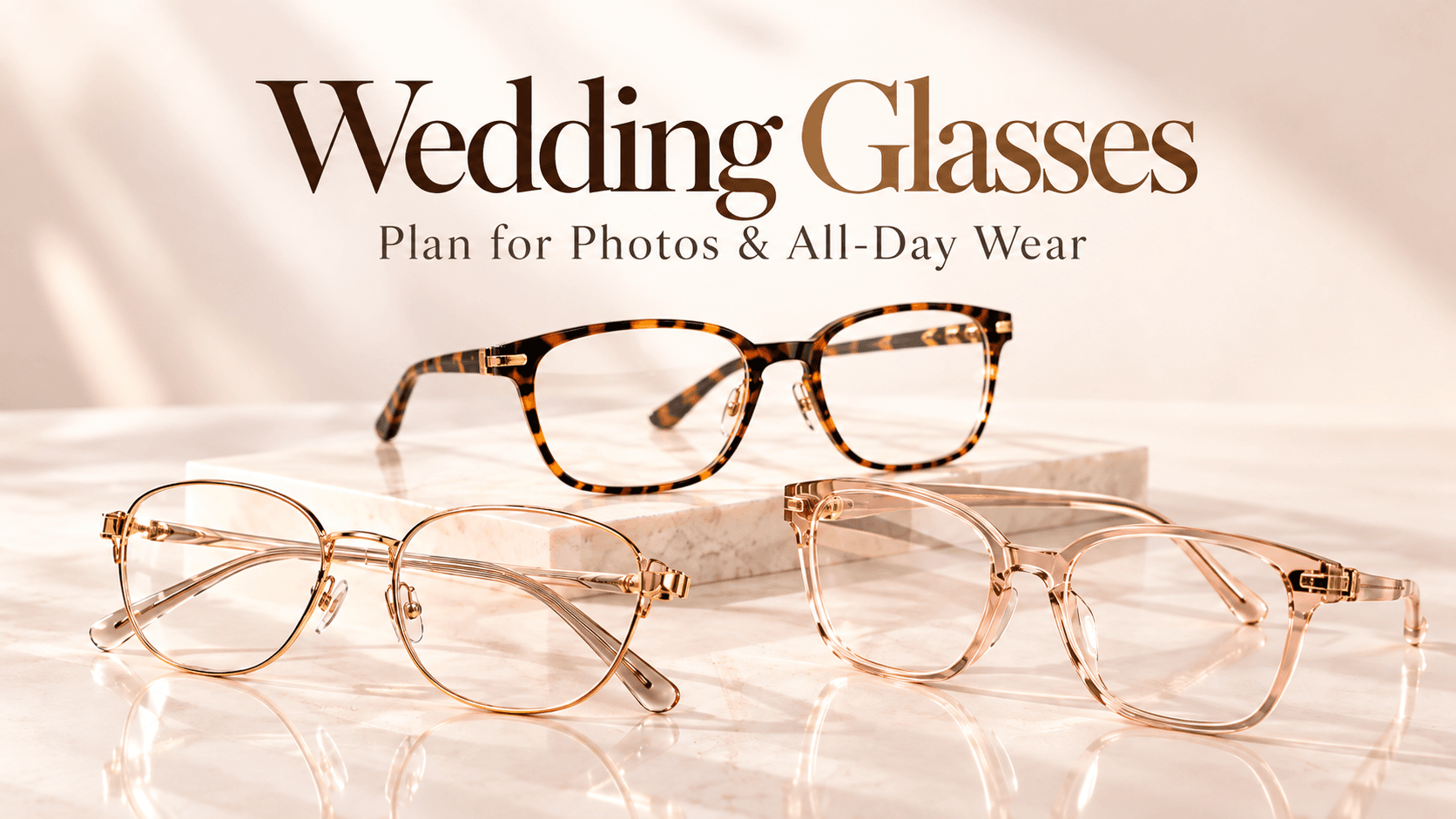
The best wedding glasses are lightweight, flattering on camera, and comfortable enough to wear from the morning ceremony to the last dance at midnight. Look for frames that complement your outfit, suit your face shape, and have an anti-reflective coating so lenses do not glare under flash photography. Getting this right requires a little planning, but the payoff is photos you will love for decades.
Why Your Regular Everyday Frames May Not Work on Your Wedding Day
Your daily glasses are chosen for routine life — not for high-resolution cameras, bright venue lighting, or hours of emotional wear. Heavy acetate frames can look overpowering in close-up portraits, while frames that sit slightly crooked become very obvious once enlarged. Wedding day light, both natural and artificial flash, also creates lens glare that washes out your eyes in photographs unless your lenses carry an anti-reflective (AR) coating.
How to Choose Frames That Look Great in Photos
Photography-friendly frames share a few common traits. Thin metal or rimless frames keep the focus on your face rather than the eyewear. Neutral or metallic tones — rose gold, silver, champagne, clear acetate — photograph cleanly against most wedding colour palettes. Avoid very dark or very thick frames unless bold eyewear is a deliberate part of your personal style.
Anti-reflective coating: Eliminates the white flash glare that obscures your eyes in photos. This is non-negotiable for wedding day lenses.
Thin metal or rimless silhouettes: Minimise visual weight and let your features read clearly on camera.
Neutral or metallic colour palette: Rose gold, silver, and clear frames complement most lehengas, sarees, sherwanis, and suits.
Proper fit: Frames that sit level and do not slide down your nose look polished in every shot. Visit an optician for a fitting adjustment before the big day.
Comfort for All-Day Wear: What to Prioritise
A wedding is typically a twelve-to-sixteen-hour event. Frames that feel fine in a shop can become a distraction by hour six. Titanium and beta-titanium frames are exceptionally lightweight and hypoallergenic — ideal if your skin reacts to nickel. Silicone nose pads distribute weight evenly and prevent the frame from slipping when you perspire. If you normally wear contact lenses, consider wearing glasses for the ceremony and switching to contacts for the reception, or vice versa, so neither your eyes nor your nose bridge feel fatigued.
Prescription vs. Non-Prescription: What Are Your Options?
If you wear prescription lenses, have your current prescription filled in your chosen wedding frame well before the event — ideally four to six weeks ahead — so you have time to adjust to any new lenses. If your prescription is mild, a non-prescription frame with AR-coated clear lenses is a stylish option that still solves the glare problem. Photochromic lenses are not recommended for indoor ceremonies because they may not fully clear under venue lighting.
Face Shape Guide: Finding the Most Flattering Wedding Frame
Your face shape matters as much on your wedding day as any other day. Oval faces suit almost any silhouette. Round faces benefit from angular or rectangular frames that add definition. Heart-shaped faces look balanced with frames that are wider at the bottom, such as a light browline style. Square faces soften beautifully with round or oval frames. When in doubt, choose a frame that is as wide as the widest part of your face.
A Quick Wedding Glasses Checklist
Book a frame fitting at least four weeks before the wedding date
Request anti-reflective coating on all lenses
Choose lightweight titanium or thin metal for all-day comfort
Match frame tone to your outfit and jewellery palette
Test frames under similar lighting to your venue if possible
Pack a microfibre cloth and a small eyewear repair kit in your wedding bag
