
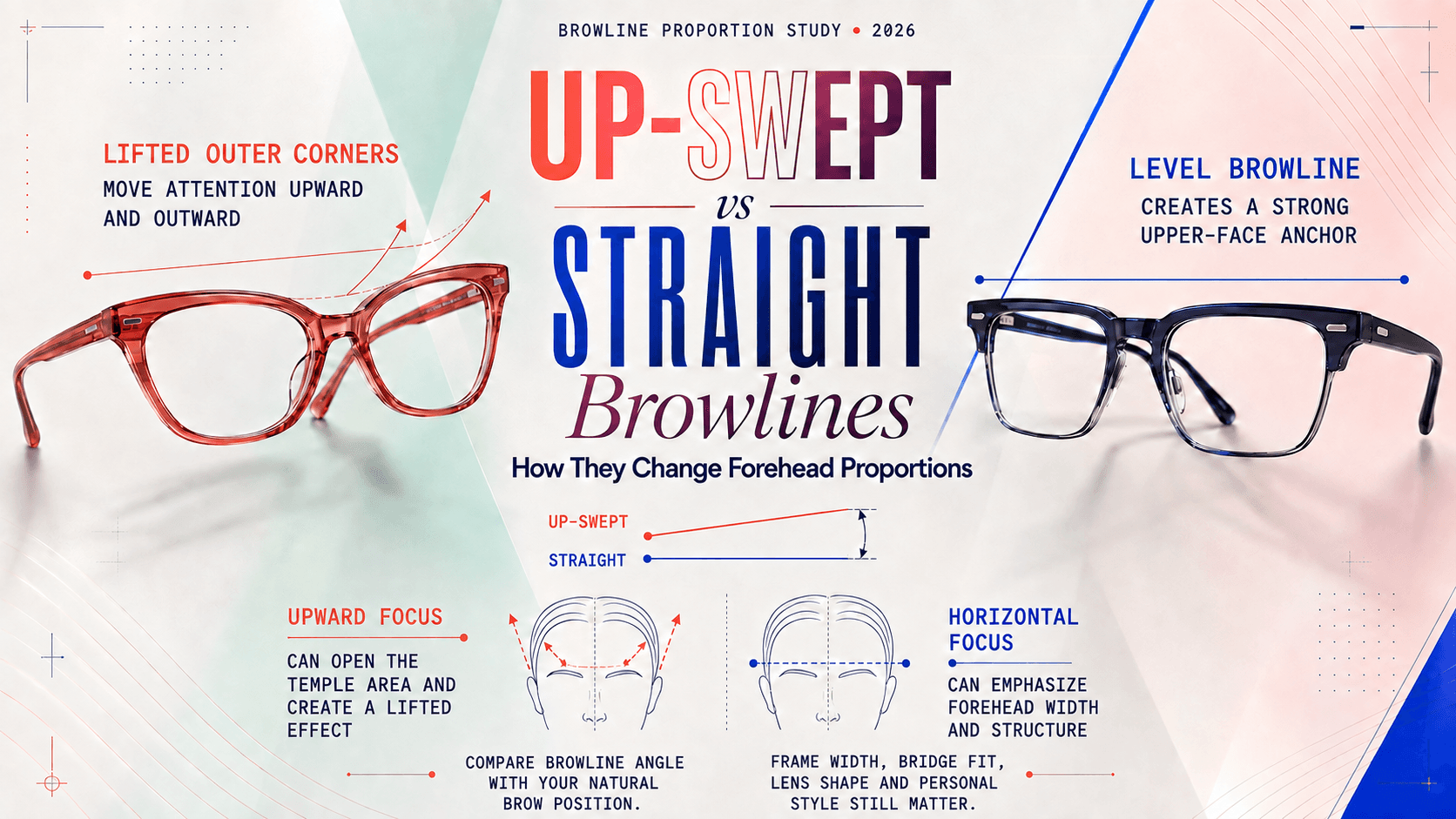
The browline of a frame — the thicker upper bar that mimics the eyebrow — is one of the most powerful tools in eyewear styling. Upswept browlines lift the eye upward and visually narrow a broad forehead, while straight browlines create a horizontal anchor that balances a tall or narrow forehead. Getting this detail right can make your glasses look tailor-made for your face rather than simply functional.
What Is a Browline Frame?
A browline frame features a bold, defined upper half — usually in acetate or metal — and a minimalist lower half. The upper bar sits roughly where your natural eyebrow sits, which is why it has such a strong influence on facial proportion. Within this family, two distinct shapes dominate: upswept (sometimes called cat-eye browlines) and straight (classic mid-century browlines).
How Upswept Browlines Affect Your Forehead
An upswept browline angles upward toward the outer corners of the frame, pulling the viewer's gaze diagonally rather than across. This has two notable effects on forehead perception:
Narrowing effect: The diagonal line draws attention away from the width of a broad forehead, making it appear less wide.
Lifting effect: The upward sweep creates an illusion of vertical movement, which can make a low or flat forehead appear slightly taller.
Upswept browlines work especially well for round, square, and heart-shaped faces, where reducing horizontal width is often the styling goal. If your forehead is noticeably wider than your jaw, an upswept frame is your ally.
How Straight Browlines Affect Your Forehead
A straight browline runs horizontally from hinge to hinge with little to no angle. This creates a strong visual baseline that grounds the upper face. The effects are almost the opposite of upswept styles:
Widening effect: The horizontal line adds perceived width to a narrow or oblong forehead.
Shortening effect: By emphasising a clear horizontal at brow level, a straight browline can reduce the apparent height of a very tall forehead.
Straight browlines suit oval, oblong, and diamond-shaped faces particularly well. If your forehead feels disproportionately tall or narrow, a classic straight browline is worth trying first.
Upswept vs Straight: A Quick Comparison
Choosing between the two often comes down to a single question — do you want to reduce width or reduce height in your forehead?
Wide forehead, narrow jaw → choose upswept to draw focus inward and upward
Tall or narrow forehead → choose straight to add horizontal balance
Balanced, oval face → both styles work; pick by personal aesthetic preference
Round face → upswept adds desirable angularity and lifts the midface
Square face → upswept softens the strong horizontal of a wide jaw and brow
Other Factors to Consider Alongside Browline Shape
Browline angle is important, but it works in concert with frame width, lens height, and colour. A wider frame amplifies the widening effect of a straight browline, while a narrower frame reduces it. Similarly, a dark acetate browline creates stronger contrast and a more defined visual effect than a thin metal version of the same shape. When in doubt, try both profiles — the difference becomes obvious within seconds in front of a mirror.
At Rimloo, you can use the virtual try-on feature to test upswept and straight browline frames side by side before you decide. Small details like browline angle can transform an average fit into a genuinely flattering one.
