
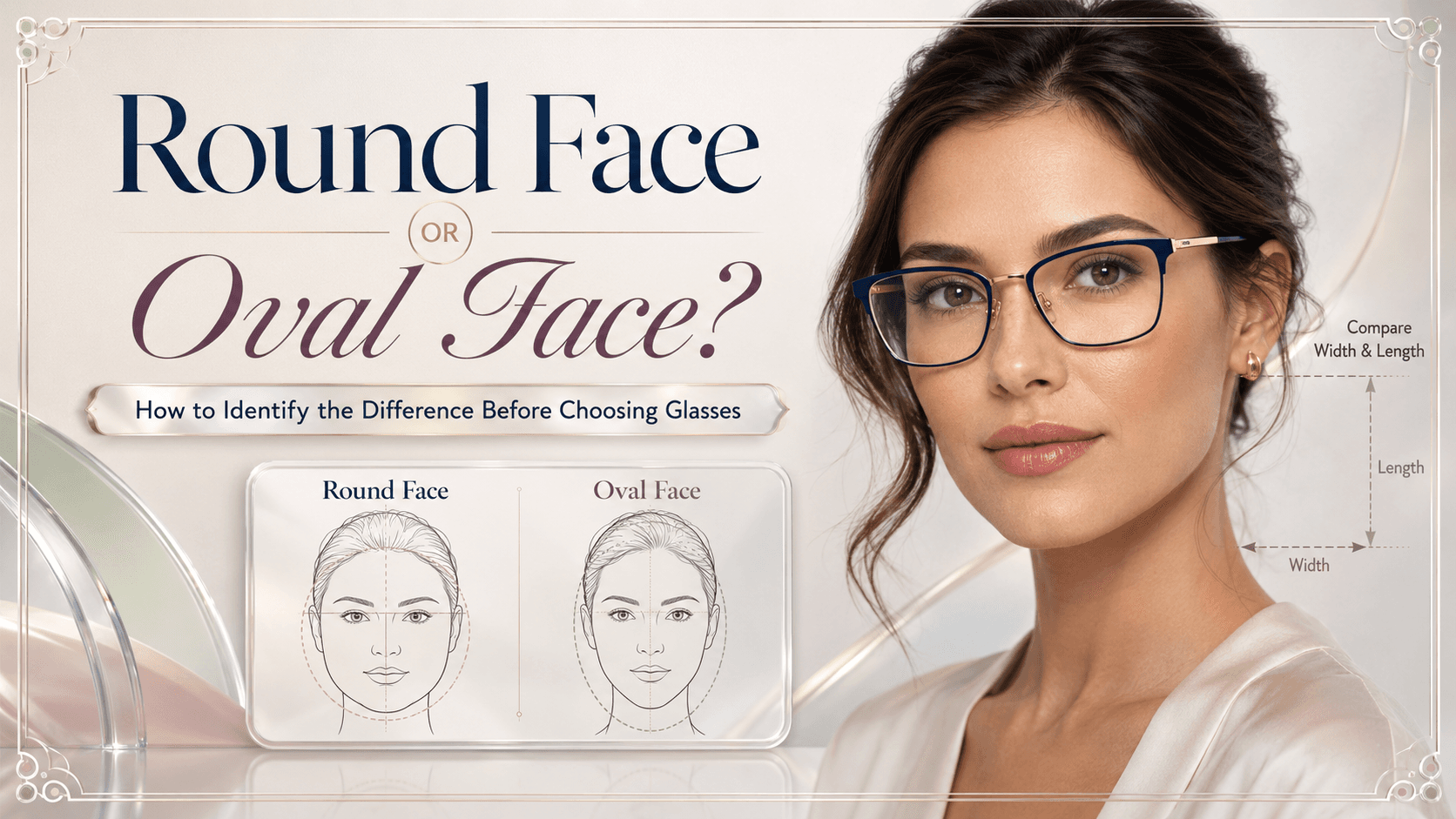
If you have soft facial curves and no sharp angles, you likely have either a round or an oval face — but the two shapes call for very different glasses. A round face is almost as wide as it is long with full cheeks and a curved chin. An oval face is longer than it is wide, with balanced proportions and a gently narrowed forehead and jaw. Identifying the difference correctly is the first step to finding frames that genuinely flatter you.
How to Tell If You Have a Round or Oval Face
Stand in front of a mirror, pull your hair back, and look straight ahead. Then ask yourself two questions: Is my face roughly as wide as it is long? And does my jawline curve softly without tapering?
Round face: Width and length are nearly equal. Cheeks are the widest point. Chin is rounded, not pointed.
Oval face: Length is noticeably greater than width. The forehead is slightly wider than the jaw. The chin tapers gently.
A quick measurement trick: use a soft tape measure or a piece of string. Measure your face from hairline to chin (length) and across the widest part of your cheeks (width). If those two numbers are close, you are likely round. If length clearly exceeds width by a visible margin, you are likely oval.
Best Glasses for a Round Face
The goal with a round face is to add length and angular contrast so the face appears slimmer and more defined.
Rectangular and square frames create the angular lines a round face lacks.
Frames that sit high on the nose bridge elongate the face visually.
Narrow frames with a strong horizontal line (think classic wayfarer shape) add structure.
Wide frames that extend slightly beyond the cheekbones balance the face width.
Avoid perfectly circular frames — they exaggerate roundness rather than balancing it.
Best Glasses for an Oval Face
Oval is considered the most versatile face shape because its balanced proportions work with almost any frame style. The only guideline is to avoid extremes that throw off your natural balance.
Most frame shapes — square, round, geometric, cat-eye — suit an oval face well.
Frames that are as wide as the broadest part of your face maintain proportion.
Oversized styles look especially striking on oval faces without overwhelming features.
Avoid very narrow frames that make the face appear too long.
Rimless and semi-rimless styles work beautifully here because the face shape does the work.
Round vs Oval Face: Quick Comparison
Round face — nearly equal length and width, full cheeks, curved chin. Best frames: rectangular, square, angular, geometric. Avoid: circular frames.
Oval face — length greater than width, balanced proportions, tapered jaw. Best frames: almost anything within proportion. Avoid: very narrow or very small frames.
One More Thing to Consider Before You Buy
Face shape is the starting point, not the whole picture. Skin tone, personal style, and whether you need prescription lenses all influence the final choice. At Rimloo, every product page includes a face-shape guide so you can filter frames by what works for your specific features. When in doubt, use the virtual try-on to see frames on your own face before you commit.
