
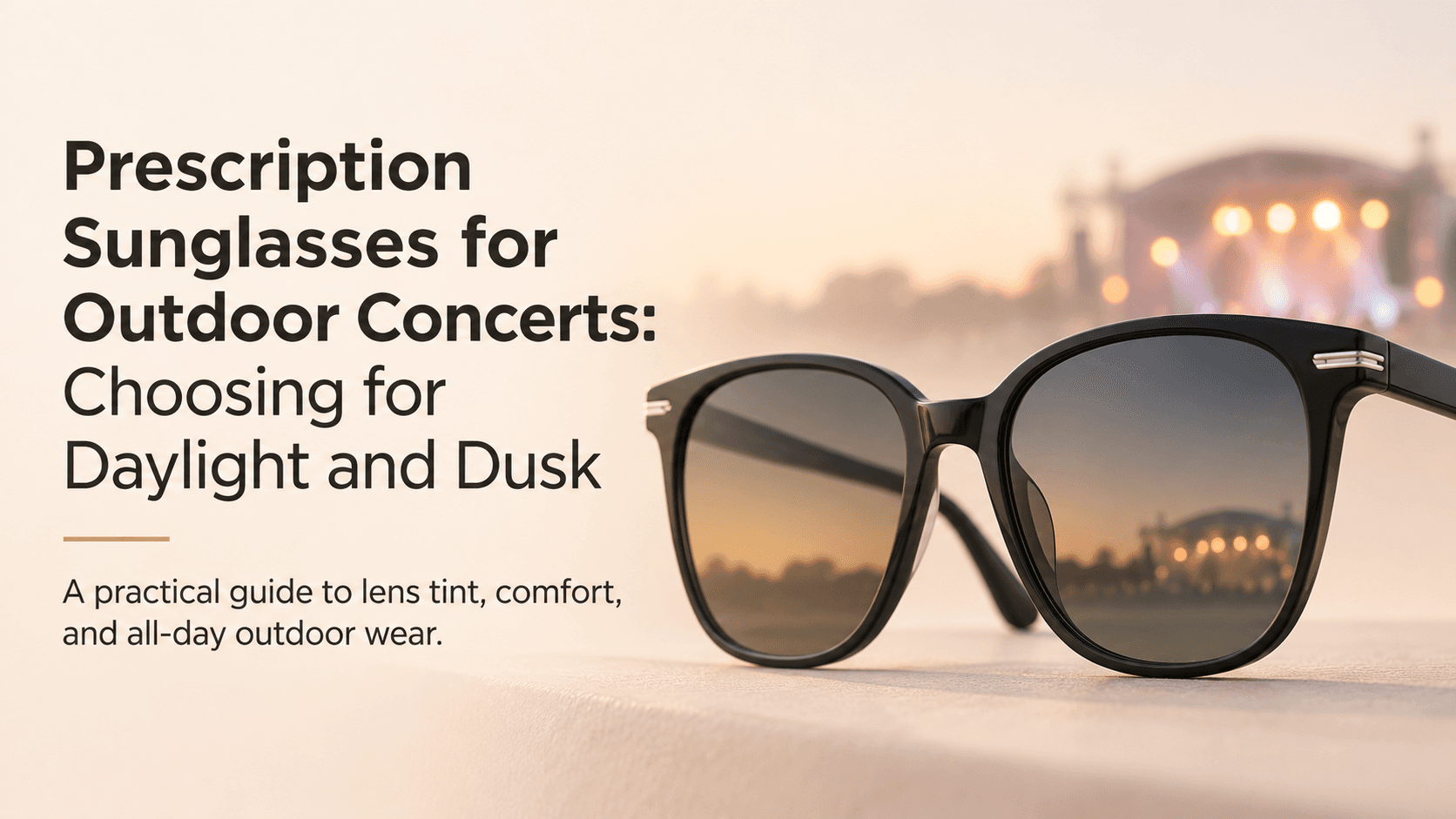
The best prescription sunglasses for outdoor concerts combine a lens tint that handles intense afternoon glare with enough light transmission to keep your vision clear as the sky darkens after sunset. Photochromic or gradient lenses are usually the smartest single-pair solution, though polarised fixed tints work brilliantly if you plan to stay through golden hour only.
Why Outdoor Concerts Demand More From Your Prescription Lenses
A music festival or open-air show is not a static lighting environment. Between 2 PM and 9 PM, ambient light can drop by over 90 percent. Standard dark sunglass lenses that protect you perfectly during the afternoon set can leave you squinting at the stage in near-darkness by the time the headliner appears. Add coloured stage lighting, LED screens, and phone torches from the crowd, and your eyes are constantly adapting. Prescription wearers face an extra challenge: switching between multiple pairs mid-show is impractical and easy to lose track of.
Lens Types: Which Works Best From Noon to Night?
Photochromic Lenses
Photochromic lenses — commonly known by the brand name Transitions — darken automatically in UV light and fade back to near-clear indoors or at dusk. For concerts that run from afternoon into evening, these are the most versatile option. They require no manual lens swap, and modern photochromic technology activates and clears faster than older generations. The key limitation is that they react to UV, not brightness alone, so they may not darken inside a shaded festival tent even on a bright day.
Gradient Tint Lenses
Gradient lenses are darker at the top and lighter toward the bottom. They shield your eyes from overhead sun while letting more light in from the stage level — a surprisingly practical design for watching a performance. They look elegant and work reasonably well into dusk, though they offer less glare protection than a full uniform tint at peak brightness.
Polarised Lenses
Polarised lenses eliminate horizontal glare from reflective surfaces — think sunlight bouncing off a metallic stage setup or a wet festival ground. They are outstanding in full daylight but can make LED screens and digital displays appear patchy or dim, which is worth considering if you are standing close to giant video walls at a large show. For daytime-only events or acoustic sets, polarised prescription sunglasses are a top choice.
Fixed Tint: Category 2 vs Category 3
Lens tint categories run from 0 (clear) to 4 (very dark). Category 2 lenses (15–29% light transmission) are ideal for variable conditions — bright enough for dusk, protective enough for moderate sun. Category 3 lenses (8–18% light transmission) are the standard for Indian summer conditions and beach use, but they can feel restrictive once the sun goes down. For concerts, a Category 2 fixed tint is a better all-day compromise than Category 3.
Frame Considerations for a Concert Environment
Comfort matters as much as lens performance when you are on your feet for four to six hours. Look for these frame qualities:
Lightweight materials such as TR-90 or titanium that do not press on your nose or ears during long wear
Wraparound or semi-rimless styles that block peripheral glare from side stages and crowd lighting
Secure fit — spring hinges and rubberised nose pads prevent slippage when you are dancing or moving through a crowd
Scratch-resistant coating on lenses, since concert environments expose your eyewear to dust, sweat, and accidental contact
UV400 protection as a non-negotiable baseline for any outdoor prescription sunglass lens
Lens Coatings That Make a Real Difference
Beyond tint and polarisation, the coatings applied to your prescription lenses significantly affect performance in a concert setting. An anti-reflective (AR) coating on the back surface of your lenses reduces bounce-back from stage lights hitting the rear face of the lens — a common source of visual fatigue. A hydrophobic coating repels sweat and light rain, keeping your vision clear through an unexpected drizzle or a sweaty crowd surge. If you use your sunglasses regularly between events, a quality scratch-resistant hard coat protects your investment and maintains optical clarity over time.
Caring for Your Concert Sunglasses Before and After the Show
Prescription lenses are precision-ground optics, and a little maintenance goes a long way. Before the show, clean lenses with a microfibre cloth and lens-safe solution — never your shirt hem, which carries dust particles that cause micro-scratches. Store your sunglasses in a hard case whenever they are not on your face; at a concert, bag pockets and festival pouches are hostile environments for unprotected eyewear. After the show, rinse away sweat and sunscreen residue with lukewarm water before wiping dry, since sunscreen chemicals can degrade lens coatings over time.
Prescription Sunglasses vs Clip-Ons vs Contact Lenses for Concerts
Contact lens wearers often consider going bare-eyed with fashion sunglasses at concerts, but dusty outdoor environments and long wear hours make contacts uncomfortable for many people. Clip-on sunglass attachments are a budget-friendly workaround, though they add weight and rarely fit securely during active movement. Dedicated prescription sunglasses remain the clearest, most reliable solution for anyone who needs vision correction outdoors — they are purpose-built for the conditions, available in your exact prescription, and far more comfortable over a full-day event than any workaround.
Making Your Final Choice
Match your lens choice to the event schedule: daytime festival with an early finish calls for polarised Category 3 lenses; afternoon-to-night concerts favour photochromic or Category 2 gradient lenses. Prioritise frames with a secure, lightweight fit, and ensure your lenses carry UV400 protection, an AR back coat, and a hydrophobic layer. With the right pair, your vision stays sharp from the opening act in bright sunshine to the headliner under a starlit sky.
