
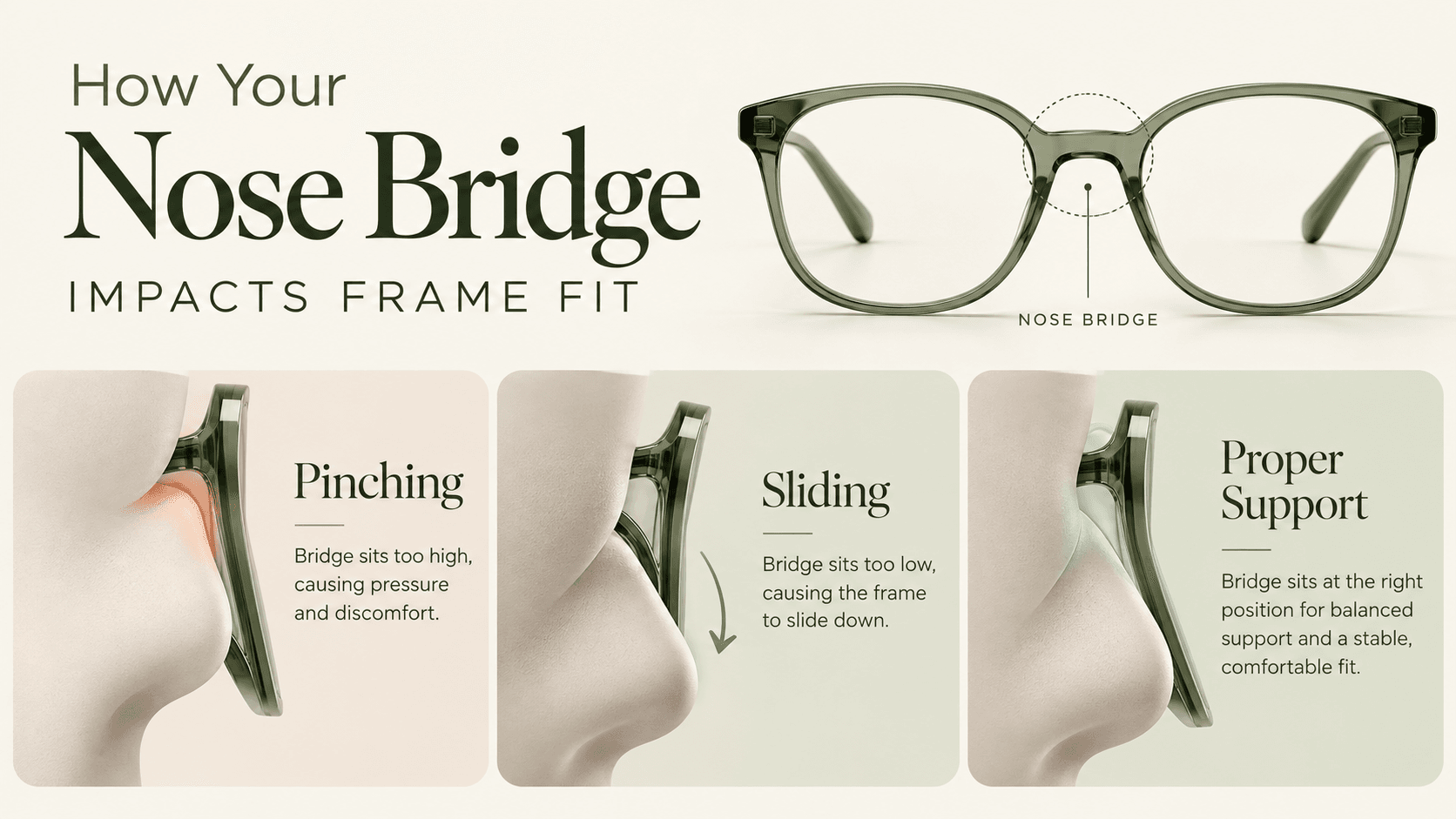
Your nose bridge determines whether your glasses sit flush, slide down constantly, or pinch uncomfortably — and it matters more than face shape alone. A frame chosen for the right bridge width and height will stay centred on your face, keep lenses at the correct optical distance, and feel weightless after hours of wear.
What Is Nose Bridge Width and Why Does It Matter?
Nose bridge width is the distance between your pupils at the narrowest point of your nose, typically measured in millimetres and printed inside the frame arm (e.g. 18□52-140, where 18 is the bridge width). If the frame bridge is wider than your nose, the glasses drift down. Too narrow and they pinch the sides of your nose, causing pressure marks and headaches.
How to Identify Your Nose Bridge Type
Most Indian consumers have one of three bridge profiles, and knowing yours is the fastest route to a comfortable fit.
Low bridge (flat nose bridge): The nose sits level with or below the pupils. Frames without nose pads slip down easily. Look for frames labelled low-bridge fit or those with adjustable silicone nose pads that grip gently.
Medium bridge: The most common profile. Standard frame sizing (bridge width 17–19 mm) usually works well. Both nose-pad frames and saddle-bridge frames tend to fit comfortably.
High bridge (prominent nose bridge): The nose rises clearly above the pupils. Wider bridge widths (20 mm+) and saddle bridges that rest along the nose rather than on pads distribute weight more evenly.
Nose Pads vs Saddle Bridge: Which Should You Choose?
Frames fall into two construction styles when it comes to the bridge area.
Nose pads (small silicone or acetate feet on metal arms) are adjustable and ideal for low or narrow bridges. An optician can bend the pad arms in or out within seconds to achieve a custom fit.
Saddle bridges (a continuous curve moulded into the frame, common in acetate styles) rest across the full width of the nose. They suit medium-to-high bridges and spread pressure over a larger surface area, reducing marks.
Signs Your Current Frames Do Not Fit Your Nose Bridge
Glasses slide to the tip of your nose within an hour of putting them on
Red or sore pressure marks appear on either side of your nose after a few hours
You tilt your head back slightly to see clearly through the optical centre of the lens
The frame sits unevenly — one side lower than the other
Practical Tips When Shopping for Frames Online
Buying eyewear online in India means you cannot physically try frames before purchase, so measurement becomes essential. Use a ruler and mirror to measure the narrowest part of your nose bridge in millimetres before opening any product page. Cross-reference that number with the bridge measurement printed in the frame spec.
Rimloo's virtual try-on tool lets you overlay frames on your face in real time, giving you a reliable preview of where the bridge will land. Combine that with the size guide on each product listing and you can confidently choose frames that suit your specific bridge profile from home.
Bridge Fit and Optical Performance
A poorly fitting bridge does not just cause discomfort — it shifts the lens away from the ideal position in front of your pupil, introducing unwanted prism effects and reducing the sharpness of your prescription. Getting the bridge right is, therefore, as important as getting the prescription itself right.
