
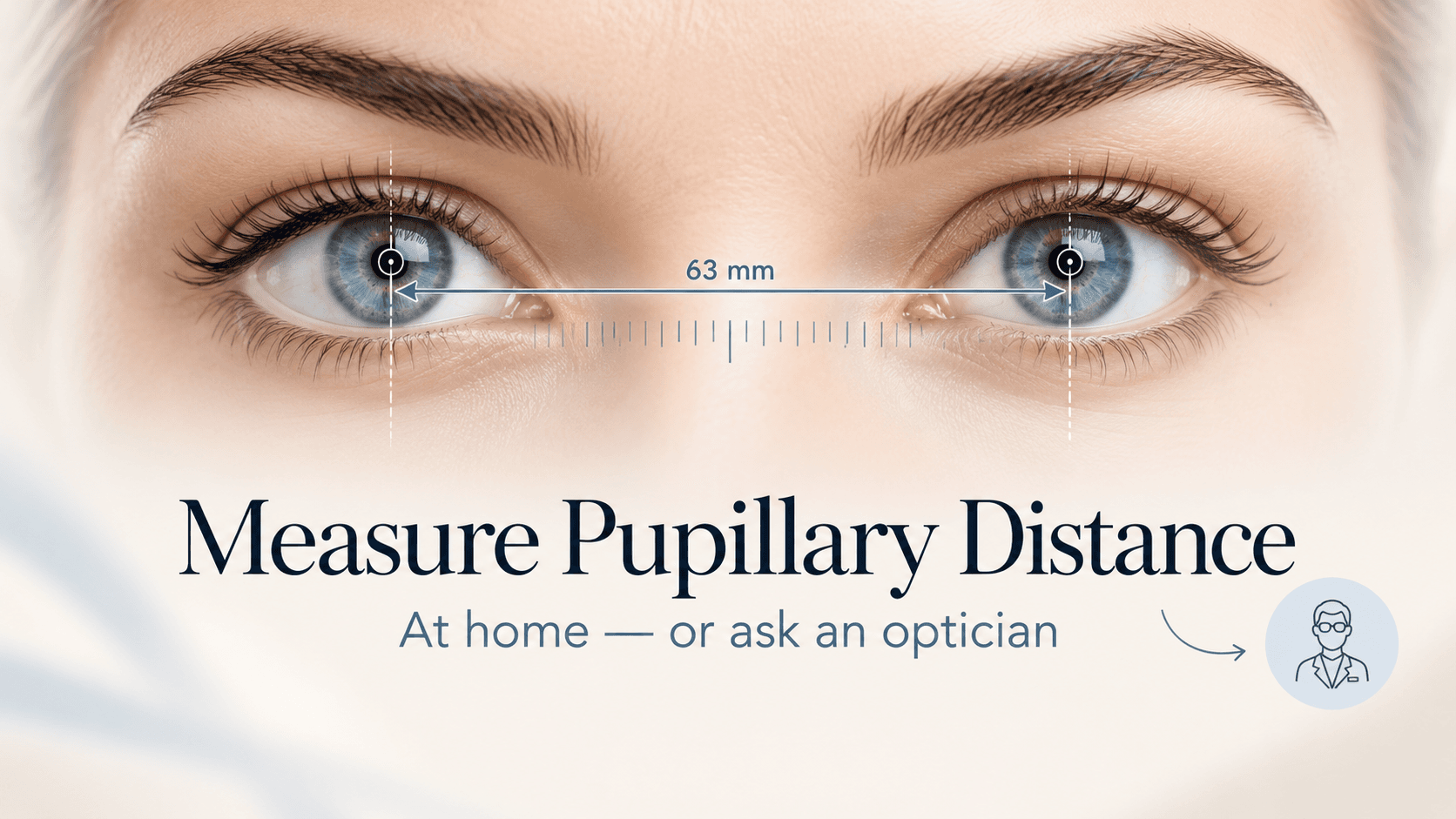
Pupillary distance (PD) is the gap in millimetres between the centres of your two pupils. It tells lens makers exactly where to place the optical centre of each lens so your eyes look through the right spot. An incorrect PD can cause blurred vision, headaches, and eye strain — even if your prescription itself is perfect.
What Is Pupillary Distance and Why Does It Matter?
Every pair of prescription glasses is ground so the optical centre of the lens lines up with your pupil. If that centre is even 2–3 mm off, your eyes have to work harder to compensate, leading to fatigue and distorted vision. PD is especially critical for progressive and high-power lenses, where the margin for error is smallest.
Most adults have a PD somewhere between 54 mm and 74 mm. Some prescriptions list a monocular PD — a separate measurement for each eye (e.g., 32/30) — rather than a single binocular number. Both formats are valid; monocular PD is simply more precise.
How to Measure Your PD at Home with a Ruler
You will need a millimetre ruler, a well-lit mirror, and ideally a friend to help. Follow these steps:
Stand 20–30 cm from the mirror in good lighting.
Hold the ruler flat against your brow, above your eyes, with the zero mark aligned to the centre of your left pupil.
Without moving the ruler, read off the millimetre mark that lines up with the centre of your right pupil. That number is your binocular PD.
Repeat the measurement three times and average the results for accuracy.
For monocular PD, align the zero mark with the bridge of your nose and measure to each pupil separately.
A friend can help by holding the ruler steady while you look straight ahead at a distant point — this reduces the parallax error that comes from measuring your own eyes in a mirror.
Using a PD-Measurement App
Several smartphone apps can estimate your PD using your phone's front camera and a reference card (usually a standard credit or debit card) held against your forehead. These apps are convenient and reasonably accurate for single-vision lenses with moderate prescriptions. For high prescriptions (beyond ±4.00 D) or progressive lenses, treat app readings as a starting estimate only.
DIY vs Professional Measurement — When to Ask an Optician
Home measurement works well for most standard prescriptions and single-vision lenses. However, you should visit an optician for a professional PD reading if:
Your prescription is stronger than ±4.00 D or includes significant cylinder power.
You are ordering progressive or bifocal lenses, which need both distance and near PD values.
You have a noticeable facial asymmetry that makes self-measurement unreliable.
A previous pair of glasses caused persistent headaches despite a correct prescription.
You are ordering glasses for a child, whose PD changes as they grow.
Opticians use a digital pupillometer, which is far more accurate than a ruler and takes monocular readings as a matter of course. Many optical stores will measure your PD for free or for a nominal fee even if you plan to order online.
Tips for Accurate Results Every Time
Always measure in natural or bright artificial light. Keep your gaze relaxed and focused on a distant point rather than on the ruler itself. Avoid measuring right after reading or screen work, when your eyes may still be converged. If your left and right monocular readings differ by more than 2 mm from what you expect, get a professional check before ordering.
Once you have a confirmed PD, you can enter it directly when ordering prescription glasses online at Rimloo — the field appears during the lens-customisation step at checkout.
