
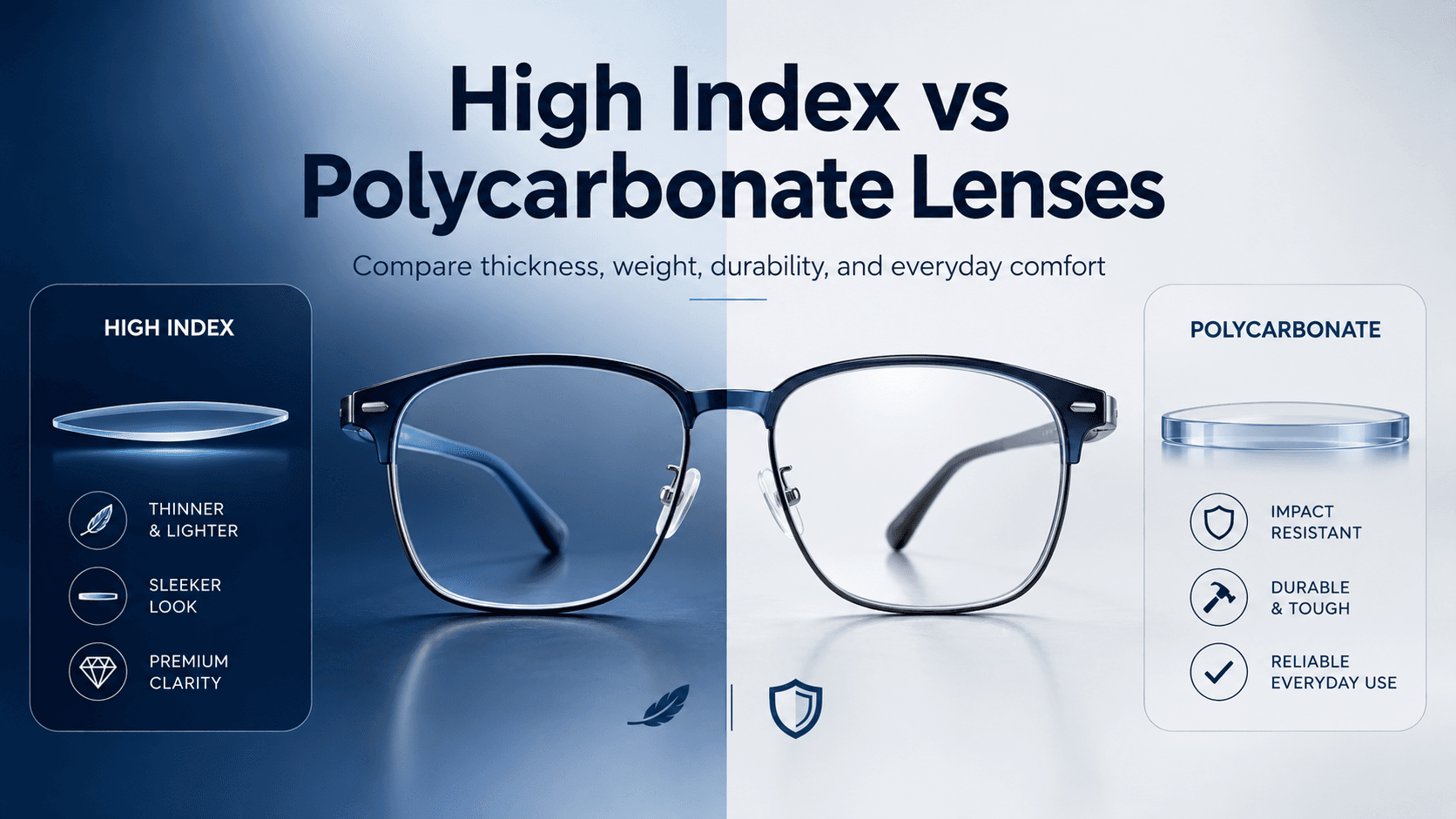
High Index vs Polycarbonate Lenses: Which One Should You Choose for Your Glasses?
Buying glasses is not only about picking a beautiful frame. The real comfort often begins with the lens.
You may love the frame shape, the color, the way it suits your face, and the way it completes your style. But after wearing it for a few hours, you may start noticing small things: pressure on the nose, thick lens edges, heavy temples, glare while working, or a lens that does not feel as comfortable as expected.
That is why choosing the right lens material matters.
Two common lens options people often compare are high index lenses and polycarbonate lenses. Both are popular. Both can make your glasses lighter than regular lenses. Both can be useful depending on your prescription and daily lifestyle. But they are not the same.
The better choice depends on one simple question:
What do your eyes, your face, and your day actually need?
This guide will help you understand the difference in a simple, human way so you can choose confidently before ordering your next pair from Rimloo.
What Are Polycarbonate Lenses?
Polycarbonate lenses are lightweight, strong, and impact-resistant lenses. They are often chosen by people who want durability, safety, and everyday comfort.
Think of polycarbonate lenses as the practical, active, dependable option. They are made for people whose glasses go through a lot during the day.
If you travel often, play sports, work outdoors, buy glasses for kids, or simply want lenses that can handle daily movement better, polycarbonate can be a smart choice.
Why People Choose Polycarbonate Lenses
Polycarbonate lenses are popular because they offer a strong balance of comfort and protection. They are lighter than many regular plastic lenses and are known for their toughness.
They are especially helpful for:
Kids’ glasses
Sports eyewear
Active lifestyles
Safety-focused eyewear
Daily wear glasses
People who want durable lenses without too much lens thickness
Polycarbonate lenses also offer built-in UV protection in many cases, which adds another layer of practical benefit for outdoor use.
What Are High Index Lenses?
High index lenses are designed to bend light more efficiently. Because of this, they can correct stronger prescriptions with less lens material. Less material usually means a thinner and lighter lens.
In simple words, high index lenses are made for people who want their strong prescription glasses to look slimmer, cleaner, and more stylish.
If your prescription is high, regular lenses can sometimes look thick at the edges or heavy in the frame. High index lenses help reduce that bulky appearance.
Why People Choose High Index Lenses
High index lenses are often preferred by people who have stronger prescriptions and want their glasses to look more elegant.
They are especially useful for:
Strong minus prescription
Strong plus prescription
Astigmatism correction
People who dislike thick lens edges
People who want a slimmer frame appearance
Fashion-focused eyewear buyers
Office professionals who wear glasses all day
High index lenses are not only about vision. They are also about confidence. Many people with strong prescriptions feel self-conscious when their lenses look thick. High index lenses help make the glasses feel more refined and natural on the face.
High Index vs Polycarbonate Lenses: Main Difference
Both lens types are good, but they solve different problems.
Polycarbonate lenses focus more on durability and impact resistance.
High index lenses focus more on thinness, lightness, and appearance for strong prescriptions.
If your lifestyle is active and safety matters most, polycarbonate may be better.
If your prescription is strong and you want thinner, more attractive lenses, high index may be better.
Which Lens Is Thinner?
High index lenses are usually thinner than polycarbonate lenses, especially for stronger prescriptions.
This is because high index lens material bends light more efficiently. A higher refractive index means the lens can do the same vision correction with less thickness.
For people with strong prescriptions, this difference can be very noticeable. The lens edges may look cleaner, and the glasses may feel less bulky.
When Thinness Matters Most
Thin lenses matter when:
Your prescription is strong
You choose a large frame
You want a premium look
You dislike thick lens edges
You wear glasses all day
You want your eyes to look more natural behind the lenses
Rimloo Tip
If you have a high prescription, avoid very oversized frames. Larger frames can make lenses look thicker, even if you choose a thinner lens material. A well-sized frame can improve both comfort and appearance.
Which Lens Is Stronger?
Polycarbonate lenses are generally stronger when it comes to impact resistance.
This is why they are commonly recommended for children, sports, protective eyewear, and active lifestyles. They can handle sudden movement and accidental drops better than many other lens materials.
High index lenses are thinner and more stylish, but they are usually not the first choice when impact resistance is the main priority.
When Strength Matters Most
Choose polycarbonate if:
You are buying glasses for a child
You play sports
You travel often
You need safety eyewear
You are rough with your glasses
You want a durable everyday lens
Rimloo Tip
If you want glasses for daily office use, high index may feel more premium. If you want glasses for active outdoor use, polycarbonate may give better peace of mind.
Which Lens Feels Lighter?
This depends on your prescription.
For mild to moderate prescriptions, polycarbonate lenses can feel very light and comfortable. For stronger prescriptions, high index lenses may feel lighter because they require less material.
So the answer is not the same for everyone.
If your prescription is low or medium, polycarbonate can be a comfortable choice. If your prescription is high, high index lenses may reduce weight better.
Face Comfort Matters
Lens weight affects more than your eyes. It affects your nose, ears, temples, and even how long you can wear your glasses comfortably.
Heavy lenses can create:
Nose marks
Sliding frames
Ear pressure
Head discomfort
Poor frame balance
A lighter lens can make your glasses feel more natural, especially during long work hours.
Which Lens Gives Better Clarity?
Both lens types can provide clear vision when made correctly according to your prescription. However, clarity can also depend on lens design, prescription strength, coating quality, frame fit, and how accurately the glasses are made.
Polycarbonate lenses are durable, but some people with higher prescriptions may notice slight color fringing or visual softness because of the material’s optical characteristics.
High index lenses can offer a cleaner visual experience for many strong prescription wearers, especially when paired with anti-reflective coating.
Coatings Make a Big Difference
No matter which lens material you choose, coatings can improve your wearing experience.
Useful coating options include:
Anti-reflective coating
Scratch-resistant coating
UV protection
Blue light filter
Photochromic coating
Polarized option for sunglasses
Rimloo Tip
If you work on a laptop, drive at night, or attend video calls often, anti-reflective coating can make your lenses look cleaner and reduce distracting reflections.
Which Lens Is Better for Strong Prescription?
High index lenses are usually better for strong prescriptions.
They help reduce lens thickness and make the glasses look more balanced on the face. This is especially important if you have a strong minus or plus number.
For strong minus prescriptions, lens edges can become thick.
For strong plus prescriptions, the center of the lens can become thick and may magnify the eyes.
High index lenses help reduce that heavy appearance.
Best Choice for Strong Prescription
Choose high index if:
Your prescription is strong
You want thinner lenses
You want a premium look
You dislike thick edges
You wear glasses every day
You want better frame style flexibility
Which Lens Is Better for Kids?
Polycarbonate lenses are usually a better choice for kids.
Children run, play, drop their glasses, and use eyewear in unpredictable ways. For them, impact resistance matters more than ultra-thin lens styling.
Polycarbonate lenses offer better durability for active children and are commonly used in kids’ eyewear.
Best Choice for Kids
Choose polycarbonate if:
The glasses are for school
The child plays outdoors
The child is active
Safety is the priority
You want stronger daily-use lenses
Which Lens Is Better for Office and Screen Use?
For office wear, both lens types can work well. The better choice depends on your prescription.
If your prescription is mild to moderate, polycarbonate lenses with blue light and anti-reflective coating can be a practical option.
If your prescription is strong and you wear glasses all day, high index lenses with anti-reflective coating may feel more comfortable and look more polished.
Best Office Lens Setup
For office users, consider:
High index lenses for strong prescription
Polycarbonate lenses for moderate prescription
Blue light protection for screen-heavy work
Anti-reflective coating for cleaner vision
Lightweight frames for all-day comfort
Which Lens Looks Better in Fashion Frames?
High index lenses usually look better in fashion frames when the prescription is strong.
If you love thin metal frames, transparent frames, rimless styles, or premium acetate designs, thick lenses can affect the final look. High index lenses help keep the frame stylish and balanced.
Polycarbonate lenses also work well in many frame styles, especially if your prescription is not too strong.
Frame Size Also Matters
Even the best lens material can look thick in the wrong frame. If you have a strong prescription, choose frames where your eyes sit close to the center of the lens. Avoid very large frames if you want the thinnest possible look.
Rimloo Tip
For strong prescriptions, medium-sized frames usually give a cleaner result than oversized frames.
High Index vs Polycarbonate: Quick Comparison
Choose High Index Lenses If You Want:
Thinner lenses
Lighter feel for strong prescription
Better cosmetic appearance
Less bulky lens edges
Premium look
More confidence in daily wear
Choose Polycarbonate Lenses If You Want:
Stronger impact resistance
Durable daily eyewear
Good option for kids
Good option for sports
Lightweight comfort for mild to moderate prescription
Practical value
Emotional Buying Guide: What Should You Really Choose?
Sometimes the right lens is not only about technical specifications. It is about how you feel when you wear your glasses.
If your glasses make you feel heavy, tired, or less confident, you may not enjoy wearing them every day.
If your lenses are too thick, you may avoid certain frames.
If your glasses feel delicate, you may worry about using them freely.
So choose based on your real life.
If You Want Confidence
Choose high index lenses if you want your strong prescription glasses to look slim, elegant, and stylish.
If You Want Protection
Choose polycarbonate lenses if you want stronger lenses for movement, travel, kids, or active use.
If You Want Daily Comfort
Choose based on your prescription. Mild to moderate prescription users may enjoy polycarbonate. Strong prescription users may feel better with high index.
Final Verdict: High Index or Polycarbonate?
There is no single winner for everyone.
High index lenses are better for strong prescriptions, thinner appearance, and premium comfort.
Polycarbonate lenses are better for impact resistance, kids, sports, and active everyday use.
The best lens is the one that matches your eyes, your frame, your lifestyle, and your comfort expectations.
At Rimloo, we believe your glasses should not feel like a compromise. They should feel natural on your face, match your personality, and support your everyday life beautifully.
Before choosing your next pair, think about three things:
How strong is your prescription?
How active is your lifestyle?
What matters more to you: thin style or extra durability?
Once you know the answer, choosing between high index and polycarbonate becomes much easier.
