
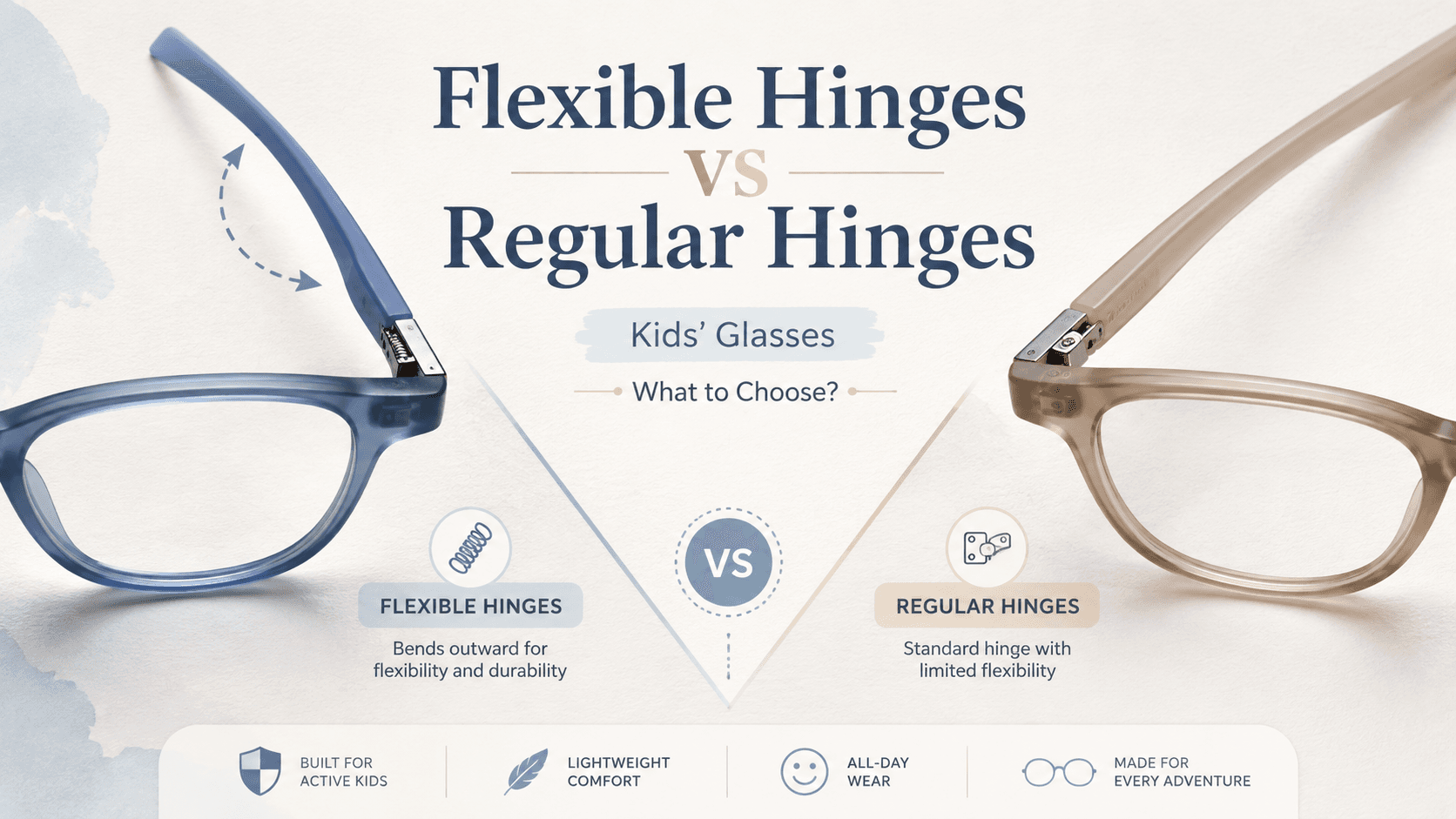
Flexible hinges are the better choice for most children's glasses. They use a spring mechanism that lets the temple arms bend outward beyond the normal range without snapping, making them far more resistant to the everyday drops, twists, and rough handling that come with childhood. Regular hinges work fine for careful wearers but are more likely to loosen or break under stress.
What Are Flexible Hinges?
Flexible hinges — also called spring hinges — contain a small coiled spring inside the hinge barrel. This spring lets the temple (arm) flex outward by an extra 20–30° and then snap back into position. The mechanism absorbs the sideways force that would otherwise bend or crack a standard hinge pin.
Regular hinges use a simple barrel-and-pin design with no spring. They open to a fixed angle and rely entirely on the rigidity of the frame material to hold their shape. For adults who handle their glasses carefully, this is perfectly adequate.
Why Do Kids Need Flexible Hinges?
Children between the ages of 4 and 14 are far harder on eyewear than adults. A study of paediatric eyewear repairs consistently shows hinge failure as the top reason parents return frames for repair. Kids pull glasses on and off with one hand, toss them onto desks, and sometimes sit or sleep on them. Flexible hinges absorb this stress silently so the frame survives.
Beyond durability, spring hinges also improve daily fit. Because the temples can flex slightly outward, the glasses sit more securely on a range of head widths without pinching — useful since children's faces change shape quickly.
Flexible vs Regular Hinges: A Quick Comparison
Durability under stress: Flexible hinges win — the spring absorbs accidental force instead of bending the pin.
Fit adaptability: Flexible hinges accommodate a wider range of head widths without a trip to the optician for adjustment.
Repair cost: Regular hinges are slightly cheaper to repair or replace when they do fail; spring-hinge replacement requires a compatible part.
Weight: The spring mechanism adds a small amount of weight, but modern designs keep this negligible for children's lightweight frames.
Longevity: Flexible hinges typically outlast regular hinges by 12–18 months in real-world children's use.
When Might Regular Hinges Still Be Acceptable?
If your child is a teenager who consistently handles their glasses with care, regular hinges on a high-quality metal or acetate frame can be perfectly adequate — and may offer a wider range of style options. Regular hinges are also fine for sunglasses worn only during outdoor activities under direct supervision.
How to Maintain Your Child's Hinges — Regardless of Type
Even the best hinge fails without basic care. Teach your child to always use both hands when putting on or removing glasses. Periodically check the hinge screws — a small eyeglass screwdriver (₹50–₹100 at any pharmacy) lets you tighten a loose screw in seconds before it becomes a lost screw. Store glasses in a hard case when not in use, and clean the hinge area gently with a microfibre cloth to prevent dust and sweat from corroding the mechanism.
For more on protecting your child's frames and lenses, explore Rimloo's range of kids' prescription glasses — all featuring spring hinges as standard — and browse our lens care guides for tips on keeping every pair in top condition.
